Search This Blog

Friday, October 10, 2025

Masolino in Castiglione d'Olana

 Walking south along the beautiful route from Como to Milan, Edward Hutton stopped at Castiglione d'Olana to view frescoes by Masolino, the great Tuscan painter of the quattrocento whose most famous work is in Florence's Brancacci chapel.


Castiglione

There are many other happy places about Varese, but the traveller, already anxious for Milan, will scarcely linger here, more especially as the best of all lies on his way. That best is the road to Castiglione d’Olana, and Castiglione itself. You go, if you are wise, through Bizzozero, climbing the hills, with wonderful views of the Alps and the lakes all the way, and then descend through delicious woods by Lozza to the little town of Castiglione, partly in the valley of the Olana, a pleasant stream, and partly on the steep hill above it. 


The Castello, which belonged to the noble family of Castiglione, on the hill above the little town, or rather village, had by the beginning of the fifteenth century become ruined, and there Cardinal Branda da Castiglione built the church we see dedicated to Our Lady of the Rosary, to S. Lorenzo and to S. Stefano, together with a little Baptistery separate from the church and to the north of it. Here by the utmost good fortune one of the greatest Tuscan painters of that day was employed to adorn that building in fresco. Branda da Castiglione was Cardinal of S. Clemente, and it was there, doubtless, he had seen the work of Masolino and liked it. So he bade him paint his own church of the Rosary with some of the joyful and glorious mysteries which that crown of prayers celebrates, and today we find in the choir the result of this commission. There we see the Marriage of the Blessed Virgin, the Annunciation, the Nativity, the Adoration of the Magi, the Assumption and the Coronation of Our Lady in six compartments with Our Lord in Benediction in the midst …. In the Baptistery close by we find many scenes far better preserved than those in the church, of the life of S. John Baptist, master-works of the great Tuscan whom Cardinal Branda da Castiglione found at work in the S. Clemente in Rome. The first modern critics to write of these paintings  were the almost infallible Crowe and Cavalcaselle. Vasari does not mention them, and, as it seems, they were quite unknown when in the end of the eighteenth century, the church being very dark, they were covered with whitewash and were only uncovered in 1843.


It has been reserved for a critic of our own time to make a further discovery. For, as it happened, Mr. Berenson came to Castiglione not long ago and found in the Palazzo Castiglione here a great frieze running round the great hall consisting of four frescoes from the master’s hand. Three of these had been whitewashed, but in that which had escaped he found one of the finest and one of the most surprising things in all Tuscan art of the quattrocento: “nothing less than a vast landscape, a sort of panorama of the Alps, with a broad torrent rushing down to the plain.” Was it Cardinal Branda who so loved these great hills he could see from his house, or Masolino himself, who, Tuscan as he was, looking upon them for the first time, gave himself suddenly to them and recorded here forever his sudden and overwhelming joy? We shall never know: only, as Mr. Berenson says, “let us cease talking about the late date at which in Italy landscape began to be treated on its own account.” *


###


Edward Hutton: The Cities of Lombardy, New York, 1912. Pp. 54-55.


*Bernard Berenson, an acquaintance of Hutton's, was a connoisseur and prolific writer on the art of the Italian Renaissance. 

Friday, October 3, 2025

Lake Como

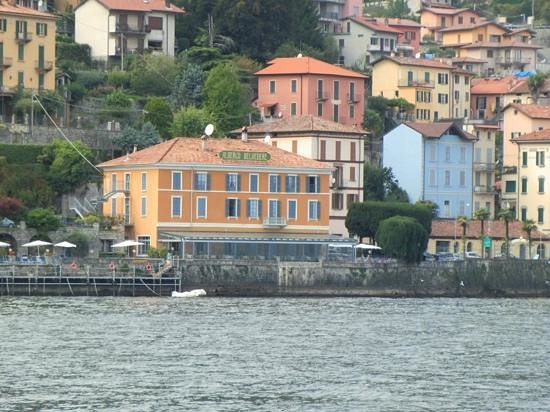
 Although my wife and I visited Lake Como more than a dozen years ago, the memory is still fresh in our minds. I will never forget entering our room at the aptly named Hotel Belvedere in Argegno, and opening the large shutters to reveal a truly fantastic vision of the beautiful blue water and the surrounding hills. Here are excerpts from Edward Hutton's description of Lago di Como.


Hotel Belvedere, Argegno

Men have fruitlessly discussed for ages which is the most beautiful of the lakes in this paradise that lies at the gates of Lombardy, among the mountains. One might as well consider whether Winchester Cathedral were more beautiful than Salisbury, or Wells than either. For no one is like another, save that all are to be enjoyed. Lago Maggiore has the gift of the wind, of the wideness of some inland sea and of distance; Lago Lugano has the gift of shadow, of great hills and of many secret places; Lago di Como has the joy of richness and of colour, the mystery of woods and the surprise of the snow, and of far-away great mountains; Lago d’Orta has flowers and silence. But of all the lakes, I love best the Larian, Lago di Como, because it is wholly Latin and there I can tread in the ways that are from of old, I can behold places that have always been sacred and remember the history of Europe. …[30]


But delightful though the lake is between Bellaggio and Colico and between Bellaggio and Lecco, there can be no doubt that its most beautiful, and its most frequented and famous part, is that which lies between Bellaggio and the city of Como—the lake of Como proper. The special and enchanted beauty of the Italian lakes is here at its best, and all that is most characteristic  in the strange lavishness of their beauty seems here to have found its best expression. And to add to our pleasure it is here, too, that the historical interest of this part of Lombardy reaches its climax. Here the Latin world is secure and we feel ourselves in the country of Pliny and Virgil…. [45]


Opposite Lezzono we see the only island on the lake, the Isola Comacina. The name of this island takes our thoughts back over a thousand years and more of history.


Here, as is supposed, Caninius Rufus, one of Pliny’s correspondents had a villa. “How is Como looking,” Pliny writes to him, “your darling spot and mine? And that most charming villa of yours, what of it, and its portico where it is always spring, its shady plane trees, its fresh crystal canal and the lake below that gives so lovely a view? [47]…


Who shall describe the way from Isola Comacina to Como:  is it not one of the most luxurious beauties in the world? Argegno with the Val d’Intelvi, Nesso with its waterfall, what can be said of them?... [47]


From Argegno, indeed, to Como it is villa and garden and grove all the way. Who is there that knows Como that has not floated at evening under those balconies heavy with roses, those terraces stately with cypresses and myrtles, those hanging gardens of azaleas and lilies and geraniums, where the magnolias shine in the twilight and the night is heavy with sweetness? [49]…


No one, I suppose, comes to Como, that shining city under the Brunate at the lake’s head, for history. There is plenty of it if one does; but…the olive-clad hills, the entrancing byways and the lake itself, entice one to be ever up and about, what time one can save from these is given, and I think without hesitation, to the Duomo, which Street so unaccountably failed to appreciate, but which has plenty of lovers nevertheless.


The Duomo and the Broletto, an earlier work of black and white marble, beside it, make up a group of buildings as picturesquely lovely as any in Lombardy, and few there be who do not straightway fall in love with them. As for the church, it is, I suppose, one of the finest examples of married Gothic and Renaissance—a Gothic yet perfectly developed and yet without fantastic excess, a Renaissance sober and sweet and without stiffness—anywhere to be found in Italy. [49-50]


###


Edward Hutton: The Cities of Lombardy, New York, 1912. Pp. 30-50.

Friday, September 26, 2025

Mt. Generoso and the Lakes

 Edward Hutton began his tour of Lombardy atop Monte Generoso at an inn appropriately named Bellavista. The spectacular panoramic views especially of the beautiful lakes, Lugano, Como, and Maggiore, filled him with a sense of awe even danger at the enchantment of their beauty.   


Now if a man would see with his bodily eyes, and as it were in a single glance, the country of Cisalpine Gaul whose history I have tried to set forth in the preceding chapter, let him enter Italy from the town of Lugano, and, taking boat from there to Capolago, and climbing thence a-foot or by funicular the mountain called Generoso, let him stay a day or two in the woods of Bellavista. Nowhere else that I know will he get all at once so full a possession of the lie of the land. The Monte Generoso stands on the modern frontier of Switzerland and Italy, and the view from Bellavista, just an inn in the chestnut woods, where the wild flowers most abound, and still more from the summit, is not only one of the most splendid in Europe, but one of the widest and most interesting. To the north and west stand the great ramparts of the Alps, and beyond, that tremendous bundle of upreared peaks we call the Bernese Oberland; in the south lies the vast Italian plain as far as Bologna where the Apennines close its southern border, and on the east as far as Verona where the Alps shut it in. At one’s feet, like so many jewels cast down before one, lie the lakes of Maggiore, Lugano, Como, and the rest, among the foothills of the great mountains. To see and to consider this view is to understand the secret and the history not of Cisalpine Gaul alone, but in a very real sense of Italy and of Europe, and I can imagine no more propitious and delightful seclusion for such a contemplation of the past and the future of all that Europe stands for than this great thirsty mountain, which in spite of the lack of water, is shrouded so wonderfully in woods and scattered with wild flowers. And then when one is weary of thought, there lie the Italian lakes for our recreation and delight: and yet not all delight.


I do not know, nor shall I ever understand precisely what it is  that lends to the lakes of Lombardy their unnatural and shining beauty, their air of enchantment, of sorcery. They are a vision of lovely and untroubled youth, of youth that is without conscience and without thought, and they have upon the soul the effect of a singular and half-remembered  music. To come upon them veiled in the midst of dawn, or shining in the glory of the morning, to watch them drowsily in the drowsy noon, to see them fade into the silent and blue and gold of the evening, into the violet of the still night is to experience a fullness of joy that only music is commonly able to bring us: and yet that joy is far removed from happiness. Something forbidden, a sense of spell or sorcery, something too sweet, something too brief, that terrifies us because it is so lovely involves this paradise in disaster, and we are  as full of fear as we should be if by chance we had come upon Dionysus himself on a still noon in the shadow of the vines, or Aphrodite  in the long summer dawn on the fringe of the Cyprian sea.  


###


Edward Hutton: The Cities of Lombardy, New York, 1912. Pp. 29-30.

Friday, September 19, 2025

Cities of Lombardy

 Edward Hutton's book on Lombardy, published in 1912, was the first of his Italian guides that I ever read. My Aunt Nan gave it to me on the death of her husband, Joseph Foppiani, over 30 years ago. His mother must have given it to him when he was young with this inscription, "Joseph, know thy country." Hutton began his tour with a discussion of the early history of Cisalpine Gaul, the name of the region during Roman times.


When I think of Lombardy, there comes back into my mind a country wide and gracious, watered by many a great river, and lying, a little vaguely, between always far-away mountains, a world that is all a garden, where one passes between fair hedgerows, from orchard to orchard, among the vines, where the fields are green with promise or shining with harvest, and there are meadows on the lower slopes of the mountains. And the whole of this wide garden seems to me, as is no other country in the world, to be subject to the sun, the stars and the great and beautiful clouds of an infinite sky; every landscape is filled with them, and beneath them the cities seem but small things, not cities truly, but rather sanctuaries, hidden in that garden for our delight, reverence and meditation, at the end of the endless ways, where only the restless poplars tell the ceaseless hours.


It is my purpose in this book to consider the nature and the history of this country, to recapture and to express as well as I may my delight in it, so that something of its beauty and its genius may perhaps disengage itself from my pages, and the reader feel what I have felt about it though he never stir ten miles from his own home. … (1)


The Pax Romana: it is the work of the Empire; a thing in our Europe hard to conceive of, but proper to Christendom, and perhaps if we could but see it to-day only awaiting our recognition. 


Those first four centuries of our era in which Christendom was founded  and Europe appeared, not as we know it to-day as a mosaic of hostile nationalities, but as one perfect whole, have never been rightly understood; they still lack an historian, and the splendour of their achievement, their magnitude and importance are wholly misconceived or ignored. In our modern self-conceit we are ignorant both of what they were  in themselves and of what we owe to them; and largely through the collapse of Europe in the sixteenth century and its appalling results both in thought and in politics we are led, too often by the wilful lying of our historians, to regard them rather as the prelude to the decline and fall of the Empire than as the great and indestructible foundation of all that is worth having in the world.


For rightly understood, these first four centuries gave us not only our culture, our constitutions,  our civilization, and our Faith, but ensured  them to us that they should always endure. They established for ever the great  lines upon which our art was to develop, to change, and yet not to suffer annihilation or barrenness. They established the supremacy of the idea, so that it might always renew our lives, our culture, and our polity, and that we might judge everything by it and fear neither revolution, defeat, nor decay. They, and they alone, established us in the secure possession of our own souls, so that we alone in the world develop from within to change but never to die and to be--yes alone in the world—Christians. 


And if the whole empire then took on a final and heroic form in those years of the Empire and the peace, Cisalpine Gaul more than any other province then came to fruition….and if we turn to the province itself, there is scarcely a town in that wide plain that did not expand and increase in a fashion almost miraculous during that period. It was then the rivers were embanked, the canals and our communications established for ever. There is no industry that did not grow incredibly in strength, there is not a class that did not increase in well-being beyond our dreams of progress.  There is scarcely anything that is really fundamental in our lives and in our politics  that was not then created that it might endure. It was then that our religion, the soul of Europe, was born, and little absorbed us so that it became the energy and the cause of all that undying but changeful principle of life and freedom which, rightly understood is Europe. Our ideas of justice, our ideas of law, our conception of human dignity and the structure of our society were then conceived and with such force that while we endure they can never die. (17-19)


###


Edward Hutton: The Cities of Lombardy, New York, 1912.  


Friday, September 12, 2025

Over the Garfagnana


Edward Hutton ended "Florence and Northern Tuscany" with an account of his walk out of Tuscany through the mountains of the Garfagnana. As he took his leave of Italy, he encountered not only the mountains but an exceptional "old-fashioned" inn-keeper.


It is into this country of happiness you come, a happiness so vaguely musical, when, leaving Lucca in the summer heat, you climb into the Garfagnana. For to your right Bagni di Lucca lies under Barga, with its church and great pulpit; and indeed, the first town you enter is Borgo a Mazzano by Sorchio; then, following still the river, you come to Gallicano, and then by a short steep road to Castelnuovo di Garfagnana at the foot of the great pass. The mountains have clustered round you, bare and threatening, and though you be still in the woods it is their tragic nudity you see all day long, full of the disastrous gestures of death, that can never change or be modified or recalled. It is under these lonely and desolate peaks that the road winds to Piazza al Serchio. …

It is very early in the morning maybe, as you climb out of this shadow and receive suddenly the kiss of the morning sun over a shoulder of the great mountains, a kiss like the kiss of the beloved. From the village of Piazza al Serchio, where the inn is rough, truly but pulito, it is a climb of some six chilometri into the pass, where you leave the river, then the road, always winding about the hills, runs level for four miles, and then drops for five miles into Fivizzano. All the way the mountains stand over you frightenly motionless and threatening, till the woods of Fivizzano, that magical town, hide you in their shadow, and evening comes as you climb the last hill that ends in the Piazza before the door of the inn.


Here are hospitality, kindness, and a welcome; you will get a great room for your rest, and the salone of the palace, for palace it is, for your sojourn, and an old-fashioned host whose pleasure is your comfort, who is, as it were, a daily miracle.  He it will be who will make your bed in the chamber where Grand Duke Leopold slept, he will wait upon you at dinner as though you were the Duke’s Grace  himself,  and if your sojourn be long, he will make you happy, and if your stay be short, you will go with regret. For his pride is your delight, and he, unlike too many famous Tuscans, has not forgotten the past…. There all day long in the pleasant heat the fountain of Cosimo III plays in the Piazza outside your window, cooling your room with its song.  And, indeed, in all Tuscany it would be hard to find a place more delightful or more lovely in which to spend the long summer that is so loath to go here in the south. Too soon, too soon the road called me from those meadows and shadowy ways, the never-ending whisper of the woods, the sound of streams, the song of the mountain shepherd girls, the quiet ways of the hills.

It was an hour after sunrise when I set out for Fordinovo on the Malaspina, for Sarzana, for Spezia, for England…. Thence by a way steep and dangerous I came into the valley of Bardine, only to mount again into Tendola and at last to Foce Cucco, where on all sides the valleys filled with woods fell away from me, and suddenly at a turning of the way, I spied out Fordinovo, lordly still on its bastion of rock, guarding Val di Magna, looking towards Luna and the sea….


It was thence for the first time for many months I looked on a land that was not Tuscany. Already autumn was come in that high place; a flutter of leaves and the wind of the mountains made a sad music round about the old walls… And then, as I sat there above the woods towards evening, from some bird passing overhead there fell a tiny feather, whiter than snow, that came straight into my hand. Was it a bird, or my angel, whose beautiful, anxious wings trembled lest I should fall in a land less simple than this? 

 ###


Edward Hutton: Florence and Northern Tuscany with Genoa, second edition, London, 1908. Pp. 426-428. 

Friday, September 5, 2025

Lucca

 Edward Hutton stopped at Lucca before taking leave of Tuscany. He particularly liked the Duomo and its sculptures.


But to-day Lucca is like a shadowy pool hidden behind the Pisan hills, like a forgotten oasis in the great plain at the foot of the mountains, a pallid autumn rose, smiling subtly among the gardens that girdle her round about with a sad garland of green, a cincture of silver, a tossing sea of olives. However you come to her, you must pass through those delicate ways, where always the olives whisper together, and their million leaves, that do not mark the seasons, flutter one by one to the ground; where the cicale die in the midst of their song, and the flowers of Tuscany scatter the shade with the colours of their beauty. In the midst of this half-real world, so languidly joyful, in which the sky counts for so much, it is always with surprise that you come upon the tremendous perfect walls of this city—walls planted all around with plane-trees, so that Lucca herself is hidden by her crown—a crown that changes at the year changes, mourning all the winter long, but in spring is set with living emeralds, a thousand and a thousand points of green fire that burst into summer’s own coronet of flame-like leaves, that fades at last into the dead and sumptuous gold of autumn. …


All that is best in Lucca, all that is sweetest and most naïve, may be found in the beautiful Duomo, which Pope Alexander II consecrated in 1070,--Pope Alexander II, who had once been bishop of Lucca….


It is, however, the façade that takes you at once by its ancient smiling aspect, the three great unequal arches, over which, in three tiers, various with beautiful columns, rise the open galleries we have so loved at Pisa.  Built, as it is said, in 1204 by Guidetto, much work remains in that beautiful frontispiece to one of the most beautiful churches in Italy…


The most beautiful and the most wonderful treasure that the church holds, that Lucca itself can boast of, is the great tomb in the north transept, carved to hold forever the beautiful Ilaria del Caretto, the wife of Paulo Guinigi,  whose tower still blossoms in the spring, since she has sat there. It is the everlasting work of Jacopo della Quercia, the Sienese. On her bed of marble the young Ilaria lies, like a lily fallen on a rock of marble, and in her face is the sweet gravity of all the springs that have gone by, and in her hand the melody of all the songs that have been sung; her mouth seems about to speak some lovely affirmation, and her body is a tower of ivory. Can you wonder that the sun lingers here softly, softly, as it steps westward, so that night creeps over her, kissing her from head to foot slowly like a lover? …


Hutton went on to discuss another sculptor, Matteo Civitali,  whose work could be found not only in the Duomo but throughout Lucca.

Matteo Civitali, the one artist of importance that Lucca produced, was born in 1435. He remains really the one artist, out of the territory of Florence, who has worked in the manner of the fifteenth-century sculptors of that city. His work is everywhere in Lucca,--here in the Duomo, in S. Romano. In S. Michele, in S. Frediano, and in the Museo in Palazzo Manzi. Certainly without the strength, the constructive ability that sustains even the most delicate work of the Florentines, he has yet a certain flower-like beauty, a beauty that seems ever about to pass away, to share its life with the sunlight that ebbs so swiftly out of the great churches where it is; and concerned as it is for the most part with the tomb, to rob death itself of a sort of immortality, to suggest in some faint and subtle way that death itself will pass away and be lost, as the sun is lost at evening in the strength of the sea.*


###

*Note. A friend from the UK pointed out that Hutton had overlooked Lucca's most singular possession, the Volto Santo, perhaps the oldest wooden crucifix. However, it was my oversight. Not only did Hutton discuss the famous object, he also provided the whole legend.

Matteo Civitali: It was he who built the marble parapet, all of red and white, round the choir, the pulpit, and the Tempietto in the nave, gilded and covered with ornaments to hold the Volto Santo, setting there the beautiful statue of St. Sebastian, which we look at to-day with joy while we turn away from that strange and marvellous shrine of the holy face of Jesus which we no longer care to see. Yet one might think that crucifix strange  and curious for a pilgrimage, beautiful, too, as it is, with the lost beauty of an art as subtle and lovely as the work of the Japanese. (416)


Edward Hutton: Florence and Northern Tuscany with Genoa, second edition, London, 1908. Pp. 413-418.

Friday, August 29, 2025

Prato and Madonna's Girdle


His visit to the little city of Prato gave Edward Hutton occasion to relate the charming legend of Madonna's Girdle. In the Middle Ages a girdle was not an undergarment but a kind of belt worn about the waist. *     


Prato is like a flower that has fallen by the wayside that has faded in the dust of the way. She is a little cozy city, scarcely more than a castello, full of ruined churches; and in the churches are ruined frescoes, ruined statues, broken pillars, spoiled altars. You pass from one church to another… and you ask yourself, as you pass from one to another, what you have come to see: only this flower fallen by the wayside.

But in truth Prato is a child of Florence, a rosy child among the flowers—in the country, too, as children should be. Her churches are small. What could be more like a child’s dream of a church than La Madonna delle Carceri? And the Palazzo Pretorio—it is a toy palace wonderfully carved and contrived, a toy that has been thrown aside. …

And since Prato is a child, there are about her many children; mischievous, shy, joyful little people, who lurk round the coppersmiths, or play in the old churches, or hide about the corridors of Palazzo Communale. And so it is not surprising that the greatest treasures of Prato are either the work of children—the frescoes, for instance, of Lippo Lippi and Lucrezia Buzi in the Duomo—or the presentment of them, yes in their happiest moments; some dancing, while others play on pipes, or with cymbals full of surprising sweetness, in the open pulpit of Donatello; a pulpit from which five times every year a delightful and wonderful thing is shown, not without its significance, too, in this child city of children—Madonna’s Girdle, the Girdle of the Mother of them all, shown in the open air, so that even the tiniest may see. …


The very Girdle of Madonna herself, in its own chapel there on the left behind the beautiful bronze screen of Bruno di ser Lapo. There, too, you will always find a group of children, and surely it was for them that Agnolo Gaddi painted those frescoes of the life of Madonna and the gift of her Girdle to St. Thomas. For it seems that doubting Thomas was doubting to the last; he alone of all the saints was the least a child. How they wonder at him now, for first he could not believe that Jesus was risen from the dead, when the flowers rise, when the spring like Mary wanders to-day in tears in the garden…. After all, is it not the cry of our very hearts often enough at Easter, when the summer for which we have waited so long seems never to be coming at all? It came at last, and St. Thomas, like to us maybe, but unlike the children, would not believe it till he had touched the very dayspring with his hands, and felt the old sweetness of the sunshine. And so, when the sun was set and the world desolate, Madonna too came to die, and was received into heaven amid a great company of angels, and they were the flowers, and there she is eternally. Now, when all this came to pass, St. Thomas was not by, and when he came and saw Winter in the world, he would not believe that Madonna was dead, nor would he be persuaded that she was crowned Queen of Angels in heaven. And Mary, in pity of his sorrow, sent him by the hands of children, “the girdle with which her body was girt,”—just a strip of the blue sky sprinkled with stars,--“and therefore he understood that she was assumpt into heaven.” And if you ask how comes this precious thing to Prato, I ask where else, then, could it be but in this little city among the children, where the promise of Spring abides continually, and the Sun is ever in their hearts. Ah, Rose of the world, Lily of the fields, you will return, like Spring you will come from that heaven where you are, and in every valley the flowers will run before you, and the poppies will stray among the corn, and the proud gladiolus will bow its violet head; then on the hillside I shall hear again the silver laughter of the olives, and in the wide valleys I shall hear all the rivers running to the sea, and the sweet wind will wander in the villages,  and in the walled cities I shall find the flowers, and I too, with the children, shall wait on the hills at dawn to see you pass by with the sun in your arms because it is spring—Stella Matutina, Causa nostrae laetitiae. 


###

*Note: Hutton relates that "a certain lad of Prato" following in the wake of a crusading army in Palestine in 1096 kissed the daughter of a great priest, and received from her the gift of Madonna's girdle.


Edward Hutton: Florence and Northern Tuscany with Genoa, second edition, London, 1908. Pp. 385-388.