Search This Blog

Showing posts with label Verrocchio. Show all posts

Friday, June 13, 2025

Florence: Verrocchio

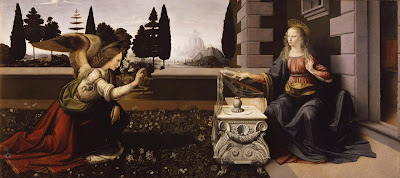
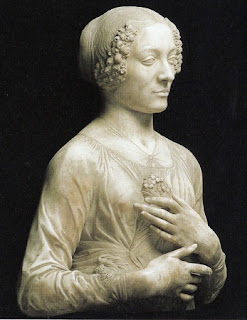
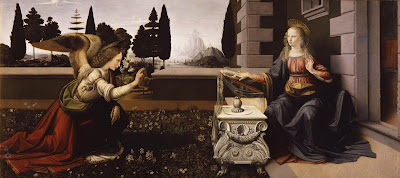
Edward Hutton regarded Andrea Verrocchio as "one of the greatest of all Italian masters of the Renaissance." Sadly, Verrocchio has been eclipsed by his student Leonardo da Vinci. For example, the famous Annunciation in the Uffizi is generally credited to the young Leonardo although it was done in the Verrocchio studio.*  In the Bargello, Hutton found two outstanding examples of Verrocchio's work as a sculptor.


It is, however, in the work of another goldsmith—or at least the pupil of one, whose name he took—that we find the greatest master of the new age, Andrea Verrocchio. Born in 1435, and dead in 1488, he was preoccupied all his life with the fierce splendour of his art, the sublime sweetness that he drew from the strength of his work. The master, certainly, of Lorenzo di Credi and Leonardo, and finally of Perugino also, he was a painter as well as a sculptor; and though his greatest work was achieved in marble and bronze, one cannot lightly pass by the Annunciation of the Uffizi, or the Baptism of the Accademia. Neglected for so long, he is at last recognized as one of the greatest of all Italian masters of the Renaissance. …


More perfect in craftsmanship and in the knowledge of anatomy than Donatello, Verrocchio here, where he seems almost to have been inspired by the David of his master, surpassed him in energy and beauty, and while Donatello’s figure  is involved with the head of Goliath, so that the feet are lost in the massive and almost shapeless bronze, Verrocchio’s David stands clear of the grim and monstrous thing at his feet. Simpler, too, and less uncertain is the whole pose of the figure, who is in no doubt of himself, and in his heart he has already “slain his thousands.”


In the portrait of Monna Vanna degli Albizi, the Lady with the Nosegay, Verrocchio is the author of the most beautiful bust of the Renaissance. She fills the room with sunshine, and all day long she seems to whisper some beloved name. A smile seems ever about to pass over her face under her clustering hair, and she has folded her beautiful hands on her bosom, as though she were afraid of her beauty and would live ever in their shadow.


In two reliefs of Madonna and child, one in marble and one in terra-cotta, you find that strange smile again, not, as with Leonardo, some radiance of the soul visible for a moment on the lips, but the smile of a mother happy with her little son. In the two Tornabuoni reliefs that we find here too in the Bargello, it is not Verrocchio’s hand that we see; but in the group of Christ and St. Thomas at Or San Michele, and in the fierce and splendid equestrian statue of Bartolomeo Colleoni at Venice, you see him at his best, occupied with a subtle beauty long sought out, and with an expression of the fierce ardour and passion that consumed him all his life. If he makes only a leaf of bronze for a tomb, it seems to quiver under his hands with an inextinguishable vitality.


###


*Today the Uffizi credits the Annunciation to Leonardo but after a Verrocchio prototype. 


Edward Hutton: Florence and Northern Tuscany with Genoa, second edition, London, 1908. Pp. 292-293 

Friday, March 21, 2025

Florence: Or San Michele

 In his account of the church of Or San Michele, Edward Hutton's described the sculptures placed in the exterior niches by the various guilds of Florence with emphasis on Verrocchio's Christ with St. Thomas.  On entering the church he turned to the magnificent shrine of the Madonna by Andrea Orcagna. *


Or San Michele, S. Michele in Orto, was till the middle of the thirteenth century a little church belonging, as it is said, to the Cistercians, who certainly claimed the patronage of it. About 1260, however, the commune of Florence began to dispute this right with the Order, and at last pulled down the church, building there, thirty years later, a loggia of brick… This loggia was the corn market of the city, a shelter, too, for the contadini who came to show their samples and to talk, gossip, and chaffer, as they do everywhere in Italy even to-day. And, as was the custom, they made a shrine of Madonna there, hanging on one of the brick pillars a picture (tavola) of Madonna that, as it is said, was the work of Ugolino da Siena. This shrine soon became famous for the miracles Madonna wrought there….


By 1353 Andrea Orcagna had been chosen to build the shrine of the Madonna, which is still one of the wonders of the city. It seems to have been in a sort of recognition of the splendour and beauty of Orcagna’s work that the Signoria, between 1355 and 1359, removed the corn market elsewhere, and thus gave up the whole loggia to the shrine of Madonna. Thus the loggia became a church, the great popular church of Florence, built by the people for their own use, in what had once been the corn-market of the city. The architect of this strange and secular building, more like a palace than a church, is unknown….


The masterpiece, certainly, of these Tuscan sculptures is the bronze group of Christ and St. Thomas by Verrocchio, which I have so loved. All the work of this master is full of eagerness and force; something of that strangeness without which there is no excellent beauty, that later was so characteristic of the work of his pupil Leonardo, …. How perfectly, and yet 

 not altogether without affectation, he has composed that difficult scene, so that St. Thomas stands a little out of the setting, and places his finger—yes, almost as a child might do—in the wounded side of Jesus, who stands majestically fair before him. It is true the drapery is complicated, a little heavy even, but with what care he has remembered everything! Consider the grace of those beautiful folds, the beauty of the hair, the loveliness of the hands; and then as Burckhardt reminds us, as a piece of work founded and cast in bronze, it is almost inimitable. 


Within, the church is strange and splendid. It is as though one stood in a loggia in deep shadow, at the end of the day in the last gold of the sunset; and there, amid the ancient fading glory of the frescoes, is the wonderful shrine that Orcagna made for the picture of the Madonna, who had turned the Granary of S. Michele into the Church of the People. Finished in 1358, this tabernacle is the loveliest work of its kind in Italy, an unique masterpiece, and perhaps the most beautiful example of the Italian Gothic manner in existence. Orcagna seems to have been at work on it for some ten years covering it with decoration and carving those reliefs of the Life of the Virgin in that grand style which he had found in Giotto and learned perhaps from Andrea Pisano. To describe the shrine itself would be impossible and useless. It is like some miniature and magic church, a casquet made splendid not with jewels but with beauty, where the miracle picture of the Madonna—not that ancient and wonderful picture by Ugolino da Siena, but a work, it is said, of Bernardo Daddi—glows under the lamps. …


Some who have seen the shrine so loaded with ornament, so like some difficult and complicated canticle, have gone away disappointed…. Yet I think it is rather the fault of Or San Michele than of the shrine itself, that it does not certainly vanquish any possible objection and assure us at once of its perfection and beauty. If it could be seen in the beautiful spacious transept of S. Croce, or even in the Santo Spirito across Arno, that sense as of something elaborate and complicated would perhaps not be felt; but here in Or San Michele one seems to have come upon a priceless treasure in a cave. 


###


 Edward Hutton: Florence and Northern Tuscany with Genoa, second edition, London, 1908. Pp. 185-193.


*Note: For a more up to date description of the Orsanmichele see the post by my English friend, David Orme. 

Friday, January 21, 2022

Florence: Verrocchio

Edward Hutton regarded Andrea Verrocchio as "one of the greatest of all Italian masters of the Renaissance." Sadly, Verrocchio has been eclipsed by his student Leonardo da Vinci. For example, the famous Annunciation in the Uffizi is generally credited to the young Leonardo although it was done in the Verrocchio studio.*  In the Bargello, Hutton found two outstanding examples of Verrocchio's work as a sculptor.


It is, however, in the work of another goldsmith—or at least the pupil of one, whose name he took—that we find the greatest master of the new age, Andrea Verrocchio. Born in 1435, and dead in 1488, he was preoccupied all his life with the fierce splendour of his art, the sublime sweetness that he drew from the strength of his work. The master, certainly, of Lorenzo di Credi and Leonardo, and finally of Perugino also, he was a painter as well as a sculptor; and though his greatest work was achieved in marble and bronze, one cannot lightly pass by the Annunciation of the Uffizi, or the Baptism of the Accademia. Neglected for so long, he is at last recognized as one of the greatest of all Italian masters of the Renaissance. …


More perfect in craftsmanship and in the knowledge of anatomy than Donatello, Verrocchio here, where he seems almost to have been inspired by the David of his master, surpassed him in energy and beauty, and while Donatello’s figure  is involved with the head of Goliath, so that the feet are lost in the massive and almost shapeless bronze, Verrocchio’s David stands clear of the grim and monstrous thing at his feet. Simpler, too, and less uncertain is the whole pose of the figure, who is in no doubt of himself, and in his heart he has already “slain his thousands.”


In the portrait of Monna Vanna degli Albizi, the Lady with the Nosegay, Verrocchio is the author of the most beautiful bust of the Renaissance. She fills the room with sunshine, and all day long she seems to whisper some beloved name. A smile seems ever about to pass over her face under her clustering hair, and she has folded her beautiful hands on her bosom, as though she were afraid of her beauty and would live ever in their shadow.


In two reliefs of Madonna and child, one in marble and one in terra-cotta, you find that strange smile again, not, as with Leonardo, some radiance of the soul visible for a moment on the lips, but the smile of a mother happy with her little son. In the two Tornabuoni reliefs that we find here too in the Bargello, it is not Verrocchio’s hand that we see; but in the group of Christ and St. Thomas at Or San Michele, and in the fierce and splendid equestrian statue of Bartolomeo Colleoni at Venice, you see him at his best, occupied with a subtle beauty long sought out, and with an expression of the fierce ardour and passion that consumed him all his life. If he makes only a leaf of bronze for a tomb, it seems to quiver under his hands with an inextinguishable vitality.


###


*Today the Uffizi credits the Annunciation to Leonardo but after a Verrocchio prototype. 


Edward Hutton: Florence and Northern Tuscany with Genoa, second edition, London, 1908. Pp. 292-293.

Friday, October 15, 2021

Florence: Or San Michele

In his account of the church of Or San Michele, Edward Hutton's described the sculptures placed in the exterior niches by the various guilds of Florence with emphasis on Verrocchio's Christ with St. Thomas.  On entering the church he turned to the magnificent shrine of the Madonna by Andrea Orcagna. *


Or San Michele, S. Michele in Orto, was till the middle of the thirteenth century a little church belonging, as it is said, to the Cistercians, who certainly claimed the patronage of it. About 1260, however, the commune of Florence began to dispute this right with the Order, and at last pulled down the church, building there, thirty years later, a loggia of brick… This loggia was the corn market of the city, a shelter, too, for the contadini who came to show their samples and to talk, gossip, and chaffer, as they do everywhere in Italy even to-day. And, as was the custom, they made a shrine of Madonna there, hanging on one of the brick pillars a picture (tavola) of Madonna that, as it is said, was the work of Ugolino da Siena. This shrine soon became famous for the miracles Madonna wrought there….


By 1353 Andrea Orcagna had been chosen to build the shrine of the Madonna, which is still one of the wonders of the city. It seems to have been in a sort of recognition of the splendour and beauty of Orcagna’s work that the Signoria, between 1355 and 1359, removed the corn market elsewhere, and thus gave up the whole loggia to the shrine of Madonna. Thus the loggia became a church, the great popular church of Florence, built by the people for their own use, in what had once been the corn-market of the city. The architect of this strange and secular building, more like a palace than a church, is unknown….


The masterpiece, certainly, of these Tuscan sculptures is the bronze group of Christ and St. Thomas by Verrocchio, which I have so loved. All the work of this master is full of eagerness and force; something of that strangeness without which there is no excellent beauty, that later was so characteristic of the work of his pupil Leonardo, …. How perfectly, and yet 

 not altogether without affectation, he has composed that difficult scene, so that St. Thomas stands a little out of the setting, and places his finger—yes, almost as a child might do—in the wounded side of Jesus, who stands majestically fair before him. It is true the drapery is complicated, a little heavy even, but with what care he has remembered everything! Consider the grace of those beautiful folds, the beauty of the hair, the loveliness of the hands; and then as Burckhardt reminds us, as a piece of work founded and cast in bronze, it is almost inimitable. 


Within, the church is strange and splendid. It is as though one stood in a loggia in deep shadow, at the end of the day in the last gold of the sunset; and there, amid the ancient fading glory of the frescoes, is the wonderful shrine that Orcagna made for the picture of the Madonna, who had turned the Granary of S. Michele into the Church of the People. Finished in 1358, this tabernacle is the loveliest work of its kind in Italy, an unique masterpiece, and perhaps the most beautiful example of the Italian Gothic manner in existence. Orcagna seems to have been at work on it for some ten years covering it with decoration and carving those reliefs of the Life of the Virgin in that grand style which he had found in Giotto and learned perhaps from Andrea Pisano. To describe the shrine itself would be impossible and useless. It is like some miniature and magic church, a casquet made splendid not with jewels but with beauty, where the miracle picture of the Madonna—not that ancient and wonderful picture by Ugolino da Siena, but a work, it is said, of Bernardo Daddi—glows under the lamps. …


Some who have seen the shrine so loaded with ornament, so like some difficult and complicated canticle, have gone away disappointed…. Yet I think it is rather the fault of Or San Michele than of the shrine itself, that it does not certainly vanquish any possible objection and assure us at once of its perfection and beauty. If it could be seen in the beautiful spacious transept of S. Croce, or even in the Santo Spirito across Arno, that sense as of something elaborate and complicated would perhaps not be felt; but here in Or San Michele one seems to have come upon a priceless treasure in a cave. 


###


 Edward Hutton: Florence and Northern Tuscany with Genoa, second edition, London, 1908. Pp. 185-193.


*Note: For a more up to date description of the Orsanmichele see the post by my English friend, David Orme.