Search This Blog

Showing posts with label S. Miniato. Show all posts

Friday, May 23, 2025

Florence: Hill of Gardens and S. Miniato

 After crossing the Arno, Edward Hutton climbed the lovely Hill of Gardens, and then came to the ancient church of S. Miniato where he paused to describe a beautiful tomb.


 Then, turning into Via Romana, you come, past the gardens of S. Piero in Gattolino. To the Porta Romano, the great gate of the Via Romana, the way to Rome, and before you is the Hill of Gardens, and behind you is the garden of the Pitti Palace, Giardino di Boboli, and farther still, across Via Romana, the Giardino Torrigiani.


The Boboli Gardens, with their alley ways of ilex, their cypresses and broken statues, their forgotten fountains, are full of sadness--… But the gardens of the Viale are in spring, at any rate, full of the joy of roses, banks, hedges, cascades of roses, armsful of them, drowsy in the heat and heavy with sweetness.


“I’mi trovai, fanciulle, un bel mattino

  Di mezzo Maggio. In un verde giardino.”


Certainly to-day there is nothing more lovely in Florence in spring, and in autumn too, than this Hill of Gardens. In autumn too; for then the way that winds there about the hills is an alley of gold, strewn with the leaves of the plane-trees that the winds have scattered in countless riches under your feet; that whisper still in golden beauty over your head. There, as you walk in spring, while the city unfolds herself before you, a garden of roses in which a lily has towered, or in the autumn afternoons when she is caught in silver mist, a city of fragile and delicate beauty, that is soon lost in the twilight, you may see Florence as she remains in spite of every violation, Citta dei Fiori, Firenze la Bella Belissima, the sweet Princess of Italy. And, like the way of life, this road among the flowers ends in a graveyard. The graveyard of S. Miniato al Monte, under which nestles S. Salvatore, that little brown bird among the cypresses, over the grey olives. [


Church of S. Miniato.


 It is the most beautiful of the Tuscan-Romanesque churches left to us in Florence; built in  1013 in the form of a basilica, with a great nave and two aisles,  the choir being raised high above the rest of the church on twenty-eight beautiful red ancient pillars, over a crypt where, under the altar, S. Miniatio sleeps through the centuries. The fading frescoes of the aisles, the splendour and quiet of this great and beautiful church that has guarded Florence almost from the beginning…have a peculiar fascination, almost ghostly in their strangeness, beyond anything else to be found in the city. And if for the most part the church is so ancient as to rival the Baptistery itself, the Renaissance has left there more than one beautiful thing…. 


In the left aisle is the chapel, built in 1461 by Antonio Rossellino, where the young Cardinal Jacopo of Portugal lies in one of the loveliest of all Tuscan tombs, and there Lucca della Robbia has placed some of his most charming terracottas, and Alessio Baldovinetti has painted in fresco. In all Tuscany there is nothing more lovely than that tomb, carved in 1467 by Antonio Rossellino for the body of the young Cardinal. But twenty-six years old when he died, “having lived in the flesh as though he were freed from it, an Angel rather than a man.” Over this beautiful sarcophagus, on a bed beside which two boy angels wait, the young Cardinal sleeps, his delicate hands folded at rest at last. Above, two angels kneel, about to give him the crown of glory which fadeth not away, and Madonna borne from heaven by the children, comes with her Son to welcome him home. There, in the most characteristic work of the fifteenth century, you find man still thinking about death, not as a trance out of which we shall awaken to some terrible remembrance, but as sleep, a sweet and fragile slumber, that has something of the drooping of the flowers about it, in a certain touching beauty and regret that is never bitter, but, like the ending of a song or the close of a fair day in spring, that rightly, though not without sadness, passes into silence, into night, in which shine only the eternal stars. 


###


Edward Hutton: Florence and Northern Tuscany with Genoa, second edition, London, 1908. Pp. 270-4.

Friday, December 17, 2021

Florence: Hill of Gardens and S. Miniato

After crossing the Arno, Edward Hutton climbed the lovely Hill of Gardens, and then came to the beautiful ancient church of S. Miniato where he paused to describe a beautiful tomb.


 Then, turning into Via Romana, you come, past the gardens of S. Piero in Gattolino. To the Porta Romano, the great gate of the Via Romana, the way to Rome, and before you is the Hill of Gardens, and behind you is the garden of the Pitti Palace, Giardino di Boboli, and farther still, across Via Romana, the Giardino Torrigiani.


The Boboli Gardens, with their alley ways of ilex, their cypresses and broken statues, their forgotten fountains, are full of sadness--… But the gardens of the Viale are in spring, at any rate, full of the joy of roses, banks, hedges, cascades of roses, armsful of them, drowsy in the heat and heavy with sweetness.


“I’mi trovai, fanciulle, un bel mattino

  Di mezzo Maggio. In un verde giardino.”…


Certainly to-day there is nothing more lovely in Florence in spring, and in autumn too, than this Hill of Gardens. In autumn too; for then the way that winds there about the hills is an alley of gold, strewn with the leaves of the plane-trees that the winds have scattered in countless riches under your feet; that whisper still in golden beauty over your head. There, as you walk in spring, while the city unfolds herself before you, a garden of roses in which a lily has towered, or in the autumn afternoons when she is caught in silver mist, a city of fragile and delicate beauty, that is soon lost in the twilight, you may see Florence as she remains in spite of every violation, Citta dei Fiori, Firenze la Bella Belissima, the sweet Princess of Italy. And, like the way of life, this road among the flowers ends in a graveyard. The graveyard of S. Miniato al Monte, under which nestles S. Salvatore, that little brown bird among the cypresses, over the grey olives. [


Church of S. Miniato.


 It is the most beautiful of the Tuscan-Romanesque churches left to us in Florence; built in  1013 in the form of a basilica, with a great nave and two aisles,  the choir being raised high above the rest of the church on twenty-eight beautiful red ancient pillars, over a crypt where, under the altar, S. Miniatio sleeps through the centuries. The fading frescoes of the aisles, the splendour and quiet of this great and beautiful church that has guarded Florence almost from the beginning…have a peculiar fascination, almost ghostly in their strangeness, beyond anything else to be found in the city. And if for the most part the church is so ancient as to rival the Baptistery itself, the Renaissance has left there more than one beautiful thing…. 


In the left aisle is the chapel, built in 1461 by Antonio Rossellino, where the young Cardinal Jacopo of Portugal lies in one of the loveliest of all Tuscan tombs, and there Lucca della Robbia has placed some of his most charming terracottas, and Alessio Baldovinetti has painted in fresco. In all Tuscany there is nothing more lovely than that tomb, carved in 1467 by Antonio Rossellino for the body of the young Cardinal. But twenty-six years old when he died, “having lived in the flesh as though he were freed from it, an Angel rather than a man.” Over this beautiful sarcophagus, on a bed beside which two boy angels wait, the young Cardinal sleeps, his delicate hands folded at rest at last. Above, two angels kneel, about to give him the crown of glory which fadeth not away, and Madonna borne from heaven by the children, comes with her Son to welcome him home. There, in the most characteristic work of the fifteenth century, you find man still thinking about death, not as a trance out of which we shall awaken to some terrible remembrance, but as sleep, a sweet and fragile slumber, that has something of the drooping of the flowers about it, in a certain touching beauty and regret that is never bitter, but, like the ending of a song or the close of a fair day in spring, that rightly, though not without sadness, passes into silence, into night, in which shine only the eternal stars. 


###


Edward Hutton: Florence and Northern Tuscany with Genoa, second edition, London, 1908. Pp. 270-4.
Friday, August 20, 2021

Return to Florence

In Florence and Northern Tuscany, Edward Hutton began his discussion of the city of Florence with a kind of overview. He started at the Uffizi, walked along the Lung' Arno, crossed the river at the Ponte Vecchio, and then climbed the hill to the Piazzale and the church of S. Miniato. 


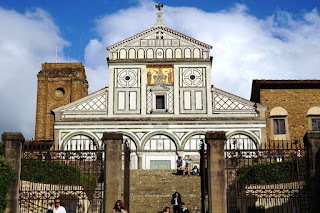
So, under the cool cloisters of Palazzo degli Uffizi I shall come at last on to Lung’ Arno, where it is very quiet, and no horses may pass, and the trams are a long way off. And I shall lift up my eyes and behold once more the hill of gardens across Arno, with the Belvedere just within the old walls, and S. Miniato, like a white and fragile ghost in the sunshine, and La Bella Villanella couched like a brown bird under the cypresses above the grey olives in the wind and the sun. And something in the gracious sweep of the hills, in the gentle nobility of that holy mountain which Michelangelo has loved and defended, which Dante Alighieri has spoken of, which Giovanni Manetti has so often climbed, will bring the tears to my eyes, and I shall turn away towards Ponte Vecchio, the oldest and most beautiful of the bridges, where the houses lead one over the river, and the little shops of the jewellers still sparkle and smile with trinkets. And in the midst of the bridge I shall wait awhile and look on Arno. Then I shall cross the bridge and wander upstream towards Porta S. Niccolo, that gaunt and naked gate in the midst of the way, and there I shall climb through the gardens up the steep hill…to the great Piazzale, and so to the old worn platform before S. Miniato itself, under the strange glowing mosaics of the façade: and, standing on the graves of dead Florentines, I shall look down on the beautiful city.


Marvellously fair she is on a summer evening as seen from that hill of gardens, Arno like a river of gold before her, leading over the plain lost in the farthest hills. Behind her the mountains rise in great ampitheatres, -- Fiesole on one side, like a sentinel on her hill; on the other, the Apennines, whose gesture, so noble, precise, and splendid, seems to point ever towards some universal sovereignty, some perfect domination, as though this place had been ordained for the resurrection of man. Under this mighty symbol of annunciation lies the city, clear and perfect  in the lucid light, her towers shining under the serene evening sky. Meditating there alone for a long time in the profound silence of that hour, the whole history of this city that witnessed the birth of the modern world, the resurrection of the gods, will come to me….


So I shall dream in the sunset. The Angelus will be ringing from all the towers, I shall have celebrated my return to the city that I have loved. The splendour of the dying day will lie upon her; in that enduring and marvellous hour, when in the sound of every bell you may find the names that are in your heart, I shall pass again through the gardens, I shall come into the city when the little lights before Madonna will be shining at the street corners, and the streets will be full of the evening, where the river, stained with fading gold, steals into the night to the sea. And under the first stars I shall find my way to my hillside. On that white country road the dust of the day will have covered the vines by the way, the cypresses will be white half-way to their tops, in the whispering olives the cicale will still be singing… In the far sky, marvellous with infinite stars, the moon will sail like a golden rose in a mirror of silver. Long and long ago the sun will have set, but when I come to the gate… one will say Chi e, and I shall make answer. So I shall come into my house, and the triple lights will be lighted in the garden, and the table will be spread. And there will be one singing in the vineyard, and I shall hear, and there will be one walking in the garden, and I shall know. 


###


Edward Hutton: Florence and Northern Tuscany with Genoa, second edition, London, 1908. Pp. 157-160.