Search This Blog

Showing posts with label Medici. Show all posts

Friday, March 28, 2025

Florence: Ricciardi Palace and the Medici

Edward Hutton's discussion of the Medici Ricciardi Palace focussed on the famed chapel where Benozzo Gozzoli depicted the Journey of the Magi. The three Magi are usually depicted as old, middle-aged, and young but Hutton saw that Gozzoli depicted more than the Magi.
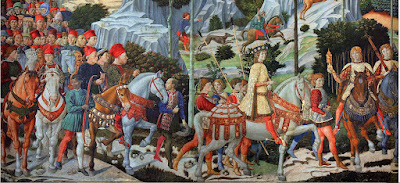


It is, however, the palace in the Via Larga that recalls to us most vividly the lives and times of these first Medici, Cosimo Vecchio, Piero the gouty, Lorenzo il Magnifico. Michelozzo, Vasari tells us, deserves infinite credit for this building, since it was the first palace built in Florence after modern rules in which the rooms were arranged with a view to convenience and beauty…. It is not, however, the splendour of the palace, fine as it is, or the memory of Cosimo even that brings us to that beautiful house to-day, but the work of Donatello in the courtyard, those marble medallions copied from eight antique gems, and that little chapel on the second floor, almost an afterthought you might think, since in a place full of splendidly proportioned rooms, it is so cramped and cornered under the staircase, where Benozzo Gozzoli has painted in fresco quite round the walls, the Journey of the Three Kings, in which Cosimo himself, Piero his son, and Lorenzo his grandson, then a golden-haired youth, ride among the rest, in a procession that never finds the manger at Bethlehem, is indeed not concerned with it, but is altogether occupied with its own light-hearted splendour, and the beauty of the fair morning among the Tuscan hills. Is it the pilgrimage of the Magi to the lowly cot of Jesus that we find in that tiny dark chapel, or the journey of man, awake now on the first morning of spring in quest of beauty? Over the grass scattered with flowers, that gay company passes at dawn by little white towns and grey towers, through woods where for a moment is heard the song of some marvellous bird, past running streams, between hedges of pomegranates and clusters of roses; and by the wayside rise the stone-pine and the cypress, while over all is the far blue sky, full of the sun, full of the wind, which is so soft that not a leaf has trembled in the woods, nor the waters stirred in a single ripple. Truly they have come to Tuscany where beauty is, and are far from Bethlehem, where Love lies sleeping. There on a mule, a black slave beside his stirrup, rides Cosimo Pater Patriae, and beside him comes Piero his son, attended too, and before them on a white horse stepping proudly, with jewels in his cap, rides the golden-haired Lorenzo, the youngest of the three kings, already magnificent, the darling of this world of hills and streams, which one day he will sing better than anyone of his time…. And so it is before an empty shrine that those clouds of angels sing; Madonna has fled away, and the children are singing a new song, surely the Trionte of Lorenzo, it is the first time perhaps that we hear—


                Quant’ e’ bella giovinezza.


Ah, if they had known how tragically that day would close.*


###


*Note: Hutton concluded this chapter with Lorenzo’s words from his Memoir. 


“although I, Lorenzo, was very young, in fact only in my twenty-first year, the leading men of the city and of the ruling party came to our house to express their sorrow for our misfortune, and to persuade me to take upon myself the charge of the government of the city as my grandfather and father had already done. This proposal being contrary to the instincts of my age, and entailing great labour and danger, I accepted against my will, and only for the sake of protecting my friends and our own fortunes, for in Florence one can ill live in the possession of wealth without control of the government.” (205)


Edward Hutton: Florence and Northern Tuscany with Genoa, second edition, London, 1908. Pp. 201-202. 

Friday, November 19, 2021

Florence: S. Lorenzo and Donatello


After recounting the history and background of the church of S. Lorenzo, “the resting place of the Medici,” Edward Hutton proceeded to the chapels in the transept, and the old sacristy where he found the incomparable work of Donatello.


 Three chapels that flank the aisles have to-day but little interest for us…nothing that will keep us for more than a moment from the chapels of the transept, the work of Desiderio da Settignano, of Verrocchio, and, above all, of Donatello. It is all unaware to the tomb of this the greatest sculptor, and in many ways the most typical artist, Florence ever produced, that we come, when, standing in front of the high altar, we read the inscription on that simple slab of stone which marks the tomb of Cosimo Vecchio; for Donatello lies in the same vault with his great patron. A modern monument in the Martelli chapel, where the beautiful Annunciation by Lippo Lippi hangs under a crucifix by Cellini, in the left transept, commemorates him; but he needs no such reminder here, for about us is his beautiful and unforgettable work: not the two ambones, which he only began on his return from Padua when he was sixty-seven years old…but the work in the old sacristy built in 1421 by Brunellesco. How rough is the modelling in the ambone reliefs, as though really, as Bandinelli has said, the sight of the old sculptor was failing; and yet, in spite of age and the intervention of his pupils, how his genius asserts itself in a certain rhythm and design in these tragic panels, where, under a frieze of dancing putti,--loves or angels I know not,--of bulls and horses, he has carved the Agony in the Garden, Christ before Pilate, and again before Caiaphas, the Crucifixion, the Deposition, in the southern ambone, while in the northern we find the Descent into Hades…the Resurrection and the Ascension, the Maries at the tomb, the Pentecost….


The old sacristy, which is full of him—for indeed all the decorative work seems to be his—is one of the first buildings of the Renaissance, the beautiful work of Filippo Brunelleschi. Covered by a polygonal dome, the altar itself stands under another dome, low and small; and everywhere Donatello has added beauty to beauty, the two friends for once combining to produce a masterpiece. … and it is in these bronze doors that, as it seems to me, you have Donato at his best, full of energy and life, yet never allowing himself for a moment to forget that he was a sculptor, that his material was bronze and had many and various beauties of its own, which it was his business to express. There are two doors, one on each side of the altar, and these doors are made in two parts, and each part is divided into five panels. With a loyalty and apprehension of the fitness of things really beyond praise, Donatello has here tried to do nothing that was outside the realm of sculpture. It was not for him to make the Gates of Paradise, but the gates of a sacristy in S. Lorenzo. His work is in direct descent from the work of the earliest Italian sculptors, a legitimate and very beautiful development of their work, within the confines of an art which was certainly sufficient of itself. Consider, then, the naturalism of that figure who opens his book on his knees so suddenly and with such energy; or again, the exquisite reluctance of him who in the topmost panel turns away from the preaching of the apostle. Certainly here you have work that is simple, sincere, full of life and energy, and is beautiful just because it is perfectly fitting and without affectation.


###


Edward Hutton: Florence and Northern Tuscany with Genoa, second edition, London, 1908. Pp. 242-243.

Friday, October 22, 2021

Florence: Ricciardi Palace and Chapel

Edward Hutton's discussion of the Medici Ricciardi Palace focussed on the famed chapel where Benozzo Gozzoli depicted the Journey of the Magi. The three Magi are usually depicted as old, middle-aged, and young and Hutton saw that Gozzoli depicted more than the Magi.


It is, however, the palace in the Via Larga that recalls to us most vividly the lives and times of these first Medici, Cosimo Vecchio, Piero the gouty, Lorenzo il Magnifico. Michelozzo, Vasari tells us, deserves infinite credit for this building, since it was the first palace built in Florence after modern rules in which the rooms were arranged with a view to convenience and beauty…. It is not, however, the splendour of the palace, fine as it is, or the memory of Cosimo even that brings us to that beautiful house to-day, but the work of Donatello in the courtyard, those marble medallions copied from eight antique gems, and that little chapel on the second floor, almost an afterthought you might think, since in a place full of splendidly proportioned rooms, it is so cramped and cornered under the staircase, where Benozzo Gozzoli has painted in fresco quite round the walls, the Journey of the Three Kings, in which Cosimo himself, Piero his soon, and Lorenzo his grandson, then a golden-haired youth, ride among the rest, in a procession that never finds the manger at Bethlehem, is indeed not concerned with it, but is altogether occupied with its own light-hearted splendour, and the beauty of the fair morning among the Tuscan hills. Is it the pilgrimage of the Magi to the lowly cot of Jesus that we find in that tiny dark chapel, or the journey of man, awake now on the first morning of spring in quest of beauty? Over the grass scattered with flowers, that gay company passes at dawn by little white towns and grey towers, through woods where for a moment is heard the song of some marvellous bird, past running streams, between hedges of pomegranates and clusters of roses; and by the wayside rise the stone-pine and the cypress, while over all is the far blue sky, full of the sun, full of the wind, which is so soft that not a leaf has trembled in the woods, nor the waters stirred in a single ripple. Truly they have come to Tuscany where beauty is, and are far from Bethlehem, where Love lies sleeping. There on a mule, a black slave beside his stirrup, rides Cosimo Pater Patriae, and beside him comes Piero his son, attended too, and before them on a white horse stepping proudly, with jewels in his cap, rides the golden-haired Lorenzo, the youngest of the three kings, already magnificent, the darling of this world of hills and streams, which one day he will sing better than anyone of his time…. And so it is before an empty shrine that those clouds of angels sing; Madonna has fled away, and the children are singing a new song, surely the Trionte of Lorenzo, it is the first time perhaps that we hear—


                Quant’ e’ bella giovinezza.


Ah, if they had known how tragically that day would close.*


###


*Note: Hutton concluded this chapter with Lorenzo’s words from his Memoir. 


“although I, Lorenzo, was very young, in fact only in my twenty-first year, the leading men of the city and of the ruling party came to our house to express their sorrow for our misfortune, and to persuade me to take upon myself the charge of the government of the city as my grandfather and father had already done. This proposal being contrary to the instincts of my age, and entailing great labour and danger, I accepted against my will, and only for the sake of protecting my friends and our own fortunes, for in Florence one can ill live in the possession of wealth without control of the government.” (205)


Edward Hutton: Florence and Northern Tuscany with Genoa, second edition, London, 1908. Pp. 201-202.