Search This Blog

Showing posts with label Lombardy. Show all posts

Friday, February 6, 2026

Crema


Edward Hutton described Crema as "a little place, no one goes there" even though it was easy to go from Cremona there and back by train in a day. He gave a brief description of the Cathedral, "no church more beautiful in all Lombardy," but devoted more attention to a church outside the walls.*


When one does pluck up courage to leave Cremona at last, to forgo quietness for the noise of the railway, and the sunshine and delight of that exquisite town for the chances of travel, it must, of course, be for Crema that one sets out—Crema that has almost no history worth knowing, but remains one of the dearest and most hidden places in all this wide and beautiful Lombard country.


I often wonder now I am set down to write about Lombardy, as I did when I made my way along the Lombard roads, whether we who go our ways up and down from city to city, from church to church, from one building to another, ever really are aware how beautiful a countryside Lombardy is under its wide incomparable sky, half lost in its own vastness…. But Lombardy is hard to see, difficult to find out and impossible to possess oneself of, without much fatigue, weariness, mud and dust. The roads are all endless there, the cities always far away, and often when they are but market towns, worse than nothing—places from which one hurries away in the first train that comes by, places that one tries to forget…. But the country: I think, indeed, no one ever sees that in the great plain. It is too big, too vague, too empty to allure us from the security and curiosity of the towns; yet it is a background full of peace to all those peaceful and lovely places: Cremona in the green meadows, Mantua amid the quietness of the lagoons, and last but not least Crema, where the white oxen gather in the streets at evening, drawing their great creaking carts laden with all the wealth of the purple vintage that shall presently, by the winepress, stain the streets and perfume the whole city. …


If there is little for the mere tourist in the streets of Crema…there is undoubtedly a church without her walls that will astonish him. I mean the round church of S. Maria della Croce, which is rather polygonal than round after all, and built of brick in the true Renaissance manner, and reminds one of nothing so much as of that heavenly building Raphael saw in the background of his picture in the Brera. It is a work by Giovanni Battagio of Lodi, a disciple of Bramante’s. I say it reminds one of nothing so much as of Raphael’s there in his picture of the Sposalizio. Well, it has just the tranquillity, the lightness, and the graceful dignity of that visionary building and it stands under its clustered domes and cupolas really like something in a dream, something not made with hands, that would actually be impossible  in any other land but this. And if it be true, as Pater has told us, that “all art aspires toward the condition of music,” here, I think, for once it has been completely successful. For it is as though suddenly as we listened. Some Magnificat by Palestrina or Marenzio had taken visible shape and “materialized itself,” as we say, before our eyes in a temple not made with hands, in which it might please the Queen of the angels a little to abide our coming.


Raphael: Sposalizio. Brera, Milan


###


*There is no church more beautiful in all Lombardy than the cathedral of Crema…it is a thing to love and be proud of, and the people of Crema justly hold it high in their affections, for it is not only beautiful and full of daring, it is also unique: there is nothing like it in all the world.


Edward Hutton: The Cities of Lombardy, New York, 1912. Pp. 234-237.

Friday, December 19, 2025

Monza: The Iron Crown


After leaving Pavia, Edward Hutton travelled to Monza to view its relics, the most famous of which was the "Iron Crown of Lombardy," originally conferred on Queen Theodolinda, the Apostle to the Lombards, by Pope Gregory I around the year 600.


Some ten miles to the north of Milan, still in the plain but within sight of the hills, stands Monza, which in its immortal, its beautiful relics, its thirteenth century Broletto, recalls for us the earliest Lombardy, for it was here from the eleventh century, in the first city within the Italian border, that the emperors-elect were crowned kings with the “iron crown of Lombardy,” still holy and still preserved over the high altar of the Duomo, before they set out on that long march to Rome, there to receive the Imperial title and consecration of the Pope. …


Standing on both banks of the Lambro, … Monza is a fair city. If the ancients knew her not, for she is a city of the Fall, to the men of the Middle Age she was as famous as any town in Italy, and the great church which Theodolinda, the Apostle of the Lombards, built beside her own palace remained through all its rebuildings the one true coronation church that has ever been erected south of the alps. …


In the chapel to the left of the choir in a large monstrance in the shape of a cross is preserved the holy and famous Iron Crown of Lombardy, which it is said Gregory the Great gave to Theodolinda. It consists of an inner circlet of iron beaten out of one of the nails of the Cross: this precious relic is encased in a circle of gold and jewels. It is one of the most sacred and priceless treasures—even from a merely historical point of view—to be found in Italy, for it has circled the brows of Theodolinda, of Charlemagne, of Frederick Barbarossa, of Charles V, and of Napoleon I. In itself it seems to bind Europe indissolubly into one; and if ever the Empire be re-erected it is with this majestic and holy symbol we shall crown our Emperor. Not with it has the modern Italian kingdom been consecrated, a newer and a more brittle ring of gold suffices it. This symbol of iron, as old and as indestructible as Europe, awaits, let us believe it, him who shall make us one. 


And here in this holy place under the  crown lies she who brought light and strength to her kingdom, the Apostle of the Lombards, Queen Theodolinda, the friend of Gregory. Her tomb, a sarcophagus resting upon four pillars of marble, is a work of the fourteenth century, and the four frescoes of scenes from her life are from the fifteenth, restored in our own day. More interesting are her gifts to the church—the few that remain—in the treasury: a hen with seven chickens of silver-gilt, her crown and comb of gold filigree and fan of painted leather, and best of all, the “precious Gospel book” and cross which Gregory gave her when her son was baptized; it was his last gift before his death.


###


Edward Hutton: The Cities of Lombardy, New York, 1912. Pp. 162-.

Friday, October 10, 2025

Masolino in Castiglione d'Olana

 Walking south along the beautiful route from Como to Milan, Edward Hutton stopped at Castiglione d'Olana to view frescoes by Masolino, the great Tuscan painter of the quattrocento whose most famous work is in Florence's Brancacci chapel.


Castiglione

There are many other happy places about Varese, but the traveller, already anxious for Milan, will scarcely linger here, more especially as the best of all lies on his way. That best is the road to Castiglione d’Olana, and Castiglione itself. You go, if you are wise, through Bizzozero, climbing the hills, with wonderful views of the Alps and the lakes all the way, and then descend through delicious woods by Lozza to the little town of Castiglione, partly in the valley of the Olana, a pleasant stream, and partly on the steep hill above it. 


The Castello, which belonged to the noble family of Castiglione, on the hill above the little town, or rather village, had by the beginning of the fifteenth century become ruined, and there Cardinal Branda da Castiglione built the church we see dedicated to Our Lady of the Rosary, to S. Lorenzo and to S. Stefano, together with a little Baptistery separate from the church and to the north of it. Here by the utmost good fortune one of the greatest Tuscan painters of that day was employed to adorn that building in fresco. Branda da Castiglione was Cardinal of S. Clemente, and it was there, doubtless, he had seen the work of Masolino and liked it. So he bade him paint his own church of the Rosary with some of the joyful and glorious mysteries which that crown of prayers celebrates, and today we find in the choir the result of this commission. There we see the Marriage of the Blessed Virgin, the Annunciation, the Nativity, the Adoration of the Magi, the Assumption and the Coronation of Our Lady in six compartments with Our Lord in Benediction in the midst …. In the Baptistery close by we find many scenes far better preserved than those in the church, of the life of S. John Baptist, master-works of the great Tuscan whom Cardinal Branda da Castiglione found at work in the S. Clemente in Rome. The first modern critics to write of these paintings  were the almost infallible Crowe and Cavalcaselle. Vasari does not mention them, and, as it seems, they were quite unknown when in the end of the eighteenth century, the church being very dark, they were covered with whitewash and were only uncovered in 1843.


It has been reserved for a critic of our own time to make a further discovery. For, as it happened, Mr. Berenson came to Castiglione not long ago and found in the Palazzo Castiglione here a great frieze running round the great hall consisting of four frescoes from the master’s hand. Three of these had been whitewashed, but in that which had escaped he found one of the finest and one of the most surprising things in all Tuscan art of the quattrocento: “nothing less than a vast landscape, a sort of panorama of the Alps, with a broad torrent rushing down to the plain.” Was it Cardinal Branda who so loved these great hills he could see from his house, or Masolino himself, who, Tuscan as he was, looking upon them for the first time, gave himself suddenly to them and recorded here forever his sudden and overwhelming joy? We shall never know: only, as Mr. Berenson says, “let us cease talking about the late date at which in Italy landscape began to be treated on its own account.” *


###


Edward Hutton: The Cities of Lombardy, New York, 1912. Pp. 54-55.


*Bernard Berenson, an acquaintance of Hutton's, was a connoisseur and prolific writer on the art of the Italian Renaissance. 

Friday, October 3, 2025

Lake Como

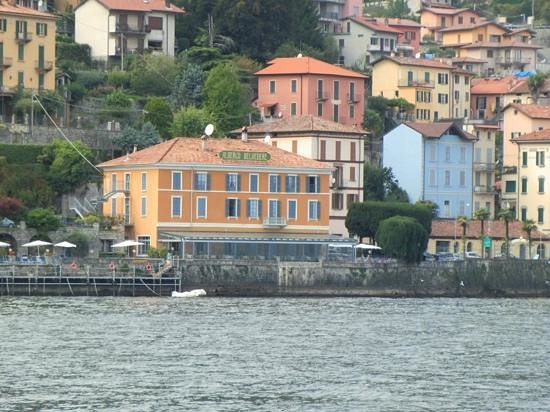
 Although my wife and I visited Lake Como more than a dozen years ago, the memory is still fresh in our minds. I will never forget entering our room at the aptly named Hotel Belvedere in Argegno, and opening the large shutters to reveal a truly fantastic vision of the beautiful blue water and the surrounding hills. Here are excerpts from Edward Hutton's description of Lago di Como.


Hotel Belvedere, Argegno

Men have fruitlessly discussed for ages which is the most beautiful of the lakes in this paradise that lies at the gates of Lombardy, among the mountains. One might as well consider whether Winchester Cathedral were more beautiful than Salisbury, or Wells than either. For no one is like another, save that all are to be enjoyed. Lago Maggiore has the gift of the wind, of the wideness of some inland sea and of distance; Lago Lugano has the gift of shadow, of great hills and of many secret places; Lago di Como has the joy of richness and of colour, the mystery of woods and the surprise of the snow, and of far-away great mountains; Lago d’Orta has flowers and silence. But of all the lakes, I love best the Larian, Lago di Como, because it is wholly Latin and there I can tread in the ways that are from of old, I can behold places that have always been sacred and remember the history of Europe. …[30]


But delightful though the lake is between Bellaggio and Colico and between Bellaggio and Lecco, there can be no doubt that its most beautiful, and its most frequented and famous part, is that which lies between Bellaggio and the city of Como—the lake of Como proper. The special and enchanted beauty of the Italian lakes is here at its best, and all that is most characteristic  in the strange lavishness of their beauty seems here to have found its best expression. And to add to our pleasure it is here, too, that the historical interest of this part of Lombardy reaches its climax. Here the Latin world is secure and we feel ourselves in the country of Pliny and Virgil…. [45]


Opposite Lezzono we see the only island on the lake, the Isola Comacina. The name of this island takes our thoughts back over a thousand years and more of history.


Here, as is supposed, Caninius Rufus, one of Pliny’s correspondents had a villa. “How is Como looking,” Pliny writes to him, “your darling spot and mine? And that most charming villa of yours, what of it, and its portico where it is always spring, its shady plane trees, its fresh crystal canal and the lake below that gives so lovely a view? [47]…


Who shall describe the way from Isola Comacina to Como:  is it not one of the most luxurious beauties in the world? Argegno with the Val d’Intelvi, Nesso with its waterfall, what can be said of them?... [47]


From Argegno, indeed, to Como it is villa and garden and grove all the way. Who is there that knows Como that has not floated at evening under those balconies heavy with roses, those terraces stately with cypresses and myrtles, those hanging gardens of azaleas and lilies and geraniums, where the magnolias shine in the twilight and the night is heavy with sweetness? [49]…


No one, I suppose, comes to Como, that shining city under the Brunate at the lake’s head, for history. There is plenty of it if one does; but…the olive-clad hills, the entrancing byways and the lake itself, entice one to be ever up and about, what time one can save from these is given, and I think without hesitation, to the Duomo, which Street so unaccountably failed to appreciate, but which has plenty of lovers nevertheless.


The Duomo and the Broletto, an earlier work of black and white marble, beside it, make up a group of buildings as picturesquely lovely as any in Lombardy, and few there be who do not straightway fall in love with them. As for the church, it is, I suppose, one of the finest examples of married Gothic and Renaissance—a Gothic yet perfectly developed and yet without fantastic excess, a Renaissance sober and sweet and without stiffness—anywhere to be found in Italy. [49-50]


###


Edward Hutton: The Cities of Lombardy, New York, 1912. Pp. 30-50.

Friday, September 26, 2025

Mt. Generoso and the Lakes

 Edward Hutton began his tour of Lombardy atop Monte Generoso at an inn appropriately named Bellavista. The spectacular panoramic views especially of the beautiful lakes, Lugano, Como, and Maggiore, filled him with a sense of awe even danger at the enchantment of their beauty.   


Now if a man would see with his bodily eyes, and as it were in a single glance, the country of Cisalpine Gaul whose history I have tried to set forth in the preceding chapter, let him enter Italy from the town of Lugano, and, taking boat from there to Capolago, and climbing thence a-foot or by funicular the mountain called Generoso, let him stay a day or two in the woods of Bellavista. Nowhere else that I know will he get all at once so full a possession of the lie of the land. The Monte Generoso stands on the modern frontier of Switzerland and Italy, and the view from Bellavista, just an inn in the chestnut woods, where the wild flowers most abound, and still more from the summit, is not only one of the most splendid in Europe, but one of the widest and most interesting. To the north and west stand the great ramparts of the Alps, and beyond, that tremendous bundle of upreared peaks we call the Bernese Oberland; in the south lies the vast Italian plain as far as Bologna where the Apennines close its southern border, and on the east as far as Verona where the Alps shut it in. At one’s feet, like so many jewels cast down before one, lie the lakes of Maggiore, Lugano, Como, and the rest, among the foothills of the great mountains. To see and to consider this view is to understand the secret and the history not of Cisalpine Gaul alone, but in a very real sense of Italy and of Europe, and I can imagine no more propitious and delightful seclusion for such a contemplation of the past and the future of all that Europe stands for than this great thirsty mountain, which in spite of the lack of water, is shrouded so wonderfully in woods and scattered with wild flowers. And then when one is weary of thought, there lie the Italian lakes for our recreation and delight: and yet not all delight.


I do not know, nor shall I ever understand precisely what it is  that lends to the lakes of Lombardy their unnatural and shining beauty, their air of enchantment, of sorcery. They are a vision of lovely and untroubled youth, of youth that is without conscience and without thought, and they have upon the soul the effect of a singular and half-remembered  music. To come upon them veiled in the midst of dawn, or shining in the glory of the morning, to watch them drowsily in the drowsy noon, to see them fade into the silent and blue and gold of the evening, into the violet of the still night is to experience a fullness of joy that only music is commonly able to bring us: and yet that joy is far removed from happiness. Something forbidden, a sense of spell or sorcery, something too sweet, something too brief, that terrifies us because it is so lovely involves this paradise in disaster, and we are  as full of fear as we should be if by chance we had come upon Dionysus himself on a still noon in the shadow of the vines, or Aphrodite  in the long summer dawn on the fringe of the Cyprian sea.  


###


Edward Hutton: The Cities of Lombardy, New York, 1912. Pp. 29-30.

Friday, September 19, 2025

Cities of Lombardy

 Edward Hutton's book on Lombardy, published in 1912, was the first of his Italian guides that I ever read. My Aunt Nan gave it to me on the death of her husband, Joseph Foppiani, over 30 years ago. His mother must have given it to him when he was young with this inscription, "Joseph, know thy country." Hutton began his tour with a discussion of the early history of Cisalpine Gaul, the name of the region during Roman times.


When I think of Lombardy, there comes back into my mind a country wide and gracious, watered by many a great river, and lying, a little vaguely, between always far-away mountains, a world that is all a garden, where one passes between fair hedgerows, from orchard to orchard, among the vines, where the fields are green with promise or shining with harvest, and there are meadows on the lower slopes of the mountains. And the whole of this wide garden seems to me, as is no other country in the world, to be subject to the sun, the stars and the great and beautiful clouds of an infinite sky; every landscape is filled with them, and beneath them the cities seem but small things, not cities truly, but rather sanctuaries, hidden in that garden for our delight, reverence and meditation, at the end of the endless ways, where only the restless poplars tell the ceaseless hours.


It is my purpose in this book to consider the nature and the history of this country, to recapture and to express as well as I may my delight in it, so that something of its beauty and its genius may perhaps disengage itself from my pages, and the reader feel what I have felt about it though he never stir ten miles from his own home. … (1)


The Pax Romana: it is the work of the Empire; a thing in our Europe hard to conceive of, but proper to Christendom, and perhaps if we could but see it to-day only awaiting our recognition. 


Those first four centuries of our era in which Christendom was founded  and Europe appeared, not as we know it to-day as a mosaic of hostile nationalities, but as one perfect whole, have never been rightly understood; they still lack an historian, and the splendour of their achievement, their magnitude and importance are wholly misconceived or ignored. In our modern self-conceit we are ignorant both of what they were  in themselves and of what we owe to them; and largely through the collapse of Europe in the sixteenth century and its appalling results both in thought and in politics we are led, too often by the wilful lying of our historians, to regard them rather as the prelude to the decline and fall of the Empire than as the great and indestructible foundation of all that is worth having in the world.


For rightly understood, these first four centuries gave us not only our culture, our constitutions,  our civilization, and our Faith, but ensured  them to us that they should always endure. They established for ever the great  lines upon which our art was to develop, to change, and yet not to suffer annihilation or barrenness. They established the supremacy of the idea, so that it might always renew our lives, our culture, and our polity, and that we might judge everything by it and fear neither revolution, defeat, nor decay. They, and they alone, established us in the secure possession of our own souls, so that we alone in the world develop from within to change but never to die and to be--yes alone in the world—Christians. 


And if the whole empire then took on a final and heroic form in those years of the Empire and the peace, Cisalpine Gaul more than any other province then came to fruition….and if we turn to the province itself, there is scarcely a town in that wide plain that did not expand and increase in a fashion almost miraculous during that period. It was then the rivers were embanked, the canals and our communications established for ever. There is no industry that did not grow incredibly in strength, there is not a class that did not increase in well-being beyond our dreams of progress.  There is scarcely anything that is really fundamental in our lives and in our politics  that was not then created that it might endure. It was then that our religion, the soul of Europe, was born, and little absorbed us so that it became the energy and the cause of all that undying but changeful principle of life and freedom which, rightly understood is Europe. Our ideas of justice, our ideas of law, our conception of human dignity and the structure of our society were then conceived and with such force that while we endure they can never die. (17-19)


###


Edward Hutton: The Cities of Lombardy, New York, 1912.  


Friday, November 4, 2022

Canossa: End of the Journey


Edward Hutton ended his tour of Lombardy with a visit to Canossa, and a stirring account of the once-famous meeting between the Emperor Henry, and Pope Gregory VII (Hildebrand). Here are some excerpts from his account.


Canossa remains in the imagination of the world as the symbol of the mighty work that Rome achieved during the Dark Ages, I mean the creation of the Papacy that was not only to dominate  but to civilize Europe, and when Hildebrand on that bare and pallid rock broke Henry in the cruel winter of 1077 that creation was proclaimed to Europe and the two succeeding centuries were already secured….


At Ciano you may get a mule or you may walk to Rosetta to that magnificent and isolated spot where the destiny of Europe for more than two centuries was decided. All the way is fair, and nothing in the world is more inspiring than the splendid climb from Ciano to Canossa. The lords of Canossa held in their day not only these mountains and all the passes into Italy across them, but a vast part of Lombardy, including Parma, Reggio, Mantua and Brescia, to say nothing of Tuscany and Spoleto. One feels at once on leaving Reggio and entering the region of the hills that one is at least really in their country.


Matilda…was the greatest of her house, the gran donna d’Italia, the friend of Hildebrand and the handmaid and protectress of the Papacy and the Church, she who reminded Dante of Persephone as she went alone singing and plucking flower after flower that strewed her way. We shall meet her again at Canossa. She lived a virgin, and on her death her vast inheritance passed by her will to the Holy See…. 


If you set out from Reggio…by road you will pass the Quattro Castella….but the Quattro Castella offers the traveller one of the most astonishing spectacles in Italy. Four conical hills rise from the vast hillside all in a line barring the way, and each crowned by a castle. They are the first outworks of that vast system of defense which guarded Canossa. [299]…


After Rossena, the great white and naked rock of Canossa crowned by its ruin comes in sight, in wonderful contrast with Rossena itself. Here in the winter of 1077 the two great forces of the world met in combat, and the emperor fell.


It is almost impossible for us in our confused and wholly material age to understand the drama that was played out upon this naked upland, as it were upon the top of the world, in the three days and nights of that bitter January. The emperor had come from his Germany into Italy with the intention of making the Pope prisoner. He knew not what he was proposing. To humble the Latin world, which the Papacy expressed, was in itself a barbarian, if an honourable, adventure; but to break the heart and soul of Europe was to achieve what even Attila had failed to do. As the event proved,  when the two men were face to face it was the barbarian who was to go down, and that not by force of arms but by force of will….


At Canossa everything was ready for an attack. Azzo d’Este was there and Hugh, Abbot of Clugny, and over them all the great Countess [Matilda]. Uplifted before all Europe, the Emperor and the Pope faced one another to decide who should be master.


Henry came. Was it the mountains that had broken him, or the astonishment of Italy, or the hand of God? Whatever it was, he was broken. His first act was to beg intercession from Matilda, who with Hugh the Abbot met him when he begged it at Bianello. The countess, who was his cousin, undertook to plead his cause.


Then Hildebrand said:  “If Henry is indeed repentant, let him lay down crown and sceptre, and declare that he is unworthy of the name of king.”


There spoke the soul of Europe that cannot be broken.


Henry did as he was ordered. It was the end of January; the earth was covered with snow, the streams were silent with frost. In the thin garb of a penitent, in a shirt of white linen, the successor of the Caesars, nay Caesar himself, slowly climbed the rocky path to the outer gate of Canossa. And they all looked upon him as he stood before the closed inner gate. There; in the bitter weather, he waited fasting for three days and three nights. On the fourth day, half dead with cold, the wretched Emperor was brought into the presence of God’s Vice-gerent. He prostrated himself in the dust, crying for pardon….


That scene will live forever in the mind of man, for it is the most perfect expression of that Europe out of which we are come and to which we shall return. Canossa is its monument, a place worthier of pilgrimage by us who are European than ever was Becket’s tomb of Canterbury, holy though that was and famous through the world. Canossa was a bigger victory than Canterbury, and Italy a bigger stage than England.


Look you, then, how the mountains shine hence, and all Lombardy is spread out before them, and Italy far away thrice guarded there to the south. It is well that our journey should draw to an end in such a famous place as this, where we may look back upon our many days of going, and possess them all in a single heart’s beat, a single glance, as Hildebrand looked over the world.


There lies Cisalpine Gaul, jewelled with cities--Modena, Parma, Verona, Mantua; girdled with her mighty river, the glistening belt of the Po; islanded by the Euganeans, and ringed and fortressed by the Alps. Here are the Apennines, yonder is Italy; and the story of Europe, that noble tale of great Rome turned Christian, and all our past, at our feet. 


###


Edward Hutton: The Cities of Lombardy, New York, 1912. Pp. 297-303.

Friday, October 28, 2022

Parma and Correggio


For some reason that he could not fully explain, Parma was one of the few little cities in Italy that he "had never been able to love." Still there was the "Duomo in its noble piazza," and the magnificent work of Correggio. 


The church is a cruciform building under an open octagon surmounted by a dome; the choir is raised above a crypt, and from the outside the arcaded apse is, I think, its most beautiful feature. But the church as seen from the street is arcaded everywhere: on the façade we have a triple columnar gallery; each which ends with a quadrilateral, itself arcaded, to which is added a semicircular apse again arcaded. Nothing more noble, rich and charming can be imagined. …


The great spectacle of the church, however, is of course the overwhelming frescoes of Correggio in the dome, which everyone who comes at all to Parma comes to see. For myself, they are beyond anything else to be found in Parma, and indeed among the most astonishing things in all Lombardy. 


Correggio’s first frescoes had been painted  for the Camera di S. Paulo, fortunate and lovely works, and later he had decorated the cupola of S. Giovanni Evangelista. It was therefore with a full knowledge of his work that in 1522 he began to cover the dome of the Cathedral with these frescoes of the Assumption of the Blessed Virgin, to whom the church was dedicated, while below stand the Apostles and the four patron saints of Parma.


Nothing else, I suppose, in European art has quite the sense we find here, the sense of flight. Madonna caught up from death, from the earth and all earthly things, is borne in an ecstasy, her arms stretching open wide, by a glad crowd of angels and cherubs, one of whom, laughing for joy, nestles in her bosom, into the heaven of heavens, a vast dome of light, built of angels, circle after circle, up to the brightness which is the smile of God. And out of that dazzling firmament one peerless archangel, Gabriel, god’s messenger, has hurled him down, trembling for joy, to meet her and welcome her, the Queen of all. Nothing else in Europe, I think, expressed so fully and so unreservedly that sense of flight—the eagerness, the joy, and the confident, radiant power of flight—as does this matchless fresco. It is impossible to look upon it without emotion or to doubt for a moment that the painter had seen a vision. One simply disregards the painter’s foibles and weaknesses; the thing is a rhapsody more wonderful than a Magnificat by Marenzio, almost inarticulate, if you like, for joy; a musical rapture that is beyond music, hat is the expression once and for all of the highest religious emotion. And to those who would criticize it, I would give the reply Titian, who had also painted an Assumption, gave; “Turn it upside down and fill it with gold, and you will still come short of its proper price.” It has been tended with careless hands, and it is to-day but a wreck of what it once was. Yet in colour still, as in gesture and delight, it remains something beyond the power of words to express, something that never was in the world or is here in no satisfying quantity.


###


Edward Hutton: The Cities of Lombardy, New York, 1912. Pp. 273-274. 

Friday, October 21, 2022

Piacenza: Pordenone, Ss. Roch and Columban


At Piacenza's S. Maria di Campagna, Edward Hutton found a veritable shrine to Pordenone, the great Renaissance master. Then, he told the story of S. Roch, "one of the true patrons and benefactors of Piacenza." Finally, he took a short but arduous trip to nearby Bobbio to see the famous Abbey associated with S. Columban. 


The younger contemporary of Lotto, always impetuous, full of aristocratic prejudices and worldly, was his complete opposite both in his life and in his art. Born at Pordenone in 1483, he died at Ferrara in 1539. He has been compared with Rubens, both on account of the vivacity of his temperament, and his love of colossal and well-developed forms. But as Morelli rightly reminds us, while the Fleming was prolific, prudent and calculating, the Italian was “passionate, excitable, ill-regulated and swayed by pride and ambition.” It is certain that he never attained the position of ease and luxury which Rubens won, but at the same time he never sunk into conventionality. “Original, highly gifted at times, even strikingly grand, he at one period sought, not unsuccessfully, to rival Titian.” His great strength lay in fresco painting, and his most interesting frescoes are, I think, these in Piacenza; at any rate they are more accessible than those near Conegliano and those at Treviso.


We see something of his gifts in the curious figure of S. Augustine by the entrance, and more in that splendid Adoration of the Magi in the first chapel on the north side of the church, in the Nativity in the lunette, and on the wall the birth of the Blessed Virgin, and above it the Flight into Egypt; and again in the Chapel of S. Catherine, which he entirely painted, even the altarpiece of the Marriage of S. Catherine being from his hand. But what are we to say of those marvellous Prophets and Sibyls on the cupola, but that there fresco painting actually passes into a kind of glorious music, into movement, colour and light.


Hard to see as these works are, badly as they have been treated, they remain masterpieces that we come back to again and again, that return to the mind when one is far away, as indeed do all his admirable works in this church. Piacenza is to be loved for them; and because of them we are not too sorrowful that the church of S. Sisto here no longer holds that “Sistine” Madonna which Raphael painted for it in 1515, and which was sold in 1753 for 20,000 ducats to the King of Poland, who was also Elector of Saxony, and which remains in Dresden….


Whatever else one does at Piacenza, one should not omit to visit that most famous shrine of a great British or rather Irish saint at the old and splendid Abbey of Bobbio….


But what the reader may ask, is Bobbio, and why should one go there? After all, the British Isles are full of forgotten shrines of early British saints and no one marks them; indeed, these same early British saints are more utterly neglected and forgotten than any other sort of beings. All the same, if you care anything for holiness, if you care at all for great achievement, if you have any reverence for learning, and the old great masters of letters, you must go to Bobbio, for there S. Columban had his home and thence “all the palimpsests known in the world have emerged.” I wish in three words, I could make known to you this Irishman who was as it were S. Benedict and S. Francis and S. Bernard all in one. I wish in three hundred words, or even in three thousand, I could tell you the man he was, and the great Abbot and leader, and above all the great Saint….


That Bobbio which he had founded became the most famous and the most intellectual of the monasteries of Italy; it was the hope of the seventh century, and may be said to have achieved as much in the salvation of Europe as any other place whatsoever. When that was accomplished in the eleventh century it began to decline, later its precious library was distributed, and in the seventeenth century it was but a shadow of itself….


Yet Bobbio is a place to linger in, to remember our Saint, and to search out the mountains as he did, and stray about the woods where the dawn is all yours and the sunset and the night, and where one day telleth another of the ancient glory of God.


###


Edward Hutton: The Cities of Lombardy, New York, 1912. Pp. 252-261.

Friday, October 14, 2022

Piacenza


When Edward Hutton crossed the Po river to get to Piacenza, he was no longer in Lombardy proper. As usual he discussed the history of the city, part of the famed Duchy of Parma, but noted that the most famous thing in the city was its Piazza de' Cavalli.


It is but twenty-two miles, less than an hour’s journey in the train from Lodi, through Caesale Pusterlengo and Codegno, and so across the Po for the first time in our journey, into Piacenza, an old and a famous city of the Romans. Even though one comes by train that crossing of the Po impresses itself upon the mind, while by road the passage is never to be forgotten, for you make it by a bridge of boats, with the swirling, cruel river within a few feet of you, and horribly strong and overwhelming. And it is well that this should be so; for, by crossing the Po, we leave Lombardy proper and come into that part of the new province of Emilia, which, since the sixteenth century, has been known as the Duchy of Parma, over which ruled the House of Farnese. …


Piacenza can never claim to be, I think, one of the most beautiful cities of Lombardy, yet it is one of the most picturesque by reason of its colouring and its vast, empty piazzas, churches and palaces, the beautiful vistas of its streets and the sense of space and bigness everywhere.


The most famous thing in it is its great Piazza—Piazza de’ Cavalli—which seems so large, so romantic and so like something on the stage, or in a dream, with its magnificent Palazzo del Comune thrust out into it on one side, the modern Palazzo delle Preture on another, the weirdly uncompromising façade of S. Francesco on a third, and everywhere long vistas of streets opening out of it on all sides, and at every angle and corner. Nor is this all. The Palazzo del Comune is perhaps the finest palace of the sort in Italy: yet how much its effect here in this Piazza is enlarged  and added to by the great bronze equestrian statues which rear before the great façade—“insignificant men, exaggerated horses, flying drapery”—yes, as baroque as you please, but splendid here, both in gesture and in colour—vivid green against the terra-cotta—and placed there by a master. 


Nothing in Piacenza is half so well worth seeing as this Piazza seemed to me to be on an autumn evening after rain. It then literally is a vision that slowly vanishes away in the twilight, from glory down to glory into the blue night: and this once seen can never be forgotten. But when we return in the morning sunlight, though the Piazza still remains magnificent, it is no longer a vision : all its poor details stand out in the harsh glitter of light, that nevertheless, I think, alone can reunite us with those affected equestrian statues of the dukes Alessandro and Ranuccio Farnese, seventeenth century work from Tuscany, all but the colour of which and gesture of which is veiled by the evening. …


From the ridiculous statues of the Farnese we turn to the noble Palazzo del Comune. This was built when Piacenza was a free city. It dates from 1281, and is one of the earliest and noblest Gothic buildings in Italy. Below is an open arcade, in which pillars of marble, supporting pointed arches, support the palace proper, consisting of brick with six round-arched windows of terra-cotta, and over all a marble cornice and battlements, with a tower at the angles.


###


Edward Hutton: The Cities of Lombardy, New York, 1912. Pp. 243-250.