Search This Blog

Showing posts with label Rome. Show all posts

Friday, June 14, 2024

Rome: The Campagna

Edward Hutton ended his book on Rome with a chapter on the Campagna, the desolate countryside outside the hills of Rome. Here is his paean to the Campagna. I suspect that he would be shocked today by the belt-ways and urban sprawl that have overtaken what he called "the soul of Rome." I add some images from nineteenth century painters who saw the Campagna as Hutton saw it.


George Inness: View of the Campagna


Rome possesses nothing half so lovely, half so precious, half so venerable, as the Campagna, in which she lies like a ship in the midst of the sea, now just visible over the billows, now lost altogether in that vast solitude of which, for the most part, she is oblivious. My happiest hours during all my sojourn in Rome have been spent in the Campagna, at all hours of the day, at every season of the year.


The immense and universal thing which lies unregarded at the gates of the Eternal City is the one Roman thing that I have been able to love absolutely without reserve or any after thought. I loved it at first sight, and to leave it still brings tears to my eyes. And yet, I have felt no intimacy with it, as I have with the Umbrian valleys, and the moorlands, the hills and the sea of the west Country whence I am sprung. It is too vast and too silent for intimacy but it has my fear and love as God has them, because it is greater than I, and in some sort has produced me. It has, too, the indefinite beauty of all supernatural things. One may find there always all that is in one’s heart, and each will find what he brings and the reward of which he is worthy. It is too beautiful to praise and too mysterious, too holy, to explain or to describe…. For, as the sea is the secret of England, so the Campagna is the secret of Rome; it haunts the City, and the majesty and largeness of its silence are the springs of its immortality. Nor may you long escape it, for all the great ways lead to it at last, and it surges against every gate….


Corot: View of the Campagna


From wherever you first see it, it calls you instantly in its solemn immensity, its vast indwelling strength, its ruined splendor, across which the broken arches of the aqueducts stagger still, and the vague white roads, lined with empty and rifled tombs, wander aimlessly, losing themselves in the silence and vastness that only the mountains may contain. And it is the mountains which hem in the Campagna, the most beautiful mountains in the world.


Wherever you may go in Rome, after that first revelation, whatever you may see, before whatever shrines you may kneel, it is the Campagna which is in your heart, for you have discovered Rome, the soul of Rome…. 


It is this one comes to realise at last, as day after day, week after week, one passes along that ancient Appian Way, between the crumbling tombs. Here and there we may find them still, the likeness of our brother carved in relief, some thought of his about it all, a few Latin words, part of an inscription, half hidden with the grass and the flowers. And as night overtakes one on that marvelous road, when the splendor of sunset is faded, and the stars one by one have scattered the heavens with hope, our thoughts turn almost in self defence, in that solemn loneliness, from death to resurrection. In the immense silence that nothing may break our imagination sinks beneath the lonely majesty of that desert, littered with the monsters of old forgotten religions, full of the dead things of Paganism and Christianity, the bones of Saints, the mighty trunks of forgotten gods.


What more is there to come out of that vast grave, that marvelous solitude?


###

Friday, June 7, 2024

Rome: Villa Borghese


Edward Hutton's discussion of the Roman villas and their gardens included a tour of the Borghese Gallery and its wonderful art collection, the highlight of which was Titian's Sacred and Profane Love.
***


But if the palaces are, in spite of their size and splendor, a little dull, a little lacking in interest and beauty, so that nowhere in Rome may we find one that moves us as the Palazzo Pubblico in Siena does, or as many of these wonderful buildings on the Grand Canal in Venice contrive to do, it is quite otherwise with the Villas. Rome is unique among the cities of the world in possessing them, and they are unique in their loveliness and charm. They have nothing in common with anything in England, but one might feel something of their charm if Hampton Court Palace with its gardens were suddenly to be found in the midst of London…. 

The Roman villa garden…has an air of the eighteenth century; it is full of silence. The cypresses are set thickly in a half-circle about a statue, or in long alley-ways that lead to a fountain; vista passes into vista, till you are led to lose yourself in the twilight of the bosco, in the midst of which you find yourself suddenly at the foot of a magical staircase of stone, wide and spacious and beautiful, and passing up it, you come at last to a little summer-house of marble, just above the tree-tops, and there, far below you, is Rome…. 

But of all these villas with their marvelous gardens which were once the glory of Rome, but few remain. Of these which are still left to us, perhaps the best known are the Villa Pamphili, the Villa Medici, and the Villa Borghese. The first is of an incomparable loveliness, the second of an incomparable mystery, the third is less rare, and of late has become one of the playgrounds of Rome, larger, and more spaciously beautiful but less fashionable than the Pincio. But in truth the Villa Borghese, with its gardens and park, is still one of the most enchanting things in the City… and then it adds to its other delights a treasure of art, a collection of pictures that is the finest in the City after that of the Vatican….


But the real glory of the gallery consists not only, or even chiefly, in the work of Raphael, but in three works by the greatest master of that or any other period, Titian, who is represented by three pictures, the first belonging to his youth, the others to his old age.


The Sacred and Profane Love, painted about 1512 for Niccolo Aurelio, Grand Chancellor of Venice, is the highest achievement of Titian’s art at the end of its Giorgionesque period…. In fact, the name it now bears, which has so puzzled the world, does not occur till the end of the eighteenth century, when it seems to have been given it by the Germans. For us, at least, it can have no authority, the subject of the picture being merely a moment of beauty, --a moment gone, but for Titian’s genius, while we try to apprehend it, in the golden summer heat, under the trees by a fountain of water….

But, after all, what we have come here to see is the Sacred and Profane Love, by Titian, and that will lead us, not from picture to picture in a sudden enthusiasm for painting, but most certainly back again into the gardens, where the world is so sleepily golden in the heat, and the shade so cool and grateful. There we shall linger till, from the far-away city, the Ave Mary rings from all the cupolas, and we must return down the long alleys in the softly fading light, stealing softly, half-reluctantly, out of the world of dreams back into the streets and the ways of man. 


###

*** Note: Hutton rejected the accepted title of Titian's painting and saw the subject as "merely a moment of beauty." Almost a hundred years later, I stood in front of the famous painting and had an intuition that the two women were actually Mary Magdalen before and after her conversion. Research confirmed this intuition and my interpretation can be found at academia.edu.


Edward Hutton: Rome, fourth edition, 1922. Pp. 327-335.

Friday, May 31, 2024

The Fountains of Rome

 No one can visit Rome without falling in love with its fountains. In his chapter on the fountains, Edward Hutton traced their origins back to ancient Rome, described their destruction during the Dark Ages, and their revival by the Papacy during the Renaissance. He then took his readers on a walking tour of his favorites.


Horace tells us somewhere that he is the friend of fountains, and, indeed, no true Roman whether of the ancient or the modern world, can ever have been without some sentiment for them, since, in fact, they are the joy of Rome, her voice, as it were, a pleasant and a joyful voice; for no city in Europe is so truly a city of running waters. All day long they waken in the heart some mystery of delight and refreshment; -- the slender jets of water wavering between the cypresses in the shadow, flashing in the sun, splashing among the statues on the cold marble. And their song in the cool, diaphanous mornings of spring is a song of life, of joy, of the brief joy of life…. 


In the fifteenth century the Popes of the Renaissance, wishing to return to her the leadership of the world, gave her back her waters, and suddenly, in a moment, as though by enchantment, she arose once more out of the wilderness and the ruins, healed and whole at the sound of that song. 


Often very early in those spring mornings which are so fair in Rome, or maybe on an autumn evening, under a moon great and golden as the sun, I have wandered through the city of fountains for the sake of their song. It begins with the strange artificial voice of Bernini’s Barcaccia in the Piazza di Spagna, where the Acqua Vergine falls humbly at the feet of Madonna, that gallery of war shooting forth from her guns, not death, but refreshment. Then, as I pass into the silence up the beautiful Scala di Spagna, and turn towards the Pincio, presently, still far off, I hear the most beautiful voice in Rome, the single melody, languid and full of mystery, and all enchantment, of the fountain before the Villa Medici, where, under the primeval ilex, a single jet of water towers like some exquisite slender lily, to droop, to fall in unimagined loveliness into the brimming vase of marble, so admirably simple and in place under these sacred trees, before that lofty villa, which, in some sort, dominates the whole City, and whence one may look across the towers and domes to the Capitol, to S. Peter’s, to the Campagna stretching away to the sea.


No other fountain in Rome is at once so simple and so beautiful as this, nor is there another which commands so wide and so majestic a prospect. And yet, if one passes down the slope of the Pincio into the Piazza del Popolo, and so crosses the Ponte Margherita, and passes at last under the height of the Vatican, comes at last into the Piazza di S. Pietro, one finds there…two fountains, quite as beautiful in their way, though truly less simple, singing ever before the threshold of the shrine of the Apostle. Rising in the shape, as it were, of fleurs de lys, the water harmonises perfectly, not only with the fountains themselves, but with the beautiful piazza in which they are so marvelously placed, forming together with it the masterpiece of Bernini. 


We come to the Piazza Navona, where stands the most extraordinary, perhaps of all Bernini’s works, the brilliant but bizarre fountain with its obelisk and statues personifying the four great rivers of the world.


It is again to a work of Bernini we come, as, passing on through the City, we stand at last before the fountain of Trevi, which resembles the Acqua Paolina, and which may be heard above all the noise of the piazza. And it is fitting that, since Rome is the city of fountains, to make sure of one’s return to her, it should be necessary to make an offering, not at the grave of Romulus, nor at the shrine of S.Peter, but to the greatest and most famous of her fountains, for it is said, whoever, at the hour of departure, drinks a cup of the water of Trevi and pays for it, has not looked on Rome for the last time. ### 


Edward Hutton: Rome, fourth edition, 1922, pp. 318-323.

Friday, May 24, 2024

Rome: Spanish Steps and Pincio


Edward Hutton especially liked the Spanish Steps and the nearby Pincio, Rome's beautiful and spacious park. "Eighteenth century work though it be, on how many nights one is content to find that marvelous staircase the most beautiful thing in Rome." Typically, he didn't like the crowds of tourists that just liked to sit on the steps then and now.*


The Piazza di Spagna, that beautiful, irregular square, with its strange fountain before the Palace of the Spanish embassy at the foot of the Spanish steps, remains for the English certainly, the very centre of Rome, though indeed it is just within the Aurelian wall. It is, in fact, one of the most characteristic in the modern city, Papal so long, the key, as it were, to all the strangers’ quarter which still forms so important and even so indispensable a part of the old capitol of the world….(291)


When coming on a winter evening along the Via Condotti we see the real beauty of Rome, a beauty really of atmosphere, of colour in the splendor which the sunset has laid upon the whole Piazza, and not least upon that stucco church whose twin towers seem to guard it from the summit of the Spanish Steps. In that fortunate hour the whole place is an acropolis of ivory and precious moonstone, stained with delicate purple and rude gold.


But in the twilight and the darkness when it is deserted by all, its grave, artificial lines so cunningly sumptuous, seem almost ascetic, and very quiet in their ample beauty leading one slowly, with dignity, with many well-timed pauses, to the summit. And then, too, the mere stucco of the beautiful church to which it serves as a threshold or atrium is lost in the generous beauty of night. One might think it indeed to be of marble or some precious unheard of stone, chrysoprase or amber, jasper or chalcedony, or of ivory and pallid gold. Built in 1493 by that madman, Charles VIII of France, the SS. Trinita de’ Monti has something of the ecstasy of a great French building restrained by the sanity of the sun…. (294)


Something of the fantastic beauty of that church which lends itself so readily to every aspect of the sky is to be found everywhere on the Pincio, which on certain afternoons is the one really gay and irresponsible place in the City, unawares so beggared. There, as it were, above the City, on a summer afternoon, amid the languid fountains, under the evergreen trees whose sharp leaves seem to be all of bronze, that trivial and tirelessly formal or weary world takes its ease, a little harshly and noisily perhaps, as Rome has always done… (294-5)


But it is not thus in in the afternoon or at sunset alone that the Pincio has a charm, but early in the morning too, before the sun has southed. It is almost deserted then, and the fountains whisper together in the silence in the shadow and the sun. One wanders there under the trees always returning to the look-out over the City towards S. Peter’s, lingering there for a time before descending to the Piazza del Popolo and the beautiful church of S. Mary. Out of the gate, Porta del Popolo passes the Flaminian way, and by that road our fathers came from England, S. Maria del Popolo being indeed the first Roman church they would see. (296)


###


Edward Hutton: Rome, fourth edition, 1922.


Note: In his extensive description of the art works in S. Maria del Popolo, Hutton did not mention the two famous paintings in the Cerasi Chapel by Caravaggio: The Crucifixion of Peter and the Conversion of Paul. 


Friday, May 17, 2024

Rome: Aventine Hill and Plainsong

 Edward Hutton's description of Rome's Aventine Hill and its churches is typical of his unique mixture of history, art, religion, and folklore. On one of our visits to Rome we stayed at a small hotel in a lovely tree-lined neighborhood right around the block from the churches he described. One of the things he did not mention was the spectacular view of St. Peter's one gets by peering through the large keyhole in the gate of the headquarters of the Knights of Malta.


Of all the hills of Rome the Aventine alone, precipitous and almost uninhabited as it is, still impresses us with its own beauty and serenity. It is as though the ancient curse of the Patricians were still heavy upon it. Something certainly of those far-off days seems to linger even yet about its shadowy, deserted ways, among the gardens there, where in spring the almond trees are so strangely lovely and in summer the cicada wearies us with its song; where many an ancient church still counts the Ave Maria through the centuries, half-forgotten in a world of silence and flowers…. Later there were temples there, too, for the shadowy Aventine had always been, as was supposed, the abode of some deity…. ‘God is there,’ said the noisy Roman world, awed by the silence of the woods, and so the hill was crowned with temples, the most renowned and splendid being that of Diana, which stood on its very summit in the midst of a grove where that pale goddess seems to have been worshipped from the time of Servius Tullius to the time of Alaric the Goth.


As we pass today from S. Maria in Cosmedin, where the shadow of the Aventine mixes with that of the Palatine hill…we come presently between the long poderi walls to the very place sacred once to Diana, but now to a lesser virgin, S. Sabina, whose church stands in the ruins of the ancient temple…. (270-1)


What remains to us of ancient beauty, however, belongs to the doors of Cyprus wood, which are not only the most beautiful things in the church, but among the most precious remains of primitive Christian art. Carved in the fifth century, they are divided into twenty-six panels representing scenes from the Old and New Testaments, and though these are no longer in their proper order…they remain representative work of the fifth century, the time of the foundation of the church. There we see Elijah borne to heaven in the fiery chariot accompanied by an angel, like a Roman Victory. Then Pharoah crosses the Red Sea, which recalls the great horsemen, the treasures of Monte Cavallo; Christ is adored by the wise kings in Phrygian dress; S. Peter denies his Lord to a damsel like a Roman Empress…. (272-3)


Click on image to enlarge

But amid so many diverse memories we are like to forget S. Sabina altogether. And truly we know little about her. Converted, as it is said, by her Greek slave, Seraphia, she was one of Hadrian’s martyrs. She lies now with Seraphia in the Confession before the high altar, the two bodies having been brought hither from the catacombs of Alexandria. (273
)


  Hutton liked to hear Mass at  S. Anselmo, a modern church, for the chant or plainsong of the Benedictine monks.


So on a Sunday morning in the marvelous Roman summer I would often pass from church to church on my way to hear Mass at S. Anselmo close by.

The great Benedictine College of S. Anselmo, great for Italy at any rate, stands in the midst of its gardens and poderi just opposite S. Alessio. Begun in 1892 and finished in 1896, S. Anselmo was built by Leo XIII, as a college for black Benedictines of all nations. And, here, truly better than anywhere else in Rome, one may hear the very song of the early Church, that long drawn-out, sweet melody, that might seem to have been born with the mystery of the Mass, but is really more universal and more ancient, the very tunes, indeed, instinctive with beauty and humility in which man has always spoken with the gods. For the plainsong is by no means an exclusively Christian music, it seems to have been used by all peoples and all religions, it is indeed an universal hymn of praise, of assurance, plaintive, too, and full of the repetitions of love, the expression of an universal joy, an universal weariness in which man seems about to cast himself for the last time on the earth at the feet of the gods among the flowers.

Coming to us from the East, full of the mystery of the desert, the song indeed of a nomad people often alone with God, the plainsong, as we call it, was first caught up and, as it were, confined by rules for Christian use by the Greek Pope Gregory (not as is generally supposed by Gregory the Great) who contrived out of its mysterious beauty the ‘Gregorian tones,’ thus confiding to it the fundamental truths of the new religion, so that if the creeds and the Gospels should be swept away, still from the assurance of that music in which all the sorrow of the world has found utterance, one might reconstruct the dogmas of the Christian faith resolved into an endless melody…. (274-5)

Note 2: What the plainsong was before it was formed for us by Gregory we may hear any day in Cairo or Tangier or in the desert. Much of it, used for another purpose, remains in the Malagueras of Malaga; and there is the root of it in the Scotch and Irish folk-tunes which can never die. This chant became the music of Italy, the only music really worth hearing or preserving in the Rispetti and Stornelli of the peasants. That it was the music of Greece and Rome, I think, might easily be proved; for to what other tunes and with what other intervals would we have sung so late a thing as the Pervigilium? The Greek songs were doubtless written for it, or under its influence in some less rugged and untutored form that we meet with today in Morocco—where I have heard as it were the Wrath of Achilles chanted as I must suppose Homer once sung. (275) 


###


 Edward Hutton: Rome, fourth edition, 1922.

Friday, May 10, 2024

Vatican: Sistine Chapel and Stanze della Segnatura

 I agree with Edward Hutton that Michelangelo's work in the Sistine Chapel is difficult to comprehend or take in. It's not just the crowds of tourists but the sheer monumentality is overwhelming. I also prefer the relatively small and intimate Stanze della Segnatura where, despite a room full of people, you are free to linger and explore the four walls at leisure before being swept into the Sistine Chapel.


Above these, supported by marvelous and gigantic images of sybyls, of prophets, of slaves, and athletes, stretches the roof of Michelangelo, that new heaven which is the old earth, beautiful with the life of man, his love which brought disaster and all joy, the wild story of the world, which ends on that vast wall above the altar where he has painted not the Last Judgment, it might seem, but the Resurrection.


This ceiling, so heavy with life that it always seems to crush us under the weight of its tremendous story, was painted for Pope Julius II., the condotierre, between the years 1506 and 1512…. (216)


But this profound and wonderful vision of life by no means decorates the chapel of the Popes; it dwarfs it. The air is so full of shapes that we can see nothing.  In this space… Michelangelo, whose spirit always seems to be brooding over some immense sorrow, has created a tremendous and a terrible crowd of figures, each one of which seems to accuse the Papacy and God Himself of some tragic crime committed upon mankind….  Here we are devoured by insatiable dreams—and how should we answer and satisfy them? (222-223)


Raphael: School of Athens.


But, after all, what strikes us most in this picture dealing so easily and surely with the greatest matters, is its value as just a picture, its decorative value, that is, its marvelously lovely expression, not of any profound or subtle thought but of its own element, a certain spaciousness, confined as we perceive at last, within very narrow material limits, but that seems infinite. It is the very triumph of decorative art, come at last to perfection in one who had been the pupil of Pietro Perugino. The difficulty of such an achievement, greater here by far than in the ‘Disputa.’ For there all heaven lay open to our eyes, is scarcely felt till in an effort to understand what is really consummate in the art of Raphael—and no man has been praised so much for the wrong things—we perceive here his real triumph. That palace or temple, all of earth, full of the measured beauty of the work of man, is not less infinite in its spaciousness after all than the whole circuit of the world, the limitless kingdom, light on light, of the sky. And this is the real triumph of Raphael, not that he has summed up the ancient and the medieval world and expressed them in the terms of the Renaissance, but that into that narrow, cramped room he has brought an infinite beauty. (227)


### 


 Edward Hutton: Rome, fourth edition, 1922.

Friday, May 3, 2024

St. Peter's: Oratory of Pope Nicholas V.


Although he disliked the pomp and splendor of the St. Peter's, Edward Hutton loved the chapel of Pope Nicholas V with its frescoes by Far Angelico. ***


Amid all the dying pomp of the Vatican, the Oratory of Nicholas V stands like a little country chapel, as simple as that, and gay as it were with the wildflowers of Tuscany. Of all the sanctuaries of the Eternal City, it alone keeps about it something of the mysticism and charm of the early Renaissance—of S. Francis, for instance. After the material splendor of S.  Peter’s, the cold magnificence of the great palace of the Popes, it offers you a marvelous repose, in which it is possible to forget even the papacy and to pray to God. And, indeed, in all the Vatican it alone is a place of perfect happiness full of sweetness and light. One finds there nothing of Roman somberness and solemnity, but, as it were, an intimate silence and joy. And to cross the threshold unexpectedly in the midst of the immense ghostly palace, so full of unreal and material things, is to come suddenly out of a dream into the sanctuary of home…. 196


Fra Angelico;


It was in 1445 that Pope Eugenius had invited Fra Giovanni da Fiesole to Rome, where he remained till, Eugenius dying in 1447, Nicholas V besought him to decorate the new chapel he was building at the Vatican…. 


There on the walls Angelico has painted the life and death of SS. Stephen and Laurence….


As one looks at these living and exquisite pictures, the work of an old man of sixty three, one is chiefly struck, I think, by their freshness, as though the influence of Rome had revealed to a mind, enclosed till then by a country cloister among the wildflowers, the realities of the world, of life, that contemporary life which was about to become so splendid. The gentle friar, who has dreamed his life away among the saints and has walked hand in hand with Jesus, as it were, has become, under the influence of the Eternal City, the most perfect and most satisfying of naturalists, not copying life but creating it, out of a profound realization of it.  Some joy always secretly in his heart has led him, suddenly so observant of men, to just this realism, as we might say, which is so new and so charming a feature of his work here in the Vatican. Consider then that woman who in the ministration of S. Stephen, lightly, lightly holds her child’s hand, oblivious of everything but the emotion which the saint’s words have suddenly awakened in her heart: or that blind man, who, when S. Laurence distributes alms, approaches with so uncertain a step, one hand stretched out before him, the other holding firmly, blindly to the friendly staff: It is as though we had really seen these people, so surely has Angelico drawn them from the mere details of life in the Eternal City. How well they must have loved one another, these two, the Pope who was the greatest humanist in Italy…and the artist who had, long and long ago, mistaken earth for heaven in his joy at its perfection, only to find here at last, it might seem, that it was in some sort the only truth he might really apprehend. (201-202)


 ###


 Edward Hutton: Rome, fourth edition, 1922.


*** A reader directed me to a virtual tour of the Pope Nicholas chapel. 

Friday, April 26, 2024

Rome: St. Peter's Monuments


Despite his lack of enthusiasm for St. Peter's both as a building and a church, Edward Hutton believed that it contained some beautiful monuments, especially the one to the last of the Stuart Kings.


Justice and Prudence

The work of Michelangelo, so disastrous to his disciples, might seem to have been understood, with a certain fineness and success for once, by Gugliemo della Porta, who built and carved the tomb of Paul III, which Cardinal Alessandro Farnese ordered in 1550. The bronze statue of the Pope, splendid in the energy of its pose, vested in the cope and pallium, the right hand raised in benediction, is seated above the tomb. Beneath, two figures, Prudence and Justice, half sit, half lie in the manner of the figures in the Medici tombs in Florence. Prudence, as one might suppose, is represented  as a veiled matron. Imposing and modest, she holds a book or a mirror in her hands, gazing only at herself, as it were, on her own soul. The Justice, however, is radiant and lovely, altogether desirable, her beautiful head full of provocation, her splendid and supple body, half naked once, stretched luxuriously, yes, beside the dead. It was Cardinal Edoardo Farnese who, with all the beastly modesty of the Catholic reaction…obliged the son of Guglielmo della Porta to clothe the Justice in the impossible chemise of lead that we see today. This at least should have involved the Papacy suddenly so shamefaced in the universal laughter of the world, the immense ridicule which is the fate of all hypocrisies. … (191)


Something of the old humanity stirred now and then certainly…in the work of Canova for instance, to be found here not only in the beautiful architectural work of the tomb of Clement XIII, but especially in that exquisite monument which commemorates the last of that unfortunate race which once ruled in merry England and with whose passing, with the advent of the Dutchman, the continuance of the German, she is merry no more. Yes, the most touching and human monument after all in the great church commemorates a tragedy of our race, the passing of the Stuarts, reminding of the rightful kings of Great Britain, France, and Ireland, James III, Charles III, and Henry IX, Cardinal York. Their ashes lie in the crypt, and this monument, where two English boys weep beside a tomb, was erected by that royal blackguard George IV, who having all his life played the part of Pimp and Pander to our English kings, tried to deceive the world with a sentimentality and an hypocrisy truly German by erecting this monument to one of those he and his wretched alien race had so unfortunately supplanted. And though for nothing else, S. Peter’s church should have the love and respect of Englishmen, since it gave a refuge to those kings of our race to whom we denied even the solace of a last resting place in English earth. (192)


###


Edward Hutton, Rome, 1922.

Friday, April 19, 2024

Rome: St. Peter's

 Edward Hutton did not like St. Peter's. He was disappointed and disconcerted by its largeness. "Nothing is so feeble as largeness if it be not ordered and contrived with beauty." I can agree with much of what he says, but every time I am in Rome, I try to attend Mass in St. Peter's and it is always something special. Maybe it is just the feeling you get in the midst of a small congregation of worshippers gathered from all over the world while crowds of tourists walk through the vast interior. 


The Popes, themselves, who, vandals as they have ever been, were never guilty of an act more barbarous than the destruction of the most famous church in Christendom, one thousand one hundred and fifty years old at the time Nicholas V pulled it down in order to build—well the beautiful and sumptuous failure we see, which, though it has been too much decried, is in fact without a sense of reverence. It is a little blatant in its pride and a stranger to humility. It seems to praise God in the language one might use to a king for the sake of impressing the populace, but not sincerely…. (181)


S. Peter’s seems vulgar in a compromise between beauty and ostentation…. The whole place is blasphemous in the confusion of its intention. It is not Greek, nor Latin, but Barbarian, and what beauty it has, and it has much, is by reason of that confusion a barbarian beauty, fundamentally insane and romantic. The richness of the material is lost in the largeness of the church, the precious in a multitude of riches. One’s attention wanders, nothing there can hold it. the place is less a church than a city in whose streets one may wander all day long searching in vain for God…. (185)


Michelangelo was already seventy years old when he became capo-maestro. Refusing all payment, he worked, he said, ‘for the love of God, the Blessed Virgin, and S. Peter.’ Bound though he was by the plans and achievements of his predecessors, he was able to discard the design of Sangallo, which besides filling the church with darkness would have involved the destruction of the Sistine chapel. He took up again the plan of Bramante, a Greek Cross under a dome. “I will throw the Pantheon there up into the sky,’ he is reported to have said. Every effort was made by the disciples of Sangallo and Giulio Romano to displace him, but the Pope not only confirmed him in his office, but also gave him even greater power than before. When he died in 1564 he had finished the drum and made the plans for the dome which Giacomo della Porta finished in 1590.It remains the only perfectly beautiful part of the church…. (182-3)

In 1640 della Porta died, and Paul V appointed Carlo Maderna architect. At the order of the Pope he abandoned both Bramante’s and Michelangelo’s designs, adopting Rossellino’s, namely a Latin Cross; for it had become necessary to impress the North with that long nave at the head of which the altar might gleam and the faithful be edified. … (182)


Maderna finished the façade in 161. Fifty-three years later Bernini completed the Piazza with its beautiful colonnades and fountains… (1830


The strong and spiritual art of Florence, of the Tuscan realists, passes at last into absolute beauty only perhaps, here at any rate, in the early work of Michelangelo, of which S. Peter’s holds the most precious example. The Madonna della Pieta, in the first chapel of the south aisle, remains the most beautiful as it is the most perfect of the many works which came from that strong and ruthless hand, so marvelously tender for once. It was carved for the Cardinal di San Dionigi, called the Cardinal Rovano, not long after the Bacchus of the Bargello in Florence. Madonna is seated on the stone where the Cross was raised, her dead Son in her lap. ‘He is of so great and so rare a beauty,’ says Condivi, ‘that no one beholds Him but is moved to pity. It is a figure truly worthy of the humanity which belonged to the Son of God and to such a Mother; nevertheless, some there be who complain that the Mother is too young compared to the Son. One day as I was talking to Michelangelo of this objection: “Do you know,” he said, “that chaste women retain their fresh looks much longer than those who are not chaste? How much more, therefore, a virgin in whom not even the least unchaste desire ever arose?" ... Michelangelo was about twenty-four or twenty-five years old when he had finished that work. It brought him fame and a great reputation, and there, alone in all his work, on the hem of Mary’s robe, he has carved her name. (189-190)


###


Edward Hutton: Rome, fourth edition, 1922.

Friday, April 12, 2024

Roman Churches: St. John Lateran


Hutton was disappointed with some of the more famous basilicas in Rome believing what original beauty and function they had once possessed had been spoiled by renovations and embellishments.


I came at last into the vestibule of S. Giovanni in Laterano before the five doors of the nave, and passing the statue of Constantine, entered the basilica. And indeed the test was too hard. My first impression, yes, in spite of a certain largeness, space, and majesty in the church, was of something lacking in simplicity. The infinite and artless detail, often vulgar enough, seemed to spoil the place—how shall I say it?—of a certain seriousness and nobility. One cannot deny the spaciousness of these five naves broken by a wide transept, beyond which rises the great tribune splendid with mosaics, nor the beauty and richness of the soffitto roof, all of purple and gold; but its dignity and repose are spoiled by the pretentious baroque statues, the ridiculous reliefs on the enormous pillars and pilasters which have hidden the ancient columns from our sight… (145)


So, little by little my visit resolved itself into a search for certain treasures that, as I knew, still remained there from one or other of the older basilicas…But all other treasures are as nothing beside the mosaic of the Tribune, which, restored though it be, remains in great part a fourth century work, repaired by Fra Jacobus Torriti in the thirteenth century.


There, under a bust of our Lord, surrounded by a glory of angels singing among the clouds, above which God the Father shines like a sign in heaven, stands a great Cross, founded upon a rock, while above hovers the snow white Dove of the Holy Spirit, and below, about the rock at the foot of the Cross, two harts and four sheep bow their heads, while within, as it seems, an angel stands before the tomb of Jesus. On either side the Cross waits a group of saints; to the left the Blessed Virgin stands in the attitude of worship, her hands raised, while the tiny figure of Pope Nicholas IV kneels, humbly clinging to her skirts. Behind him, as his guardian, S. Francis lifts his hands in prayer, while s. Peter and S. Paul come after, bearing scrolls. To the right of the Cross are S. John Baptist, S. John Evangelist, and S. Andrew, and behind S. John Baptist stands the tiny figure of S. Antonio. And at the feet of the saints flows a great river, on which cupids sail in little boats among the swans, while on the banks the peacocks strut among the flowers.


Much of this work, the beautiful head of Christ, for instance, might seem to be of the fourth century, so fine it is and so close to the antique, in contrast with the figures of Nicholas IV, S. Francis, and S. Antonio, which are obviously of the thirteenth century and Fra Jacobus’s own. (146)


###


Edward Hutton: Rome, 1922.

Friday, April 5, 2024

Rome: Pantheon

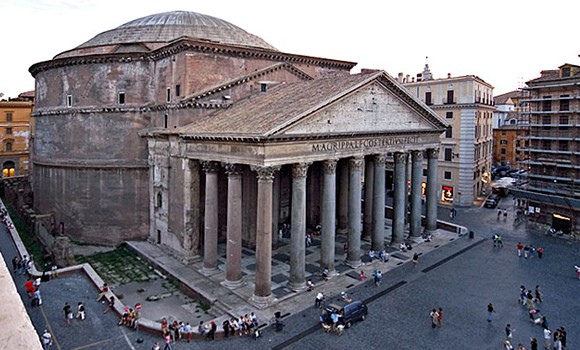
 In his book on Rome Edward Hutton devoted a chapter to the Pantheon.


The continuity of the life, of the political life of the City that is so well expressed by the Capitol is found too, in its religious aspect certainly, in the Pantheon, which since the time of its foundation, has always been sacred to the gods, to the saints, those Dive—Divinities, as both pagans and Christians have agreed to call them. If we need then, a witness to the continuity of the religious life of the City, of the slow and after all so gentle passing of Paganism into Christianity, in the hearts of men, at any rate, with many a strange and beautiful conservation of old things, old customs, old ways of thinking, we shall find it best, perhaps, in the Pantheon, which, sacred once as we may suppose, to the protecting divinities of Caesar, now holds the dust of the last conquerors from Piedmont. … (76)

The Pantheon…remains the most perfect ancient building in Rome, the only one, indeed, whose walls and arches have been completely preserved….built with all the solidity, boldness and splendor of the Roman genius, and remains one of the wonders of the world….The tremendous walls of the rotunda, a perfect circle, are divided into two stories by ring courses, while above them springs the most wonderful thing in Rome, that cupola of concrete, covered over with tiles of gilded bronze, which was once the greatest dome in the world….(77)


And today the Pantheon is like a sudden revelation, as though in an unexpected moment we had come into a legion of Caesar’s army, or in the quiet sunlight, amid the ruins of the Forum, had heard the persistent voice of Cato in the senate House: Delenda est Carthago... Phocas, the tyrant, in the exile of the gods, presented it to Pope Boniface IV, who on May 13, 609, consecrated it to S. Mary of the Martyrs… (79)

So the Pantheon became S. Maria ad Martyres, and to ensure its sanctity the Pope caused to be buried there twenty-eight wagon loads of the bones of the martyrs brought hither from the catacombs….

Yet it was the Pope himself who did his best to destroy it, for Urban VIII, stole the brazen tubes on which the roof of the vestibule rested, to convert them into the twisted columns of the baldacchino of S. Peter…And if of old it excited the wonder and awe of the City, and in the Middle Age guarded the dust of the Martyrs, certainly then, more precious than silver or gold, in the Renaissance it became the very model of the greatest buildings of that time. The Baptistry of Florence was certainly meant to be as like it as it might be; it inspired the dome of S. Maria del Fiori, and Michelangelo swore to build it, as it were aloft, over S. Peter’s, an oath which he contrived to keep; while it was there that Raphael preferred to lie, with his betrothed beside him and his disciples at his feet, pursuing the dream of beauty, which, as was said, had ravished him from our world. (80)

Raphael's Tomb


###


Edward Hutton: Rome, fourth edition, 1922.

Friday, March 29, 2024

Roman Catacombs

 After the brutality of the Colosseum, and the languor of the Roman baths, Edward Hutton found something very different in the Catacombs.


The Catacombs—the place by the tombs, in which to the curious philologist every symbol of Christianity seems to lie hid, the cup of the Holy Grail, the ship of the Church, was indeed the very cradle of Christianity, of Catholicism, where Love lay helpless, a little child… Born, as it were, in the desert, in the stony silence of Judea, Christianity, by an act of Love, had at once solved the great mystery; it was in itself a denial of Death, of the power of Death, and as though to prove its sincerity, its belief in the hope it alone had dared to offer mankind, it made its first home in the Catacombs, those cemeteries of the dead. They too are our company, it seemed to say, for Death is not death but a sleep; and so it refused to be separated from them, waiting patiently beside their resting place, really in communion with them, who had slept and wakened. The Christian alone in Rome found hope in his heart…. (97)


There in the darkness, lighted only by occasional lumenaria, they celebrated their mysteries, even in the time of the Apostles, the Mass, the Commendatio Animae, the Funeralia, refusing always to speak of the departing brother or sister as dying, but rather as of one summoned or called away, accertitus, as the beautiful Roman inscription has it, assercitus ab angelis—summoned by angels…. (98)


These cemeteries, later to bear the names of Saints, … stretched really for miles outside the Wall on the left bank of the Tiber. And beside them were the gardens—horti—those cemeteries in the open air… these gardens were, however, comparatively few and were too public to be used for worship. It was in the Catacombs, so many of which still remain unexplored, that the Christian Church spent its childhood… (98)


Equanimity, a bold and confident gladness, grave and yet by no means without its more joyful moments, would seem to have been the most striking characteristic of the Catacombs. Expressing itself in many a beautiful or graceful custom accommodated to the human heart…especially in a wonderful new music and poetry… (99)


The Mass indeed would seem to have been said always, even in the Apostolic age, though not as we have it today; … A ritual, altogether expressive and full of meaning—a meaning often obscure to us in its detail at any rate—grew little by little about it in those early times really for the sake of expressing some profound mystery that could only thus be made plain, which it was not lawful to speak. And for the Christians of the Minor Peace certainly, the ritual of the Mass, its action namely, was altogether indicative, not hiding but expressing the very ‘heart of the mystery,’ which for them, as for us was often rather obscured than made plain by the words, then in the Greek language, the people answering in their own vulgar tongue, that colloquial or base Latin into which, though without any more popular success, the whole of the Liturgy had gradually passed… (100)


It was then as a dramatic action, a tragic drama, as we might say, that the Mass from the earliest times presented itself to those who in the subterranean oratories of the Catacombs were gathered together not merely in a common act of worship to hear the words of life, to be made partakers with Christ of the Kingdom of Heaven, but chiefly to remind themselves of the great deliverance won for them by that mournful and heroic Figure who passed before them in the words of the drama, the actions of the priest, from birth to death, to resurrection, into His Heaven. (102)


And so one’s first impression on entering one of these catacombs today is altogether of serenity and peace; a kind of ecstatic happiness, temperate and still fresh with a hope that has never quite passed away. On the walls one reads words of quiet expectation, full of light, confidence, and repose; Pax, you read, Pax tibi, in Pace Christi or Vivas in Deo; and then sometimes as though to sum up all contentment, Vivas in Christo, in Bono. And the scenes painted there are serene and glad. In those days at any rate they do not seem to have been very preoccupied with the Crucifixion, the death of Christ; they thought only of the resurrection. A certain Latin sanity and quietness are expressed in the work we find there; and indeed there is no hatred or contempt at all of Pagan thought or religion, not even a complete repudiation of it, for it remains, yes, a real thing, seen with new eyes as we might say, seen really for the first time, and drawn gently into the service of Christ, so that Orpheus becomes as it were but a prophecy of Him there in S. Calisto, and the Good Shepherd bears the lamb on his shoulders precisely as Hermes had been wont to do, but with a new tenderness….(105)


It was indeed a new ‘state of soul,’ really a new morality that one came upon suddenly in these dark obscure ways…Side by side they lay down to sleep, the rich beside the poor, the bond by the free, all whom Christ had made equal, to await in perfect confidence the promised resurrection. (106)


Edward Hutton: Rome, fourth edition, 1922.


###