Search This Blog

Showing posts with label Gozzoli. Show all posts

Friday, August 14, 2026

Montefalco and Benozzo Gozzoli


Montefalco is noted for its spectacular views of the surrounding countryside, as well as for its fine wines, but Edward Hutton visited the mountain of falcons to view the famous fresco cycle of the life of S. Francis by Benozzo Gozzoli.


 So the summer days passed, and when it was too hot in the valley I went up to Montefalco and found there coolness and silence.


The road to Montefalco is beautiful with views of the ever-changing valley and the mountains; and the little city herself stands high on her hill. Her unfrequented streets are still as of old, and she seems to look across the wide valley to Assisi as a daughter towards her mother. It is not Giotto who has clothed her with glory while telling the legend of S. Francis, but Benozzo Gozzoli, the pupil of Fra Angelico, with his simple literalism and delightful sense of the loveliness of such natural things as flowers and animals, who has painted for her the same immortal story—not in vain, for his influence is found again and again in such men as Bonfigli, Niccolo da Foligno, whose work one has learned to care for in Foligno and Assisi, and in Fiorenzo di Lorenzo.  Nor, as it seems to me, did Pintoricchio wholly escape his charm; much of his delight in these natural beauties which crowd his pictures is, it may well be, owing to the work of this Tuscan painter.


 It is in the little church of San Francesco—desecrated now and used as a picture-gallery—in which was once the choir, that we find the frescoes of the life of S. Francis, painted in the middle of the fifteenth century by Benozzo Gozzoli. It is here for the first time almost we come upon the growth, that development into some half-apprehended ideal, which every legend seems to follow. S. Francis was a man so like to Christ as almost to be mistaken for Him; it is therefore certain that he too, like the Prince of Life, was born in a stable. And even as old Simeon and Anna had prophesied of Christ, so a pilgrim tells of S. Francis, and a poor man spreads his coat for the saint to tread on. Thus gradually in the minds of men S. Francis became even in lesser things, a kind of imitation of Jesus of Nazareth….The frescoes continue the life of the saint almost as in the upper church at Assisi, where the traditional works of Giotto were doubtless known to Benozzo Gozzoli. These Montefalco frescoes are particularly interesting as the early work of a man who, brought by Fra Angelico to Rome and Orvieto—where, as here, his work is really an imitation of his master—was later to develop a more individual style, as in the frescoes in the Riccardi chapel, or at San Gimignano, or in his ruined masterpieces at Pisa, where he painted from 1469 to 1487. Here in Montefalco he is strictly the pupil of Fra Angelico. But in that attitude of the scholar to one who was so worthy of his allegiance, it may well be, we find his work really finer than when he had become himself a little master. … In his early work, however, under the influence of Angelico, he, having had a glimpse of heaven, turning to the earth he found it every whit as fair. … He tells the story of S. Francis, here in Montefalco, like a romantic almost, in which the spirit of adventure, the call of the road, the magical persistence of tomorrow blend very happily with the lovely life of the little poor man. Looking on these frescoes… his work is so boyish, as it were, as almost to disarm criticism, and in that very freshness, without ulterior ideas about art, he comes nearer perhaps than Giotto to realizing for us the romantic beauty of S. Francis’s life. He certainly realizes that, and strives to make us realise it as no other painter of the Franciscan legend has been able to do, before the far more exquisite and spiritual work of Sasseta. And so, though for no other cause yet for this, I return to Montefalco again and again.


###


Edward Hutton: Assisi and Umbria Revisited, London, 1953. Pp. 57-58

Friday, March 28, 2025

Florence: Ricciardi Palace and the Medici

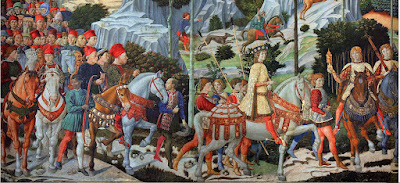
Edward Hutton's discussion of the Medici Ricciardi Palace focussed on the famed chapel where Benozzo Gozzoli depicted the Journey of the Magi. The three Magi are usually depicted as old, middle-aged, and young but Hutton saw that Gozzoli depicted more than the Magi.


It is, however, the palace in the Via Larga that recalls to us most vividly the lives and times of these first Medici, Cosimo Vecchio, Piero the gouty, Lorenzo il Magnifico. Michelozzo, Vasari tells us, deserves infinite credit for this building, since it was the first palace built in Florence after modern rules in which the rooms were arranged with a view to convenience and beauty…. It is not, however, the splendour of the palace, fine as it is, or the memory of Cosimo even that brings us to that beautiful house to-day, but the work of Donatello in the courtyard, those marble medallions copied from eight antique gems, and that little chapel on the second floor, almost an afterthought you might think, since in a place full of splendidly proportioned rooms, it is so cramped and cornered under the staircase, where Benozzo Gozzoli has painted in fresco quite round the walls, the Journey of the Three Kings, in which Cosimo himself, Piero his son, and Lorenzo his grandson, then a golden-haired youth, ride among the rest, in a procession that never finds the manger at Bethlehem, is indeed not concerned with it, but is altogether occupied with its own light-hearted splendour, and the beauty of the fair morning among the Tuscan hills. Is it the pilgrimage of the Magi to the lowly cot of Jesus that we find in that tiny dark chapel, or the journey of man, awake now on the first morning of spring in quest of beauty? Over the grass scattered with flowers, that gay company passes at dawn by little white towns and grey towers, through woods where for a moment is heard the song of some marvellous bird, past running streams, between hedges of pomegranates and clusters of roses; and by the wayside rise the stone-pine and the cypress, while over all is the far blue sky, full of the sun, full of the wind, which is so soft that not a leaf has trembled in the woods, nor the waters stirred in a single ripple. Truly they have come to Tuscany where beauty is, and are far from Bethlehem, where Love lies sleeping. There on a mule, a black slave beside his stirrup, rides Cosimo Pater Patriae, and beside him comes Piero his son, attended too, and before them on a white horse stepping proudly, with jewels in his cap, rides the golden-haired Lorenzo, the youngest of the three kings, already magnificent, the darling of this world of hills and streams, which one day he will sing better than anyone of his time…. And so it is before an empty shrine that those clouds of angels sing; Madonna has fled away, and the children are singing a new song, surely the Trionte of Lorenzo, it is the first time perhaps that we hear—


                Quant’ e’ bella giovinezza.


Ah, if they had known how tragically that day would close.*


###


*Note: Hutton concluded this chapter with Lorenzo’s words from his Memoir. 


“although I, Lorenzo, was very young, in fact only in my twenty-first year, the leading men of the city and of the ruling party came to our house to express their sorrow for our misfortune, and to persuade me to take upon myself the charge of the government of the city as my grandfather and father had already done. This proposal being contrary to the instincts of my age, and entailing great labour and danger, I accepted against my will, and only for the sake of protecting my friends and our own fortunes, for in Florence one can ill live in the possession of wealth without control of the government.” (205)


Edward Hutton: Florence and Northern Tuscany with Genoa, second edition, London, 1908. Pp. 201-202. 

Friday, April 28, 2023

Montefalco


Montefalco is noted for its spectacular views of the surrounding countryside, as well as for its fine wines, but Edward Hutton visited the mountain of falcons to view the famous fresco cycle of the life of S. Francis by Benozzo Gozzoli.


 So the summer days passed, and when it was too hot in the valley I went up to Montefalco and found there coolness and silence.


The road to Montefalco is beautiful with views of the ever-changing valley and the mountains; and the little city herself stands high on her hill. Her unfrequented streets are still as of old, and she seems to look across the wide valley to Assisi as a daughter towards her mother. It is not Giotto who has clothed her with glory while telling the legend of S. Francis, but Benozzo Gozzolli, the pupil of Fra Angelico, with his simple literalism and delightful sense of the loveliness of such natural things as flowers and animals, who has painted for her the same immortal story—not in vain, for his influence is found again and again in such men as Bonfigli, Niccolo da Foligno, whose work one has learned to care for in Foligno and Assisi, and in Fiorenzo di Lorenzo.  Nor, as it seems to me, did Pintoricchio wholly escape his charm; much of his delight in these natural beauties which crowd his pictures is, it may well be, owing to the work of this Tuscan painter.


 It is in the little church of San Francesco—desecrated now and used as a picture-gallery—in which was once the choir, that we find the frescoes of the life of S. Francis, painted in the middle of the fifteenth century by Benozzo Gozzoli. It is here for the first time almost we come upon the growth, that development into some half-apprehended ideal, which every legend seems to follow. S. Francis was a man so like to Christ as almost to be mistaken for Him; it is therefore certain that he too, like the Prince of Life, was born in a stable. And even as old Simeon and Anna had prophesied of Christ, so a pilgrim tells of S. Francis, and a poor man spreads his coat for the saint to tread on. Thus gradually in the minds of men S. Francis became even in lesser things, a kind of imitation of Jesus of Nazareth….The frescoes continue the life of the saint almost as in the upper church at Assisi, where the traditional works of Giotto were doubtless known to Benozzo Gozzoli. These Montefalco frescoes are particularly interesting as the early work of a man who, brought by Fra Angelico to Rome and Orvieto—where, as here, his work is really an imitation of his master—was later to develop a more individual style, as in the frescoes in the Riccardi chapel, or at San Gimignano, or in his ruined masterpieces at Pisa, where he painted from 1469 to 1487. Here in Montefalco he is strictly the pupil of Fra Angelico. But in that attitude of the scholar to one who was so worthy of his allegiance, it may well be, we find his work really finer than when he had become himself a little master. … In his early work, however, under the influence of Angelico, he, having had a glimpse of heaven, turning to the earth he found it every whit as fair. … He tells the story of S. Francis, here in Montefalco, like a romantic almost, in which the spirit of adventure, the call of the road, the magical persistence of tomorrow blend very happily with the lovely life of the little poor man. Looking on these frescoes… his work is so boyish, as it were, as almost to disarm criticism, and in that very freshness, without ulterior ideas about art, he comes nearer perhaps than Giotto to realizing for us the romantic beauty of S. Francis’s life. He certainly realizes that, and strives to make us realise it as no other painter of the Franciscan legend has been able to do, before the far more exquisite and spiritual work of Sasseta. And so, though for no other cause yet for this, I return to Montefalco again and again.


###


Edward Hutton: Assisi and Umbria Revisited, London, 1953. Pp. 57-58
Friday, October 22, 2021

Florence: Ricciardi Palace and Chapel

Edward Hutton's discussion of the Medici Ricciardi Palace focussed on the famed chapel where Benozzo Gozzoli depicted the Journey of the Magi. The three Magi are usually depicted as old, middle-aged, and young and Hutton saw that Gozzoli depicted more than the Magi.


It is, however, the palace in the Via Larga that recalls to us most vividly the lives and times of these first Medici, Cosimo Vecchio, Piero the gouty, Lorenzo il Magnifico. Michelozzo, Vasari tells us, deserves infinite credit for this building, since it was the first palace built in Florence after modern rules in which the rooms were arranged with a view to convenience and beauty…. It is not, however, the splendour of the palace, fine as it is, or the memory of Cosimo even that brings us to that beautiful house to-day, but the work of Donatello in the courtyard, those marble medallions copied from eight antique gems, and that little chapel on the second floor, almost an afterthought you might think, since in a place full of splendidly proportioned rooms, it is so cramped and cornered under the staircase, where Benozzo Gozzoli has painted in fresco quite round the walls, the Journey of the Three Kings, in which Cosimo himself, Piero his soon, and Lorenzo his grandson, then a golden-haired youth, ride among the rest, in a procession that never finds the manger at Bethlehem, is indeed not concerned with it, but is altogether occupied with its own light-hearted splendour, and the beauty of the fair morning among the Tuscan hills. Is it the pilgrimage of the Magi to the lowly cot of Jesus that we find in that tiny dark chapel, or the journey of man, awake now on the first morning of spring in quest of beauty? Over the grass scattered with flowers, that gay company passes at dawn by little white towns and grey towers, through woods where for a moment is heard the song of some marvellous bird, past running streams, between hedges of pomegranates and clusters of roses; and by the wayside rise the stone-pine and the cypress, while over all is the far blue sky, full of the sun, full of the wind, which is so soft that not a leaf has trembled in the woods, nor the waters stirred in a single ripple. Truly they have come to Tuscany where beauty is, and are far from Bethlehem, where Love lies sleeping. There on a mule, a black slave beside his stirrup, rides Cosimo Pater Patriae, and beside him comes Piero his son, attended too, and before them on a white horse stepping proudly, with jewels in his cap, rides the golden-haired Lorenzo, the youngest of the three kings, already magnificent, the darling of this world of hills and streams, which one day he will sing better than anyone of his time…. And so it is before an empty shrine that those clouds of angels sing; Madonna has fled away, and the children are singing a new song, surely the Trionte of Lorenzo, it is the first time perhaps that we hear—


                Quant’ e’ bella giovinezza.


Ah, if they had known how tragically that day would close.*


###


*Note: Hutton concluded this chapter with Lorenzo’s words from his Memoir. 


“although I, Lorenzo, was very young, in fact only in my twenty-first year, the leading men of the city and of the ruling party came to our house to express their sorrow for our misfortune, and to persuade me to take upon myself the charge of the government of the city as my grandfather and father had already done. This proposal being contrary to the instincts of my age, and entailing great labour and danger, I accepted against my will, and only for the sake of protecting my friends and our own fortunes, for in Florence one can ill live in the possession of wealth without control of the government.” (205)


Edward Hutton: Florence and Northern Tuscany with Genoa, second edition, London, 1908. Pp. 201-202.