Search This Blog

Friday, June 26, 2026

Assisi: Church of San Francesco


Edward Hutton began his tour of Assisi in the church of San Francesco.


It is to this great triple church one comes first, by Porta San Francesco and the cloistered Piazza Inferiore, into the cool darkness of the lower church of San Francesco. It seems more like a fortress than a church as you climb the hill, built as it is on arches of stone against the hill-side; and this impression is greater yet if you approach Assisi by the old road from Bastiola. But as you enter the church you seem to have wandered back into the north with its twilight churches, where the sun never shines and they worship God in semi-darkness. And, indeed, it is not till evening that the level light of the setting sun throws a glory over a splendour that in the morning is rather felt than seen.


San Francesco is the grandiose tomb of the little poor man, who should have been buried in the lee of some wood where birds sing and the earth is carpeted with primroses. Begun by Frate Elias in 1228 for the Holy See, immediately after the death of the saint, San Francesco consists of two churches, superimposed one on another, to which a large crypt is now added. The lower church has a cavernous nave, lined with chapels, with an apse, and eastern and western transepts. Beneath this is the crypt, now enlarged, in the midst of which towers the rock to which the tomb of the saint, hidden for seven hundred years, is chained. Above the lower church is the radiant upper church, consisting of nave, apse and wide transept. San Francesco was completed in 1253….


It is here, in the upper and lower churches, perhaps, better than anywhere else in Italy, that the beginnings of Italian art can be studied.


The lower church, one of the most impressive buildings in the world, is precious with the paintings and the glass of the masters of the fourteenth century. It is the irony of fate that the darkness which fills the church should make a sight of all the splendour so difficult….


The Upper Church, in contrast with the Lower Church, is a temple of colour and light. It is as though the one symbolized the humble life of S. Francis on earth, the other his glory in heaven. Of the same form as the Lower Church, save that it has no chapels and no eastern transept, it gives us an idea of space and light and beauty such as we never receive in the Lower Church, where the low roof and the twilight mask the frescoes, the chapels, the colour on wall and ceiling, and even the very church itself, in the sombre, mysterious night of the catacombs. But in the Upper Church all is changed; it seems to glow like some perfect jewel, and almost to illuminate itself rather than to receive light from the sun shining over the world outside. And it is here are preserved some of the most precious early frescoes in Italy. (10)


###


Edward Hutton: Assisi and Umbria Revisited, London, 1953. Pp. 3-4, 10.

Friday, June 19, 2026

Assisi


Edward Hutton published "Assisi and Umbria Revisited" in 1953.  He began his account in the city of St. Francis.


Today there is nothing, can be nothing, in Assisi but the memory  of him who took Lady Poverty to wife. Yet the city we see but little resembles what it was in Francis’s day. What we see is not what he saw, but is, in fact, his creation. The city S. Francis knew had no San Francesco, no Sacro Convento, no Santa Chiara, and no Rocca towering over all. The western hill on which the triple church of San Francesco stands, the Collis Infernis or Collis Inferni, was divided from the city, quite outside which it stood, by a deep ravine which was only finally filled up and the upper and lower piazzas of San Francesco constructed in the sixteenth century. Before that the church was reached by a bridge over the ravine. Perhaps from very far off, from Perugia, for instance, we may have an impression of the city as S. Francis knew it, crouched on the skirts of Subasio. But there are, of course, many buildings within the city which he knew well; the Roman Temple, the great façade of the Duomo, and the churches, Santa Maria Maggiore, San Pietro, San Giacomo within the wall, San Damiano and the Carceri without. And he seems to have loved this, his birthplace, so well that, great traveller though he was, he never wanted to leave it, to go far away from it. The places he loved best were Monte Subasio, Rivotorto, the Portiuncula, San Damiano, the island in Lago Trasimeno, and Assisi itself, which he turned to bless with words of love as they bore him to the Portiuncula to die. Hardly one of these places, however, at all resembles what it was in his day, least of all his best-loved Rivotorto and Santa Maria degli Angeli. It is only the wide landscape that is the same and there is surely a divine harmony between the soul of S. Francis and this landscape of the valley of Spoleto which his early biographers seem instinctively to have understood.


And yet one finds oneself on his account wandering up and down the steep and climbing ways, through street and piazza where he played as a child, where he went gaily as a young man, which presently saw him begging his bread, and echoed alike with the scorn of his fellows and the irresistible words of his preaching. Here is the house, here is the stable, in which he was born; here the font in which he was baptized. Just beyond the walls is San Damiano where the Crucifix spoke to him. Here before Santa Maria Maggiore he stripped himself and repudiated his earthly father, Pietro Bernadone. There is the house of his first companion, Bernard of Quintavalle. And there in the Vescovado he lay till they bore him out of Porta Moiano on his last journey when he turned and blessed the city he loved, but could no longer see, on the way to S. Mary of the Angels, where he was to die. And finally, here in the great triple church dedicated in his honour, on the Collis Inferni, now the Collis Paradisi, we may venerate his dust.


###


Edward Hutton: Assisi and Umbria Revisited, 1953. Pp. 1-3.

Friday, June 12, 2026

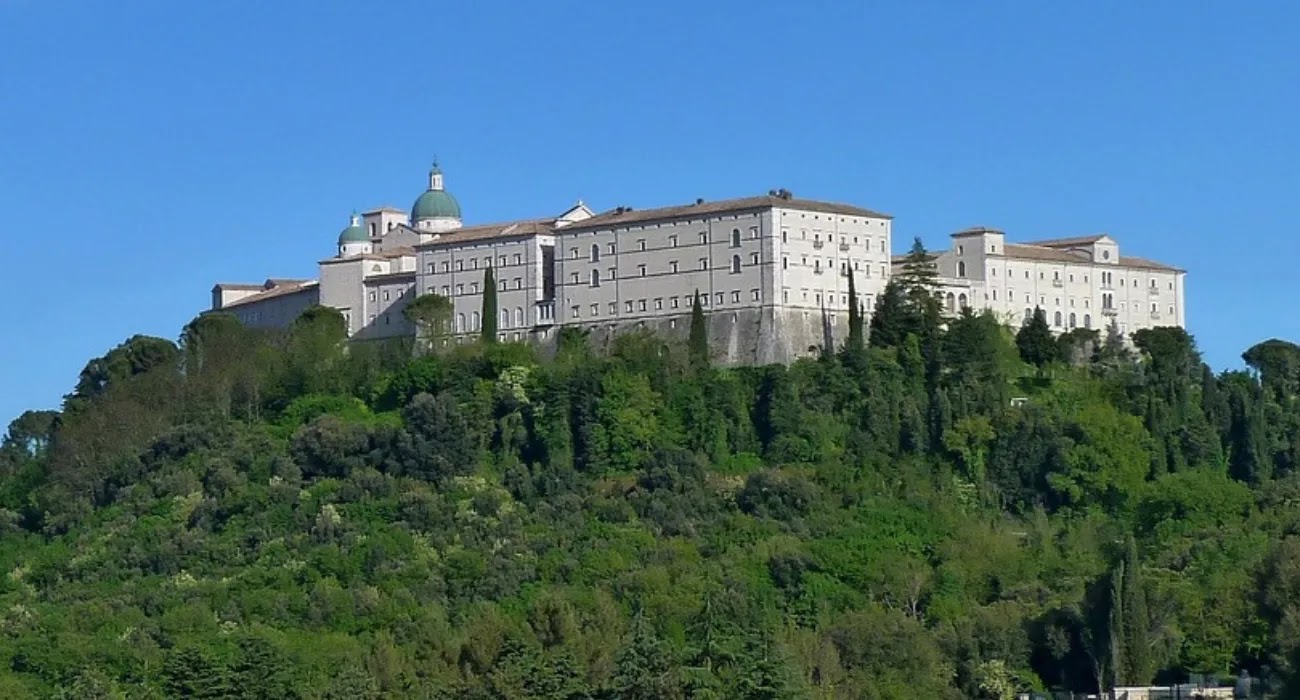
Montecassino


Edward Hutton brought "Naples and Campania Revisited" to an end with visits to three great monasteries, LaCava, Montevergine, and Montecassino. Below is his reflection on Montecassino, including an appendix detailing the destruction caused by the Italian campaign in 1944. During the war Hutton had served with the British army advising on which cultural and historical sites to avoid bombing. Apparently, his advice was not taken on Montecassino. 


Another and a greater abbey than La Cava, the great abbey of Montecassino, the greatest and the most ancient in Europe, stands on a mountain top in Campania Felice, 1.500 feet above the sea, about half way between Naples and Rome. It was the cradle of the Benedictine Order and dates from the first third of the sixth century…. (233)


Such was the abbey as I remembered it, all of which was seemingly swept away by the Allies in 1944. And as I climbed the long hill, crowned as I saw with new buildings, I wondered what I was going to find at the top.


Well, what I found was a reproduction as near as might be of the abbey that was destroyed in 1944. I suppose the monks were so deeply attached  to the destroyed buildings that they could not forgo reproducing them. Yet, though I could well understand this very natural sentimentality, I thought it unfortunate, for there was nothing of any artistic distinction in the buildings that were destroyed….


Every traveller to South Italy should come to Montecassino if only because of the immense influence  it has had in the history of Europe and indeed of mankind. Fourteen hundred years ago and more S. Benedict founded here the cradle of that Order of monks which transformed Europe, cut down its impenetrable forests, drained its impassable marshes, educated its barbarians and made them Christians. It was the monks of S. Benedict who converted the English, supplied the country with statesmen, counsellors and bishops and presently covered England with mighty houses, Glastonbury, Reading, Durham, and the like, to be utterly destroyed by a reckless and unhappy king, yet are now rising again, so that it is today possible to land at Dover, cross the country to the Atlantic, and sleep at a Benedictine monastery every night.


As you lie there on that mountain-side before the abbey newborn, looking over the deep valley where the Liri wanders under Aquino and Pontecorvo and I know not how many other ancient cities groved and garlanded with the ilex, the olive and the vine, where beyond, rises range after range of purple mountain chain, you may think on these things. (239)…


APPENDIX III. SOME OF THE CHURCHES DAMAGED IN CAMPANIA IN THE WAR, 1939-1945.


Perhaps the destruction of Montecassino was the most shocking moral outrage of the war in Italy, Mr. Majdalany points out in his excellent book (Cassino: Portrait of a Battle [1957]} that the Allied Command seems to have been astonished at the difficulties that faced our armies at Cassino, yet the Italian Military College had used Cassino for generations as an example of an impregnable defense barrier. In the tremendous and relentless bombing of the great monastery the Cathedral church was the first to be attacked and destroyed.  What was achieved by the destruction of the famous monastery? According to Mr. Majdalany, who took part in the attack. It “achieved nothing”, but the tenth German Army was able “to establish posts in the Abbey ruins”.


It might seem that the whole Italian campaign was a mistake, misconceived and eventually starved to death. The mere idea of waging modern war up the length of the peninsula through the beautiful cities which hold treasures of architecture, painting and sculpture, the inheritance of mankind, should, I imagine, have given pause to even the most philistine and obsessed political leader. It was, one regrets to recall, an English proposal. The Americans, merely for military reasons, disliked the Italian diversion, and Eisenhower finally brought it to an end by draining it of troops and material for the invasion of Normandy. (275-276)


###


Edward Hutton: Naples and Campania Revisited. London, 1958.Preface. Pp. 235-239, 275-276. 

Friday, June 5, 2026

Paestum


Edward Hutton devoted a chapter to Paestum, its history and its three spectacular, deserted temples: all that is left of an ancient Greek colony that predated the Romans. *


The great spectacle which La Cava or Salerno usually affords the traveller, which for the most part is the reason for a visit to them, is the Greek Temples of Paestum, twenty-four miles to the south of Salerno in the malarious marsh by the low seashore that stretches from Monte Giove on the north to Agropoli on the south. The traveller usually leaves La Cava or Salerno or even Naples in the morning, spends the best part of the day at Paestum, and returns in time for dinner; and this procedure, unsatisfactory as it is, forces one to see those marvellous sanctuaries in the company of a crowd of tourists and in the ugliest hours of the day, but is generally considered necessary on account of the unhealthy and malarious situation of Paestum itself.  Paestum, however, is worth any sort of trouble to see quietly, apart from the crowd, and best of all in the early morning, and therefore one should leave Salerno by automobile so as to get the early morning and if possible the rising sun over the Temples at Paestum, which alas, has been much sophisticated since I first knew it. In the old days I used to go to Eboli and drive from there. Eboli itself, the ancient Eburnum, on the hills to the north-east of the great Pianura di Pesto, I found to be full of interest. This almost unvisited little town boasted a quite possible hostelry in the Albergo Pastore, and from the grand old Castello offered the traveller glorious views of the great mountains and over the forest and the plain to the far-away temples and the sea….


The road from Eboli to Paestum very early in the morning was full of delight. The forest of Persano was of old of much greater extent and beauty than it is today; but in 1746 all the Bosco Grande was destroyed by fire: what remains is a vast ruin of the great forest of the Silarus…


But not the  wild desolation of the plain, nor its silence, nor its shadowy light, prepare one in any way at all for that vision of splendour and sadness which it still guards so well. One enters the gate of the desolate city, and there within the low over grown far-stretched walls of the place, in the immense silence of early morning, in the clear and tender light beside the sea, three temples stand that in their mysterious isolation and tragic beauty are like something wholly divine, at one with the sky and the earth and the sea, from which indeed they come, out of which they were hewn, and in honour of which they still stand, abandoned by man, after centuries of silence, in so great majesty.


Within a walled pentagon, near three miles in circumference, they are alone with the sun, the sea and the wind. What can that city have been like which boasted such sanctuaries as these? It cannot have been less, one might think, than the capital of Magna Graecia, beside which Cuma was a provincial town and Neapolis a village….


The three temples stand within the ruined walls in a rough and stony place, strewn with the debris of other buildings and overgrown with brambles and wild flowers, and among them the newly-planted twice-blossoming roses of which Virgil sings. The two principal temples stand there together in the south, their facades facing the agora, or market-place, the consecrated open space which in coast towns usually lay on the sea side of the city….


When all is said, however, the delight of Paestum lies in its appeal to the eye, in the sheer beauty of these golden buildings shining there in the dawn between the great mountains and the sea, in the midst of the wide plain, deserted and silent, where only the sun and the wind are at home.


### 


Edward Hutton: Naples and Campania Revisited. London, 1958.Preface. Pp. 227-234.


*Note: Look at this image of a diver from a fresco now in the Paestum Museum provided by David Orme from England. What does it tell us about ancient Greece and Rome?