Search This Blog

Showing posts with label Donatello. Show all posts

Friday, June 6, 2025

Florence: Donatello


In his tour of the Bargello, Florence's sculpture gallery, Edward Hutton had high praise for the work of Donatello and its unique contribution to Renaissance sculpture. Donatello's marble David, pictured below, is less famous than his bronze version, but Hutton regarded his St. George as his masterpiece.


Of Donatello’s life we know almost nothing. If we seek to learn something of him, it must be in his works, of which so many remain to us. We know, however, that he was the intimate friend of Brunellesco, and that it was with him he set out for Rome soon after this great and proud man had withdrawn from the contest with Ghiberti for the Baptistery gates. Donatello was to visit Rome again in later life, but on this first journey that he made with Brunellesco for the purpose of study, he must have become acquainted with what was left of antiquity in the Eternal City. It was too soon for that enthusiasm for antiquity, which later overwhelmed Italian art so disastrously, to have arisen. When Donatello returned about a year later to Florence to work for the Opera del Duomo, it is not any classic influence we find in his statues, but rather the study of nature, an extraordinary desire to express not beauty, scarcely ever that, but character. His work is strong, and often splendid, full of energy, movement, and conviction, but save now and then, as in the S. Croce Annunciation, for instance, it is not content with just beauty….(284)
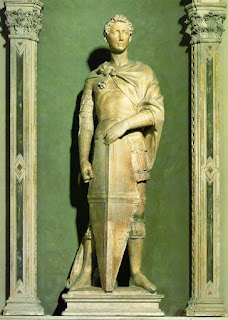

Donatello: St. George


There are some ten works by the master in the Bargello, together with numerous casts of his statues and reliefs in other parts of Italy, so that he may be studied here better than anywhere else. Looking thus on his work more or less as a whole, it is a new influence we seem to divine for the first time in the marble David, a little faintly, perhaps, but obvious enough in the St. George, a Gothic influence that appears very happily for once, in work that almost alone in Italy seems to need just that, well, as an excuse for beauty. That marble statue of David was made at almost the same time as the St. John the Divine, for the Duomo too, where it was to stand within the church in a chapel there in the apse. A little awkward in his half-shy pose, the young David stands over the head of Goliath, uncertain whether to go or stay. It is a failure which passes into the success, the more than success of the St. George,  which is perhaps his masterpiece. Made for the Guild of Armourers, from the first day on which it was set up it has been beloved. Michelangelo loved it well, and Vasari is enthusiastic about it, while Bocchi, writing in 1571, devotes a whole book to it…. With a proud and terrible impetuosity St. George seems about to confront some renowned and famous enemy, that old dragon whom once he slew. Full of confidence and beauty he gazes unafraid… Well may Michelangelo have whispered “March!” as he passed by, it is the very order he awaits, the whisper of his own heart. … 


 So in the bronze David now in the Bargello we seem to see youth itself dreaming after the first victory of all the conquests to come, while a smile of half-conscious delight is passing from the lips; tyranny is dead…. (287)


But here in the Bargello we have enough of his work to enable us to divine something at least of his secret. And this seems to me to have been Donatello’s  intention in the art of sculpture: his figures are like gestures of life, of the soul, sometimes involuntary and full of weariness, sometimes altogether joyful, but always the expression of a mood of the soul which is dumb, that in its agony or delight has in his work expressed  itself by means of the body, so that though he never carves the body for its own sake, or for the sake of beauty, he is as faithful in his study of it for the sake of the truth, as he is in his study of those moods of the soul which through him seem for the first time to have found an utterance. (288)


###


Edward Hutton: Florence and Northern Tuscany with Genoa, second edition, London, 1908. Pp. 284-288.

Friday, April 25, 2025

Florence: Church of S. Lorenzo


After recounting the history and background of the church of S. Lorenzo, “the resting place of the Medici,” Edward Hutton proceeded to the chapels in the transept, and the old sacristy where he found the incomparable work of Donatello.


 Three chapels that flank the aisles have to-day but little interest for us…nothing that will keep us for more than a moment from the chapels of the transept, the work of Desiderio da Settignano, of Verrocchio, and, above all, of Donatello. It is all unaware to the tomb of this the greatest sculptor, and in many ways the most typical artist, Florence ever produced, that we come, when, standing in front of the high altar, we read the inscription on that simple slab of stone which marks the tomb of Cosimo Vecchio; for Donatello lies in the same vault with his great patron. A modern monument in the Martelli chapel, where the beautiful Annunciation by Lippo Lippi hangs under a crucifix by Cellini, in the left transept, commemorates him; but he needs no such reminder here, for about us is his beautiful and unforgettable work: not the two ambones, which he only began on his return from Padua when he was sixty-seven years old…but the work in the old sacristy built in 1421 by Brunellesco. How rough is the modelling in the ambone reliefs, as though really, as Bandinelli has said, the sight of the old sculptor was failing; and yet, in spite of age and the intervention of his pupils, how his genius asserts itself in a certain rhythm and design in these tragic panels, where, under a frieze of dancing putti,--loves or angels I know not,--of bulls and horses, he has carved the Agony in the Garden, Christ before Pilate, and again before Caiaphas, the Crucifixion, the Deposition, in the southern ambone, while in the northern we find the Descent into Hades…the Resurrection and the Ascension, the Maries at the tomb, the Pentecost….


The old sacristy, which is full of him—for indeed all the decorative work seems to be his—is one of the first buildings of the Renaissance, the beautiful work of Filippo Brunelleschi. Covered by a polygonal dome, the altar itself stands under another dome, low and small; and everywhere Donatello has added beauty to beauty, the two friends for once combining to produce a masterpiece. … and it is in these bronze doors that, as it seems to me, you have Donato at his best, full of energy and life, yet never allowing himself for a moment to forget that he was a sculptor, that his material was bronze and had many and various beauties of its own, which it was his business to express. There are two doors, one on each side of the altar, and these doors are made in two parts, and each part is divided into five panels. With a loyalty and apprehension of the fitness of things really beyond praise, Donatello has here tried to do nothing that was outside the realm of sculpture. It was not for him to make the Gates of Paradise, but the gates of a sacristy in S. Lorenzo. His work is in direct descent from the work of the earliest Italian sculptors, a legitimate and very beautiful development of their work, within the confines of an art which was certainly sufficient of itself. Consider, then, the naturalism of that figure who opens his book on his knees so suddenly and with such energy; or again, the exquisite reluctance of him who in the topmost panel turns away from the preaching of the apostle. Certainly here you have work that is simple, sincere, full of life and energy, and is beautiful just because it is perfectly fitting and without affectation.


###


Edward Hutton: Florence and Northern Tuscany with Genoa, second edition, London, 1908. Pp. 242-243.

Friday, January 14, 2022

Florence: Donatello


In his tour of the Bargello, Florence's sculpture gallery, Edward Hutton had high praise for the work of Donatello and its unique contribution to Renaissance sculpture. Donatello's marble David, pictured below, is less famous than his bronze version, but Hutton regarded his St. George as his masterpiece.


Of Donatello’s life we know almost nothing. If we seek to learn something of him, it must be in his works, of which so many remain to us. We know, however, that he was the intimate friend of Brunellesco, and that it was with him he set out for Rome soon after this great and proud man had withdrawn from the contest with Ghiberti for the Baptistery gates. Donatello was to visit Rome again in later life, but on this first journey that he made with Brunellesco for the purpose of study, he must have become acquainted with what was left of antiquity in the Eternal City. It was too soon for that enthusiasm for antiquity, which later overwhelmed Italian art so disastrously, to have arisen. When Donatello returned about a year later to Florence to work for the Opera del Duomo, it is not any classic influence we find in his statues, but rather the study of nature, an extraordinary desire to express not beauty, scarcely ever that, but character. His work is strong, and often splendid, full of energy, movement, and conviction, but save now and then, as in the S. Croce Annunciation, for instance, it is not content with just beauty….(284)


Donatello: St. George


There are some ten works by the master in the Bargello, together with numerous casts of his statues and reliefs in other parts of Italy, so that he may be studied here better than anywhere else. Looking thus on his work more or less as a whole, it is a new influence we seem to divine for the first time in the marble David, a little faintly, perhaps, but obvious enough in the St. George, a Gothic influence that appears very happily for once, in work that almost alone in Italy seems to need just that, well, as an excuse for beauty. That marble statue of David was made at almost the same time as the St. John the Divine, for the Duomo too, where it was to stand within the church in a chapel there in the apse. A little awkward in his half-shy pose, the young David stands over the head of Goliath, uncertain whether to go or stay. It is a failure which passes into the success, the more than success of the St. George,  which is perhaps his masterpiece. Made for the Guild of Armourers, from the first day on which it was set up it has been beloved. Michelangelo loved it well, and Vasari is enthusiastic about it, while Bocchi, writing in 1571, devotes a whole book to it…. With a proud and terrible impetuosity St. George seems about to confront some renowned and famous enemy, that old dragon whom once he slew. Full of confidence and beauty he gazes unafraid… Well may Michelangelo have whispered “March!” as he passed by, it is the very order he awaits, the whisper of his own heart. … 


 So in the bronze David now in the Bargello we seem to see youth itself dreaming after the first victory of all the conquests to come, while a smile of half-conscious delight is passing from the lips; tyranny is dead…. (287)


But here in the Bargello we have enough of his work to enable us to divine something at least of his secret. And this seems to me to have been Donatello’s  intention in the art of sculpture: his figures are like gestures of life, of the soul, sometimes involuntary and full of weariness, sometimes altogether joyful, but always the expression of a mood of the soul which is dumb, that in its agony or delight has in his work expressed  itself by means of the body, so that though he never carves the body for its own sake, or for the sake of beauty, he is as faithful in his study of it for the sake of the truth, as he is in his study of those moods of the soul which through him seem for the first time to have found an utterance. (288)


###


Edward Hutton: Florence and Northern Tuscany with Genoa, second edition, London, 1908. Pp. 284-288.

Friday, November 19, 2021

Florence: S. Lorenzo and Donatello


After recounting the history and background of the church of S. Lorenzo, “the resting place of the Medici,” Edward Hutton proceeded to the chapels in the transept, and the old sacristy where he found the incomparable work of Donatello.


 Three chapels that flank the aisles have to-day but little interest for us…nothing that will keep us for more than a moment from the chapels of the transept, the work of Desiderio da Settignano, of Verrocchio, and, above all, of Donatello. It is all unaware to the tomb of this the greatest sculptor, and in many ways the most typical artist, Florence ever produced, that we come, when, standing in front of the high altar, we read the inscription on that simple slab of stone which marks the tomb of Cosimo Vecchio; for Donatello lies in the same vault with his great patron. A modern monument in the Martelli chapel, where the beautiful Annunciation by Lippo Lippi hangs under a crucifix by Cellini, in the left transept, commemorates him; but he needs no such reminder here, for about us is his beautiful and unforgettable work: not the two ambones, which he only began on his return from Padua when he was sixty-seven years old…but the work in the old sacristy built in 1421 by Brunellesco. How rough is the modelling in the ambone reliefs, as though really, as Bandinelli has said, the sight of the old sculptor was failing; and yet, in spite of age and the intervention of his pupils, how his genius asserts itself in a certain rhythm and design in these tragic panels, where, under a frieze of dancing putti,--loves or angels I know not,--of bulls and horses, he has carved the Agony in the Garden, Christ before Pilate, and again before Caiaphas, the Crucifixion, the Deposition, in the southern ambone, while in the northern we find the Descent into Hades…the Resurrection and the Ascension, the Maries at the tomb, the Pentecost….


The old sacristy, which is full of him—for indeed all the decorative work seems to be his—is one of the first buildings of the Renaissance, the beautiful work of Filippo Brunelleschi. Covered by a polygonal dome, the altar itself stands under another dome, low and small; and everywhere Donatello has added beauty to beauty, the two friends for once combining to produce a masterpiece. … and it is in these bronze doors that, as it seems to me, you have Donato at his best, full of energy and life, yet never allowing himself for a moment to forget that he was a sculptor, that his material was bronze and had many and various beauties of its own, which it was his business to express. There are two doors, one on each side of the altar, and these doors are made in two parts, and each part is divided into five panels. With a loyalty and apprehension of the fitness of things really beyond praise, Donatello has here tried to do nothing that was outside the realm of sculpture. It was not for him to make the Gates of Paradise, but the gates of a sacristy in S. Lorenzo. His work is in direct descent from the work of the earliest Italian sculptors, a legitimate and very beautiful development of their work, within the confines of an art which was certainly sufficient of itself. Consider, then, the naturalism of that figure who opens his book on his knees so suddenly and with such energy; or again, the exquisite reluctance of him who in the topmost panel turns away from the preaching of the apostle. Certainly here you have work that is simple, sincere, full of life and energy, and is beautiful just because it is perfectly fitting and without affectation.


###


Edward Hutton: Florence and Northern Tuscany with Genoa, second edition, London, 1908. Pp. 242-243.

Friday, October 8, 2021

Florence: Museum of the Duomo

More than a hundred years ago Edward Hutton expressed his great chagrin at the fate of Italian devotional works of art  that were stripped from their original sites and stored in museums. Today, they still make up a majority of the world's great art. I can understand his sentiment but since so many churches and monasteries were vandalized or suppressed, I can only be thankful for what we can see in museums today, even if it takes a great deal of imagination to see these masterpieces as their original viewers saw them.


I speak of Donatello elsewhere in this book, but you will find one of his best works among much curious, interesting litter from the Duomo in the Opera del Duomo, the Cathedral Museum in the old Falconieri Palace just behind the apse of the cathedral… It is, however, in a room on the first floor that you will find the great organ lofts, one by Donatello and the other by Luca della Robbia, which I suppose are among the best known works of art in the world. Made for the Cathedral, these galleries for singers seem to be imprisoned in a museum.


The beautiful youths of Luca, the children of Donatello, for all their seeming vigour and joy, sing and dance no more; they are in as evil a case as the Madonnas of the Uffizi, who, in their golden frames behind the glass, under the vulgar, indifferent eyes of the multitude, envy Madonna of the street-corner the love of the lowly. So it is with the beautiful Cantorie made for God’s praise by Donatello and Luca della Robbia. Before the weary eyes of the sight-seer, the cold eyes of the scientific critic, in the horrid silence of the museum, amid so much that is dead… some shadow has fallen upon them, and though they keep still the gesture of joy, they are really dead or sleeping. Is it only sleep? Do they perhaps at night, when all the doors of their prisons are barred and their gaolers are gone, praise God in his Holiness, even in such a hell as this? Who knows? They were made for a world so different, for a time that out of the love of God had seen arise the very beauty of the world, and were glad therefor. Ah, of how many beautiful things have we robbed God in our beggary? We have imprisoned the praise of the artists in the museums that Science may pass by and sneer, we have arranged the saints in order, and Madonna we have carefully hidden under the glass, because now we never dream of God or speak with Him at all. Art is dying, Beauty is become a burden, Nature a thing for science and not for love. They are become too precious, the old immortal things; we must hide them away lest they fade and God take them from us:… 


Thus they have stolen away the silver altar of the Baptistery, that miracle of the fourteenth century silversmiths, Betto di Geri, Leonardo di Ser Giovanni, and the rest, that it may be a cause of wonder in a museum. So a flower looks between the cold pages of a botanist’s album, so a bird sings in his cage: for life is to do that for which we were created, and if that be the praise of God in His sanctuary, to stand impotently by under the gaze of innumerable unbelievers in a museum is to die. And truly that is the shame of Italy that so many fair and lovely things have been torn out of their places to be catalogued in a gallery. It were a thousand times better that they were allowed to fade quietly on the walls of the church where they were born. 


###


Edward Hutton: Florence and Northern Tuscany with Genoa, second edition, London, 1908. Pp. 182-3.