Search This Blog

Showing posts with label Raphael. Show all posts

Friday, July 18, 2025

Florence: Raphael in the Pitti Palace

There was so much to see in the Uffizi gallery that Edward Hutton could do little more, except in the case of Botticelli, than divide the collection into the schools of Florence, Siena, Umbria, and Venice and then offer just a sentence or two to each painting. Even Michelangelo's Doni Tondo, for example, was only described as a "very splendid Holy Family, splendid perhaps rather than beautiful..." But in the Pitti Palace he took notice of its great Raphael collection, and the influence of Florence on the young painter from Umbria.


And it is in this mystical and smiling country, where the light is so soft and tender, softer than on any Tuscan hills, that the most perfect if not the greatest painter of the Renaissance grew up. You may find some memory of that beautiful land of hills and quiet valleys even in his latest work, after he had learned from every master, and summed up, as it were, the whole Renaissance in his achievement. But in the four pictures here in the Pitti, it is the influence of Florence you find imposing itself upon the art of Umbria, transforming it, strengthening it, and suggesting, it may be, the way of advance. Something of the art of Pietro [Perugino] you see in the portraits of Maddalena Doni, Angelo Doni, and La Donna Gravida…It is the influence of Florence we seem to find too in the simplicity of the Madonna del Granduca. Here is a picture certainly in the manner of Perugino, but with something lost, some light, some beatitude, yet with something gained also, if only in a certain measure of restraint, a real simplicity that is foreign to that master.


And then, if we compare it with the Madonna della Sedia, which is said to have been painted on the lid of a wine cask, we shall find, I think, that however many new secrets he may learn Raphael never forgot a lesson. It is Perugino who has taught him to compose so perfectly, that the space, small or large, of the picture itself becomes a means of beauty. How perfectly he has placed Madonna with her little Son, and St. John praying beside them, so that until you begin to take thought you are not aware how difficult that composition must have been, and indeed you never remember how small that tondo really is. How eagerly those easel pictures of Madonna have ben loved, and yet to-day how little they mean to us; some virtue seems to have gone out of them, so that they move us no longer, and we are indeed a little impatient at their fame, and ready to accuse Raphael of I know not what insincerity or dreadful facility.


Yet we have only to look at the portraits to know we are face to face with one of the greatest and most universal of painters. Consider then, La Donna Veleta, or the Pope Julius II, or the Leo X with the two Cardinals, how splendid they are, how absolutely characterized and full of life, life seen in the tranquillity of the artist, who has understood everything, and with whom truth has become beauty. In the Leo X with the Cardinals, Guilio de’ Medici and Lorenzo dei Rossi, how tactfully Raphael has contrived the light and shadow so that the fat heavy face of the Pope is not overemphasized, and you discern perfectly the beauty of the head, the delicacy of the nostrils, the clever, sensual, pathetic, witty mouth. And the hands seem about to move, to be a little tremulous with life, to be on the verge of a gesture, to have only just become motionless on the edge of the book. It is in these portraits that the art of Raphael is at its greatest, becomes universal, achieves, immortality.


 ###


Edward Hutton: Florence and Northern Tuscany with Genoa, second edition, London, 1908. Pp. 340-341.  

Friday, May 10, 2024

Vatican: Sistine Chapel and Stanze della Segnatura

 I agree with Edward Hutton that Michelangelo's work in the Sistine Chapel is difficult to comprehend or take in. It's not just the crowds of tourists but the sheer monumentality is overwhelming. I also prefer the relatively small and intimate Stanze della Segnatura where, despite a room full of people, you are free to linger and explore the four walls at leisure before being swept into the Sistine Chapel.


Above these, supported by marvelous and gigantic images of sybyls, of prophets, of slaves, and athletes, stretches the roof of Michelangelo, that new heaven which is the old earth, beautiful with the life of man, his love which brought disaster and all joy, the wild story of the world, which ends on that vast wall above the altar where he has painted not the Last Judgment, it might seem, but the Resurrection.


This ceiling, so heavy with life that it always seems to crush us under the weight of its tremendous story, was painted for Pope Julius II., the condotierre, between the years 1506 and 1512…. (216)


But this profound and wonderful vision of life by no means decorates the chapel of the Popes; it dwarfs it. The air is so full of shapes that we can see nothing.  In this space… Michelangelo, whose spirit always seems to be brooding over some immense sorrow, has created a tremendous and a terrible crowd of figures, each one of which seems to accuse the Papacy and God Himself of some tragic crime committed upon mankind….  Here we are devoured by insatiable dreams—and how should we answer and satisfy them? (222-223)


Raphael: School of Athens.


But, after all, what strikes us most in this picture dealing so easily and surely with the greatest matters, is its value as just a picture, its decorative value, that is, its marvelously lovely expression, not of any profound or subtle thought but of its own element, a certain spaciousness, confined as we perceive at last, within very narrow material limits, but that seems infinite. It is the very triumph of decorative art, come at last to perfection in one who had been the pupil of Pietro Perugino. The difficulty of such an achievement, greater here by far than in the ‘Disputa.’ For there all heaven lay open to our eyes, is scarcely felt till in an effort to understand what is really consummate in the art of Raphael—and no man has been praised so much for the wrong things—we perceive here his real triumph. That palace or temple, all of earth, full of the measured beauty of the work of man, is not less infinite in its spaciousness after all than the whole circuit of the world, the limitless kingdom, light on light, of the sky. And this is the real triumph of Raphael, not that he has summed up the ancient and the medieval world and expressed them in the terms of the Renaissance, but that into that narrow, cramped room he has brought an infinite beauty. (227)


### 


 Edward Hutton: Rome, fourth edition, 1922.

Friday, April 5, 2024

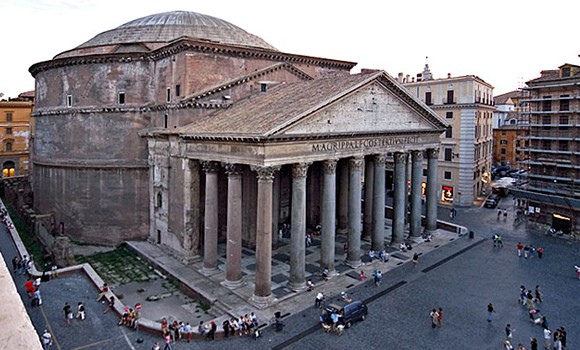
Rome: Pantheon

 In his book on Rome Edward Hutton devoted a chapter to the Pantheon.


The continuity of the life, of the political life of the City that is so well expressed by the Capitol is found too, in its religious aspect certainly, in the Pantheon, which since the time of its foundation, has always been sacred to the gods, to the saints, those Dive—Divinities, as both pagans and Christians have agreed to call them. If we need then, a witness to the continuity of the religious life of the City, of the slow and after all so gentle passing of Paganism into Christianity, in the hearts of men, at any rate, with many a strange and beautiful conservation of old things, old customs, old ways of thinking, we shall find it best, perhaps, in the Pantheon, which, sacred once as we may suppose, to the protecting divinities of Caesar, now holds the dust of the last conquerors from Piedmont. … (76)

The Pantheon…remains the most perfect ancient building in Rome, the only one, indeed, whose walls and arches have been completely preserved….built with all the solidity, boldness and splendor of the Roman genius, and remains one of the wonders of the world….The tremendous walls of the rotunda, a perfect circle, are divided into two stories by ring courses, while above them springs the most wonderful thing in Rome, that cupola of concrete, covered over with tiles of gilded bronze, which was once the greatest dome in the world….(77)


And today the Pantheon is like a sudden revelation, as though in an unexpected moment we had come into a legion of Caesar’s army, or in the quiet sunlight, amid the ruins of the Forum, had heard the persistent voice of Cato in the senate House: Delenda est Carthago... Phocas, the tyrant, in the exile of the gods, presented it to Pope Boniface IV, who on May 13, 609, consecrated it to S. Mary of the Martyrs… (79)

So the Pantheon became S. Maria ad Martyres, and to ensure its sanctity the Pope caused to be buried there twenty-eight wagon loads of the bones of the martyrs brought hither from the catacombs….

Yet it was the Pope himself who did his best to destroy it, for Urban VIII, stole the brazen tubes on which the roof of the vestibule rested, to convert them into the twisted columns of the baldacchino of S. Peter…And if of old it excited the wonder and awe of the City, and in the Middle Age guarded the dust of the Martyrs, certainly then, more precious than silver or gold, in the Renaissance it became the very model of the greatest buildings of that time. The Baptistry of Florence was certainly meant to be as like it as it might be; it inspired the dome of S. Maria del Fiori, and Michelangelo swore to build it, as it were aloft, over S. Peter’s, an oath which he contrived to keep; while it was there that Raphael preferred to lie, with his betrothed beside him and his disciples at his feet, pursuing the dream of beauty, which, as was said, had ravished him from our world. (80)

Raphael's Tomb


###


Edward Hutton: Rome, fourth edition, 1922.

Friday, December 15, 2023

Bologna: Accademia and Museo Civico

 Edward Hutton's art sympathies were with the pre-Raphaelites, as evidenced by his appraisal of Raphael's St. Cecilia. Below are highlights from his tour of Bologna's Accademia and Museo Civico.


Of the school of Bologna, the school painting that is native to the city…there can be nothing to say, for until very late times there was no tradition of art peculiar to Bologna, which for the most part leant almost entirely upon Ferrara…We therefore learn without surprise that in the second half of the fifteenth century the Ferrarese Francesco Costa established himself here in Bologna and was followed in 1483 by his countryman Lorenzo Costa. It was from them that the first Bolognese painter to show any sign of genius learnt his art. This man was Francesco di Maria Raibolini, whom all the world knows as Francia. ...
 
Francia
Bologna is rich in his work, the Accademia possessing no less than nine of his works… the too refined and eclectic art of Francia cannot recompense us for the fact that the unself-conscious art of the fourteenth century and early fifteenth century is not to be had in Bologna.
Raphael: St. Cecilia

Through Timoteo Viti, who was, after Giovanni Santi Raphael’s first master, we reach Raphael, by whom there is here the famous S. Cecilia, from the church of S. Giovanni in Monto, where it adorned the altar dedicated in honour of Beata Cecilia Duglioli. There, as we know, S. Cecilia stands in the midst, a small organ reversed in her hands, her eyes lifted to heaven, her own music quite put out by the songs she heard of the angels. About her stand S. John, S. Augustine, and S. Paul and S. Mary Magdalen. The picture has suffered greatly, and we are not sure how much of it was even due to Raphael himself, and this, I suppose, must excuse our disappointment in it. Indeed we turn from it with a real eagerness to that Madonna and Child in Glory with S. Michael, S. John, S. Catherine, and S. Apollonia by Perugino which hangs in this same room, and curiously enough was painted for the same church, but in 1498, whereas Raphael’s picture is, I think, of 1516….

Perugino

The excellent Museo Civico is not so disappointing as the Academia, for it does not promise so much. It contains too, what I should suppose is one of the finest collections of Etruscan antiquities in existence, but, for me it holds but two things of real delight, I mean the two reliefs of Jacopo della Quercia, the first a relief of the Birth of the Virgin in Sala xv, the other a relief of the Madonna and child in Sala xvi. For these in their beauty no words are good enough, nor may one ever really forget them. 
Jacopo della Quercia
###
Edward Hutton: The Cities of Romagna and the Marches, NY, 1925. Pp. 86-88.

Friday, October 7, 2022

Crema


Edward Hutton described Crema as "a little place, no one goes there" even though it was easy to go from Cremona there and back by train in a day. He gave a brief description of the Cathedral, "no church more beautiful in all Lombardy," but devoted more attention to a church outside the walls.*


When one does pluck up courage to leave Cremona at last, to forgo quietness for the noise of the railway, and the sunshine and delight of that exquisite town for the chances of travel, it must, of course, be for Crema that one sets out—Crema that has almost no history worth knowing, but remains one of the dearest and most hidden places in all this wide and beautiful Lombard country.


I often wonder now I am set down to write about Lombardy, as I did when I made my way along the Lombard roads, whether we who go our ways up and down from city to city, from church to church, from one building to another, ever really are aware how beautiful a countryside Lombardy is under its wide incomparable sky, half lost in its own vastness…. But Lombardy is hard to see, difficult to find out and impossible to possess oneself of, without much fatigue, weariness, mud and dust. The roads are all endless there, the cities always far away, and often when they are but market towns, worse than nothing—places from which one hurries away in the first train that comes by, places that one tries to forget…. But the country: I think, indeed, no one ever sees that in the great plain. It is too big, too vague, to empty to allure us from the security and curiosity of the towns; yet it is a background full of peace to all those peaceful and lovely places: Cremona in the green meadows, Mantua amid the quietness of the lagoons, and last but not least Crema, where the white oxen gather in the streets at evening, drawing their great creaking carts laden with all the wealth of the purple vintage that shall presently, by the winepress, stain the streets and perfume the whole city. …


If there is little for the mere tourist in the streets of Crema…there is undoubtedly a church without her walls that will astonish him. I mean the round church of S. Maria della Croce, which is rather polygonal than round after all, and built of brick in the true Renaissance manner, and reminds one of nothing so much as of that heavenly building Raphael saw in the background of his picture in the Brera. It is a work by Giovanni Battagio of Lodi, a disciple of Bramante’s. I say it reminds one of nothing so much as of Raphael’s there in his picture of the Sposalizio. Well, it has just the tranquillity, the lightness, and the graceful dignity of that visionary building and it stands under its clustered domes and cupolas really like something in a dream, something not made with hands, that would actually be impossible  in any other land but this. And if it be true, as Pater has told us, that “all art aspires toward the condition of music,” here, I think, for once it has been completely successful. For it is as though suddenly as we listened. Some Magnificat by Palestrina or Marenzio had taken visible shape and “materialized itself,” as we say, before our eyes in a temple not made with hands, in which it might please the Queen of the angels a little to abide our coming.


Raphael: Sposalizio. Brera, Milan


###


*There is no church more beautiful in all Lombardy than the cathedral of Crema…it is a thing to love and be proud of , and the people of Crema justly hold it high in their affections, for it is not only beautiful and full of daring, it is also unique: there is nothing like it in all the world.


Edward Hutton: The Cities of Lombardy, New York, 1912. Pp. 234-237.

Friday, July 29, 2022

Milan: Brera Gallery


Edward Hutton believed that Milan produced no school of painting but that its art galleries, especially the Brera, contained many fine works from all over Italy. He provided brief listings of the holdings in the Brera's rooms. Below find some highlights from his account.


But happily for the traveller, the works of the North Italian schools by no means fill the Brera and the other public galleries of Milan. Many a masterpiece is to be found there of the true Italian schools, as well as a few pictures from the North, and to these we shall now turn our attention.


We pass at once to a painter, Borgognone (1450-1523), Foppa’s pupil a man excellent as an artist and full of subtle harmonies in his landscape, and yet not without a strength and almost country roughness found in his figures.


Borgognones work in Milan is extraordinarily plentiful…. Little by little, I think as we get to know him better, the study of his work becomes a study of backgrounds. These delicate and delightful little scenes he would paint perhaps from real life or from a wonderful memory of some glimpse he had had of a city street, or the reach of a canal, or a byway in the country, and his certainty of vision as of touch in these things is magical and beyond praise, something that Mr. Berenson compares with Whistler. 


But with Borgognone the school of Milan, if it can be said ever to have existed, comes suddenly to an end. Bramante appears, and after Bramante Leonardo. They were only not an utter disaster for Milan because there was really nothing to destroy. The native artistic genius that they might have killed had never existed, and their schools consist, as we might suppose, of copyists and prettifiers… (122)


A whole room is given over to the Late Bolognese masters, but these will not detain us, though our fathers would have spent much time there. We turn with a real eagerness that they would have failed to understand to the pictures of Gentile da Fabriano, Piero della Francesca, Luca Signorelli, Giovanni Santi, Benozzo Gozzoli and, once more at one with our ancestors, Raphael….


We come into the real Umbrian indeed with the work of Giovanni Santi, the father of Raphael, who has here a charming picture of the Annunciation; and to the most perfect expression of that school in the glorious picture by Raphael, one of his few really successful subject panels in the Sposalizio. It is a priceless treasure that cannot be matched, but it is so well known that to describe it would be absurd.


Two works, at any rate, by Northern masters, the great and beautiful Rembrandt, so rare a thing in Italy, a portrait of his sister, an early work, and the portrait of the Princess Amalie by Vandyck, should not be missed. While our eyes rest upon the Rembrandt all Milan seems to be nothing but make-believe, and all but three of the works here in the Brera, the merest pretence. The great Dutchman comes among these Italians even in Milan, like an emperor, and it is they who seem to be as strangers. [126-127]


 ###


Edward Hutton: The Cities of Lombardy, New York, 1912. Pp. 122-127. 

Friday, February 25, 2022

Florence: Raphael in the Pitti Palace

There was so much to see in the Uffizi gallery that Edward Hutton could do little more, except in the case of Botticelli, than divide the collection into the schools of Florence, Siena, Umbria, and Venice and then offer just a sentence or two to each painting. Even Michelangelo's Doni Tondo, for example, was only described as a "very splendid Holy Family, splendid perhaps rather than beautiful..." But in the Pitti Palace he took notice of its great Raphael collection, and the influence of Florence on the young painter from Umbria.


And it is in this mystical and smiling country, where the light is so soft and tender, softer than on any Tuscan hills, that the most perfect if not the greatest painter of the Renaissance grew up. You may find some memory of that beautiful land of hills and quiet valleys even in his latest work, after he had learned from every master, and summed up, as it were, the whole Renaissance in his achievement. But in the four pictures here in the Pitti, it is the influence of Florence you find imposing itself upon the art of Umbria, transforming it, strengthening it, and suggesting, it may be, the way of advance. Something of the art of Pietro [Perugino] you see in the portraits of Maddalena Doni, Angelo Doni, and La Donna Gravida…It is the influence of Florence we seem to find too in the simplicity of the Madonna del Granduca. Here is a picture certainly in the manner of Perugino, but with something lost, some light, some beatitude, yet with something gained also, if only in a certain measure of restraint, a real simplicity that is foreign to that master.


And then, if we compare it with the Madonna della Sedia, which is said to have been painted on the lid of a wine cask, we shall find, I think, that however many new secrets he may learn Raphael never forgot a lesson. It is Perugino who has taught him to compose so perfectly, that the space, small or large, of the picture itself becomes a means of beauty. How perfectly he has placed Madonna with her little Son, and St. John praying beside them, so that until you begin to take thought you are not aware how difficult that composition must have been, and indeed you never remember how small that tondo really is. How eagerly those easel pictures of Madonna have ben loved, and yet to-day how little they mean to us; some virtue seems to have gone out of them, so that they move us no longer, and we are indeed a little impatient at their fame, and ready to accuse Raphael of I know not what insincerity or dreadful facility.


Yet we have only to look at the portraits to know we are face to face with one of the greatest and most universal of painters. Consider then, La Donna Veleta, or the Pope Julius II, or the Leo X with the two Cardinals, how splendid they are, how absolutely characterized and full of life, life seen in the tranquillity of the artist, who has understood everything, and with whom truth has become beauty. In the Leo X with the Cardinals, Guilio de’ Medici and Lorenzo dei Rossi, how tactfully Raphael has contrived the light and shadow so that the fat heavy face of the Pope is not overemphasized, and you discern perfectly the beauty of the head, the delicacy of the nostrils, the clever, sensual, pathetic, witty mouth. And the hands seem about to move, to be a little tremulous with life, to be on the verge of a gesture, to have only just become motionless on the edge of the book. It is in these portraits that the art of Raphael is at its greatest, becomes universal, achieves, immortality.


 ###


Edward Hutton: Florence and Northern Tuscany with Genoa, second edition, London, 1908. Pp. 340-341. 

Friday, October 16, 2020

Vatican: Sistine Chapel and Stanze della Segnatura

I agree with Edward Hutton that Michelangelo's work in the Sistine Chapel is difficult to comprehend or take in. It's not just the crowds of tourists but the sheer monumentality is overwhelming. I also prefer the relatively small and intimate Stanze della Segnatura where, despite a room full of people, you are free to linger and explore the four walls at leisure before being swept into the Sistine Chapel.


Above these, supported by marvelous and gigantic images of sybyls, of prophets, of slaves, and athletes, stretches the roof of Michelangelo, that new heaven which is the old earth, beautiful with the life of man, his love which brought disaster and all joy, the wild story of the world, which ends on that vast wall above the altar where he has painted not the Last Judgment, it might seem, but the Resurrection.


This ceiling, so heavy with life that it always seems to crush us under the weight of its tremendous story, was painted for Pope Julius II., the condotierre, between the years 1506 and 1512…. (216)


But this profound and wonderful vision of life by no means decorates the chapel of the Popes; it dwarfs it. The air is so full of shapes that we can see nothing.  In this space… Michelangelo, whose spirit always seems to be brooding over some immense sorrow, has created a tremendous and a terrible crowd of figures, each one of which seems to accuse the Papacy and God Himself of some tragic crime committed upon mankind….  Here we are devoured by insatiable dreams—and how should we answer and satisfy them? (222-223)


Raphael: School of Athens.


But, after all, what strikes us most in this picture dealing so easily and surely with the greatest matters, is its value as just a picture, its decorative value, that is, its marvelously lovely expression, not of any profound or subtle thought but of its own element, a certain spaciousness, confined as we perceive at last, within very narrow material limits, but that seems infinite. It is the very triumph of decorative art, come at last to perfection in one who had been the pupil of Pietro Perugino. The difficulty of such an achievement, greater here by far than in the ‘Disputa.’ For there all heaven lay open to our eyes, is scarcely felt till in an effort to understand what is really consummate in the art of Raphael—and no man has been praised so much for the wrong things—we perceive here his real triumph. That palace or temple, all of earth, full of the measured beauty of the work of man, is not less infinite in its spaciousness after all than the whole circuit of the world, the limitless kingdom, light on light, of the sky. And this is the real triumph of Raphael, not that he has summed up the ancient and the medieval world and expressed them in the terms of the Renaissance, but that into that narrow, cramped room he has brought an infinite beauty.
(227)


### 


 Edward Hutton: Rome, fourth edition, 1922.

Friday, May 29, 2020

Bologna: Accademia and Museo Civico

Edward Hutton's art sympathies were with the pre-Raphaelites, as evidenced by his appraisal of Raphael's St. Cecilia. Below are highlights from his tour of Bologna's Accademia and Museo Civico.

Of the school of Bologna, the school painting that is native to the city…there can be nothing to say, for until very late times there was no tradition of art peculiar to Bologna, which for the most part leant almost entirely upon Ferrara…We therefore learn without surprise that in the second half of the fifteenth century the Ferrarese Francesco Costa established himself here in Bologna and was followed in 1483 by his countryman Lorenzo Costa. It was from them that the first Bolognese painter to show any sign of genius learnt his art. This man was Francesco di Maria Raibolini, whom all the world knows as Francia. ...
 
Francia
Bologna is rich in his work, the Accademia possessing no less than nine of his works… the too refined and eclectic art of Francia cannot recompense us for the fact that the unself-conscious art of the fourteenth century and early fifteenth century is not to be had in Bologna.
Raphael: St. Cecilia
Through Timoteo Viti, who was, after Giovanni Santi Raphael’s first master, we reach Raphael, by whom there is here the famous S. Cecilia, from the church of S. Giovanni in Monto, where it adorned the altar dedicated in honour of Beata Cecilia Duglioli. There, as we know, S. Cecilia stands in the midst, a small organ reversed in her hands, her eyes lifted to heaven, her own music quite put out by the songs she heard of the angels. About her stand S. John, S. Augustine, and S. Paul and S. Mary Magdalen. The picture has suffered greatly, and we are not sure how much of it was even due to Raphael himself, and this, I suppose, must excuse our disappointment in it. Indeed we turn from it with a real eagerness to that Madonna and Child in Glory with S. Michael, S. John, S. Catherine, and S. Apollonia by Perugino which hangs in this same room, and curiously enough was painted for the same church, but in 1498, whereas Raphael’s picture is, I think, of 1516….
Perugino

The excellent Museo Civico is not so disappointing as the Academia, for it does not promise so much. It contains too, what I should suppose is one of the finest collections of Etruscan antiquities in existence, but, for me it holds but two things of real delight, I mean the two reliefs of Jacopo della Quercia, the first a relief of the Birth of the Virgin in Sala xv, the other a relief of the Madonna and child in Sala xvi. For these in their beauty no words are good enough, nor may one ever really forget them. 
Jacopo della Quercia
###
Edward Hutton: The Cities of Romagna and the Marches, NY, 1925. Pp. 86-88.