Search This Blog

Friday, June 13, 2025

Florence: Verrocchio

Edward Hutton regarded Andrea Verrocchio as "one of the greatest of all Italian masters of the Renaissance." Sadly, Verrocchio has been eclipsed by his student Leonardo da Vinci. For example, the famous Annunciation in the Uffizi is generally credited to the young Leonardo although it was done in the Verrocchio studio.*  In the Bargello, Hutton found two outstanding examples of Verrocchio's work as a sculptor.
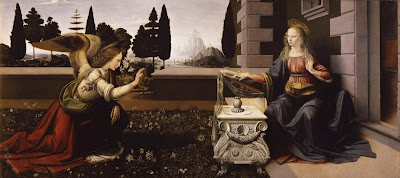


It is, however, in the work of another goldsmith—or at least the pupil of one, whose name he took—that we find the greatest master of the new age, Andrea Verrocchio. Born in 1435, and dead in 1488, he was preoccupied all his life with the fierce splendour of his art, the sublime sweetness that he drew from the strength of his work. The master, certainly, of Lorenzo di Credi and Leonardo, and finally of Perugino also, he was a painter as well as a sculptor; and though his greatest work was achieved in marble and bronze, one cannot lightly pass by the Annunciation of the Uffizi, or the Baptism of the Accademia. Neglected for so long, he is at last recognized as one of the greatest of all Italian masters of the Renaissance. …


More perfect in craftsmanship and in the knowledge of anatomy than Donatello, Verrocchio here, where he seems almost to have been inspired by the David of his master, surpassed him in energy and beauty, and while Donatello’s figure  is involved with the head of Goliath, so that the feet are lost in the massive and almost shapeless bronze, Verrocchio’s David stands clear of the grim and monstrous thing at his feet. Simpler, too, and less uncertain is the whole pose of the figure, who is in no doubt of himself, and in his heart he has already “slain his thousands.”


In the portrait of Monna Vanna degli Albizi, the Lady with the Nosegay, Verrocchio is the author of the most beautiful bust of the Renaissance. She fills the room with sunshine, and all day long she seems to whisper some beloved name. A smile seems ever about to pass over her face under her clustering hair, and she has folded her beautiful hands on her bosom, as though she were afraid of her beauty and would live ever in their shadow.


In two reliefs of Madonna and child, one in marble and one in terra-cotta, you find that strange smile again, not, as with Leonardo, some radiance of the soul visible for a moment on the lips, but the smile of a mother happy with her little son. In the two Tornabuoni reliefs that we find here too in the Bargello, it is not Verrocchio’s hand that we see; but in the group of Christ and St. Thomas at Or San Michele, and in the fierce and splendid equestrian statue of Bartolomeo Colleoni at Venice, you see him at his best, occupied with a subtle beauty long sought out, and with an expression of the fierce ardour and passion that consumed him all his life. If he makes only a leaf of bronze for a tomb, it seems to quiver under his hands with an inextinguishable vitality.


###


*Today the Uffizi credits the Annunciation to Leonardo but after a Verrocchio prototype. 


Edward Hutton: Florence and Northern Tuscany with Genoa, second edition, London, 1908. Pp. 292-293 

Friday, June 6, 2025

Florence: Donatello


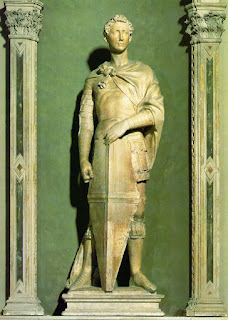
In his tour of the Bargello, Florence's sculpture gallery, Edward Hutton had high praise for the work of Donatello and its unique contribution to Renaissance sculpture. Donatello's marble David, pictured below, is less famous than his bronze version, but Hutton regarded his St. George as his masterpiece.


Of Donatello’s life we know almost nothing. If we seek to learn something of him, it must be in his works, of which so many remain to us. We know, however, that he was the intimate friend of Brunellesco, and that it was with him he set out for Rome soon after this great and proud man had withdrawn from the contest with Ghiberti for the Baptistery gates. Donatello was to visit Rome again in later life, but on this first journey that he made with Brunellesco for the purpose of study, he must have become acquainted with what was left of antiquity in the Eternal City. It was too soon for that enthusiasm for antiquity, which later overwhelmed Italian art so disastrously, to have arisen. When Donatello returned about a year later to Florence to work for the Opera del Duomo, it is not any classic influence we find in his statues, but rather the study of nature, an extraordinary desire to express not beauty, scarcely ever that, but character. His work is strong, and often splendid, full of energy, movement, and conviction, but save now and then, as in the S. Croce Annunciation, for instance, it is not content with just beauty….(284)


Donatello: St. George


There are some ten works by the master in the Bargello, together with numerous casts of his statues and reliefs in other parts of Italy, so that he may be studied here better than anywhere else. Looking thus on his work more or less as a whole, it is a new influence we seem to divine for the first time in the marble David, a little faintly, perhaps, but obvious enough in the St. George, a Gothic influence that appears very happily for once, in work that almost alone in Italy seems to need just that, well, as an excuse for beauty. That marble statue of David was made at almost the same time as the St. John the Divine, for the Duomo too, where it was to stand within the church in a chapel there in the apse. A little awkward in his half-shy pose, the young David stands over the head of Goliath, uncertain whether to go or stay. It is a failure which passes into the success, the more than success of the St. George,  which is perhaps his masterpiece. Made for the Guild of Armourers, from the first day on which it was set up it has been beloved. Michelangelo loved it well, and Vasari is enthusiastic about it, while Bocchi, writing in 1571, devotes a whole book to it…. With a proud and terrible impetuosity St. George seems about to confront some renowned and famous enemy, that old dragon whom once he slew. Full of confidence and beauty he gazes unafraid… Well may Michelangelo have whispered “March!” as he passed by, it is the very order he awaits, the whisper of his own heart. … 


 So in the bronze David now in the Bargello we seem to see youth itself dreaming after the first victory of all the conquests to come, while a smile of half-conscious delight is passing from the lips; tyranny is dead…. (287)


But here in the Bargello we have enough of his work to enable us to divine something at least of his secret. And this seems to me to have been Donatello’s  intention in the art of sculpture: his figures are like gestures of life, of the soul, sometimes involuntary and full of weariness, sometimes altogether joyful, but always the expression of a mood of the soul which is dumb, that in its agony or delight has in his work expressed  itself by means of the body, so that though he never carves the body for its own sake, or for the sake of beauty, he is as faithful in his study of it for the sake of the truth, as he is in his study of those moods of the soul which through him seem for the first time to have found an utterance. (288)


###


Edward Hutton: Florence and Northern Tuscany with Genoa, second edition, London, 1908. Pp. 284-288.

Friday, May 30, 2025

Florence: Bargello

Before entering the Bargello, Florence's museum of sculpture, Hutton reflected on what his own age had lost. Writing in 1908 he could hardly have imagined the catastrophe that would ensue six years later with the First World War.


Often as I wander through these rooms or loiter in the shadow under the cloisters of the beautiful courtyard, perhaps the most lovely court in Tuscany, the remembrance of that old fierce life which desired beauty so passionately and was so eager for every superiority, comes to me, but I ask myself how the dream which that world pursued with so much simplicity and enthusiasm can have led us  at last to the world of today, with its orderly disorder, its trams and telegraphs and steam engines, its material comfort which how strangely, we have mistaken for civilization. In all London there is no palace so fine as this old prison, nor a square so beautiful as Piazza della Signoria…. Our craftsmen have become machine minders, our people, on the verge of starvation, as we admit,  without order, with restraint, without the discipline of service, having lost the desire of beauty or splendour, have become serfs because they are ignorant and fear to die.  And it is we who have claimed half the world  and thrust upon it an all but universal domination. In thus bringing mankind under our rule, it is ever of our civilization that we boast, that immense barbarism which in its brutality and materialism first tried to destroy the Latin Church and then the Latin world, which alone could have saved us from ourselves. … and today, half dead with our own smoke, herded together like wild beasts, slaves of our own inventions, ah, blinded by our unthinkable folly, before the statues that they made, before the pictures that they painted, before the palaces that they built, in the churches where they still pray, stupefied by our own stupidity, brutalized by our own barbarism, we boast of a civilization that has already made us ridiculous, and of which we shall surely die. Here in the Bargello, the ancient palace of the Podesta of a Latin city, let us be silent and forget our madness before the statues of the Gods, the images of the great and beautiful people of old…. [277]


The panels of the Sacrifice of Isaac submitted by Brunelleschi and Ghiberti in the famous early fifteenth century contest to win the commission for the Baptistry doors are preserved in the Bargello. Here is Hutton's comparison. [click on image to enlarge] 


Looking on those two panels where both artists have carved the Sacrifice of Isaac, you see Ghiberti at his best, the whole interest not divided, as it is in Brunellesco’s panel, between the servants and the sacrifice, but concentrated altogether on the scene which is about to become so tragical. Yet with what energy Brunellesco had conceived an act that in his hands  seems really to have happened. How swiftly the angel has seized the hand of Abraham; how splendidly he stands, the old man who is about to kill his only son for the love of God. And then consider the beauty of Isaac, that naked body which in Brunellesco’s hands is splendid with life, really living and noble, with a truth and loveliness far in advance of the art of his time. Ghiberti has felt none of the joy of a creation such as this; his Isaac is sleepy, a little surprised and altogether docile; he has not sprung up from his knees as in Brunellesco’s panel, but looks up at the angel as though he had never understood that his very life was at stake. Yet it was in those gates which, Brunellesco, as it is said, retiring from the contest, the Opera then gave into his hands, that we shall find the best work of Ghiberti….All the rest of his work seems to me lacking in conviction, to be frankly almost an experiment….It was not to the disciples of Ghiberti that the future belonged, but to those who have studied with Brunellesco. His crucifix in S. Maria Novella, his Evangelists in the Pazzi chapel, are among the finest work of that age, full of life and remembrance of it in their strength and beauty. [282-3]


###


Edward Hutton: Florence and Northern Tuscany with Genoa, second edition, London, 1908. Pp. 277-283. 

Friday, May 23, 2025

Florence: Hill of Gardens and S. Miniato

 After crossing the Arno, Edward Hutton climbed the lovely Hill of Gardens, and then came to the ancient church of S. Miniato where he paused to describe a beautiful tomb.


 Then, turning into Via Romana, you come, past the gardens of S. Piero in Gattolino. To the Porta Romano, the great gate of the Via Romana, the way to Rome, and before you is the Hill of Gardens, and behind you is the garden of the Pitti Palace, Giardino di Boboli, and farther still, across Via Romana, the Giardino Torrigiani.


The Boboli Gardens, with their alley ways of ilex, their cypresses and broken statues, their forgotten fountains, are full of sadness--… But the gardens of the Viale are in spring, at any rate, full of the joy of roses, banks, hedges, cascades of roses, armsful of them, drowsy in the heat and heavy with sweetness.


“I’mi trovai, fanciulle, un bel mattino

  Di mezzo Maggio. In un verde giardino.”…


Certainly to-day there is nothing more lovely in Florence in spring, and in autumn too, than this Hill of Gardens. In autumn too; for then the way that winds there about the hills is an alley of gold, strewn with the leaves of the plane-trees that the winds have scattered in countless riches under your feet; that whisper still in golden beauty over your head. There, as you walk in spring, while the city unfolds herself before you, a garden of roses in which a lily has towered, or in the autumn afternoons when she is caught in silver mist, a city of fragile and delicate beauty, that is soon lost in the twilight, you may see Florence as she remains in spite of every violation, Citta dei Fiori, Firenze la Bella Belissima, the sweet Princess of Italy. And, like the way of life, this road among the flowers ends in a graveyard. The graveyard of S. Miniato al Monte, under which nestles S. Salvatore, that little brown bird among the cypresses, over the grey olives. [


Church of S. Miniato.


 It is the most beautiful of the Tuscan-Romanesque churches left to us in Florence; built in  1013 in the form of a basilica, with a great nave and two aisles,  the choir being raised high above the rest of the church on twenty-eight beautiful red ancient pillars, over a crypt where, under the altar, S. Miniatio sleeps through the centuries. The fading frescoes of the aisles, the splendour and quiet of this great and beautiful church that has guarded Florence almost from the beginning…have a peculiar fascination, almost ghostly in their strangeness, beyond anything else to be found in the city. And if for the most part the church is so ancient as to rival the Baptistery itself, the Renaissance has left there more than one beautiful thing…. 


In the left aisle is the chapel, built in 1461 by Antonio Rossellino, where the young Cardinal Jacopo of Portugal lies in one of the loveliest of all Tuscan tombs, and there Lucca della Robbia has placed some of his most charming terracottas, and Alessio Baldovinetti has painted in fresco. In all Tuscany there is nothing more lovely than that tomb, carved in 1467 by Antonio Rossellino for the body of the young Cardinal. But twenty-six years old when he died, “having lived in the flesh as though he were freed from it, an Angel rather than a man.” Over this beautiful sarcophagus, on a bed beside which two boy angels wait, the young Cardinal sleeps, his delicate hands folded at rest at last. Above, two angels kneel, about to give him the crown of glory which fadeth not away, and Madonna borne from heaven by the children, comes with her Son to welcome him home. There, in the most characteristic work of the fifteenth century, you find man still thinking about death, not as a trance out of which we shall awaken to some terrible remembrance, but as sleep, a sweet and fragile slumber, that has something of the drooping of the flowers about it, in a certain touching beauty and regret that is never bitter, but, like the ending of a song or the close of a fair day in spring, that rightly, though not without sadness, passes into silence, into night, in which shine only the eternal stars. 


###


Edward Hutton: Florence and Northern Tuscany with Genoa, second edition, London, 1908. Pp. 270-4.

Friday, May 16, 2025

Oltr'arno Churches


Edward Hutton's tour of the Oltr'arno, the section of Florence across the Arno river, took him to two of its most famous churches, the Carmine with its Brancacci chapel, and S. Spirito. 


The Sesto Oltr’arno, the Quartiere di S. Spirito as it was called later, was never really part of the city proper, but rather a suburb surrounded, as Florence itself was, by wall and river. The home for the most part of the poor, though by no means without the towers and palaces of the nobles, it seems always to have lent itself readily enough to the hatching of any plot against the Government of the day. …


Church of the Carmine:


“it is in itself one of the most meretricious and worthless buildings of the eighteenth century, full of every sort of flamboyant ornament and insincere, uncalled-for decoration; and yet, in spite of every vulgarity, how spacious it is, as though even in this evil hour the Latin genius could not wholly forget its delight in space and light. It is then really only the Brancacci chapel in the south transept that has any interest for us, since there, better than anywhere else, we may see the work of two of the greatest masters of the first years of the Quattrocento.


Masolino, according to Mr. Berenson, was born in 1384, and died after 1423, while his pupil Masaccio was born in 1401, and died, one of the youngest of Florentine painters, in 1428….


In Masaccio’s work you will find a more splendid style, the real majesty of the creator, a strangely sure generalization and expression… in the fresco of the Tribute Money, how real and full of energy these people are,--the young man with his back to us, who has been interrupted; Jesus Himself, who has just interposed; Peter, who is protesting. How full of a real majesty is this composition, admirably composed, too, and original even in that. Here, it might seem, we have the end of merely decorative painting, the beginning of realism, of the effect of reality, and it is therefore with surprise we see so facile a master as Filippino Lippi set to finish work of such elemental and tremendous genius.…


Church of S. Spirito:


 The church was begun in 1433, and was burned down in 1471… It was rebuilt, however, in the next twenty years from the designs of Brunellesco, and is to-day the most beautiful fifteenth-century church in Florence, full of light and sweetness, very spacious too, and with a certain fortunate colour about it that gives it an air of cheerfulness and serenity beyond anything of the kind to be found in the Duomo or S. Lorenzo. And then, the Florentines have been content to leave it alone,--at any rate, so far as the unfinished façade is concerned. It is in the form of a Latin cross, and suggests even yet in some happy way the very genius of the Latin people in its temperance and delight in the sun and the day. The convent, it is true, has been desecrated, and is now a barracks; most of the altars have been robbed of their treasures; but the church itself remains to us a very precious possession from that fifteenth century, which in Italy certainly was so fortunate, so perfect a dawn of a day that was a little disappointing, and at evening so disastrous. 


###


Edward Hutton: Florence and Northern Tuscany with Genoa, second edition, London, 1908. Pp. 264-269.

Friday, May 9, 2025

Florence: Perugino's Crucifixion

 Edward Hutton could be called a Pre-Raphaelite, an admirer of those painters who came before Raphael. One of those painters was Perugino,  Raphael's teacher, whose fame was largely exceeded by his great student. Hutton especially admired Perugino's Crucifixion that can still be found in the church of S. Maria Maddalena de' Pazzi. 


It is to another desecrated Benedictine convent you come when, passing through Via dei Pilastrati and turning into Via Farina, you come at last in Via della Colonna to S. Maria Maddalena de’ Pazzi. This too is now a barracks and a school. It was not, however, the nuns who commissioned Perugino to paint for them his masterpiece, the Crucifixion, in the refectory, but some Cistercian monks who had acquired the convent in the thirteenth century. Perugino was painting there in 1496. …


 There, in 1496, as I have said, Perugino finished the fresco of the Crucifixion that he had begun some years before in the chapter-house of the old S. Maria Maddalena. In almost perfect preservation still, this fresco on the wall of that quiet and empty room is perhaps the most perfect expression of the art of Perugino—those dreams of the country and of certain ideal people he has seen there; Jesus and His disciples, Madonna and Mary Magdalen, sweet, smiling, and tearful ghosts passing in the sunshine, less real than the hills, all perhaps that the world was able to bear by way of remembrance of those it had worshipped once, but was beginning to forget. And here at last, in this fresco, the landscape has really become of more importance than the people, who breathe there so languidly. The Crucifixion has found something of the expressiveness, the unction of a Christian hymn, something of the quiet beauty of the Mass that was composed to remind us of it; already it has passed away from reality, is indeed merely a memory in which the artist has seen something less and something more than the truth.


Divided into three compartments, we see through the beautiful round arches of some magic casement, as it were, the valleys and hills of Italy, the delicate trees, the rivers and the sky of a country that is holy, which man has taken particularly too himself. And then, as though summoned back from forgetfulness by the humanism of that landscape where the toil and endeavour of mankind is so visible in the little city far away, the cultured garden of the world, a dream of the Crucifixion comes to us, a vision of all that man has suffered for man, summed up, as it were, naturally enough by that supreme sacrifice of love; and we see not an agonised Christ or the brutality of the priests and the soldiers,, but Jesus, who loved us, hanging on the Cross, with Mary Magdalen kneeling at his feet, and on the one side Madonna and St. Bernard, and on the other St. John and St. Benedict. And though, in a sort of symbolism, Perugino has placed above the Cross the sun and the moon eclipsed, the whole world is full of the serene and perfect light of late afternoon, and presently we know that vision of the Crucifixion will fade away, and there will be left to us only that which we really know, and have heard and seen, the valleys and the hills, the earth from which we are sprung.


There are but six figures in the whole picture, and it is just this spaciousness, perhaps, earth and sky counting for so much, that makes this work so delightful. For it is not from the figures at all that we receive the profoundly religious expression that this picture makes upon all who look unhurriedly upon it; but from the earth and sky, where in the infinite space God dwells, no longer hanging upon a Cross tortured by men who have unthinkably made so terrible a mistake, but joyful in His heaven, moving in every living thing that He has made; visible only in the invisible wind that passes over the streams suddenly at evening, or subtly makes musical the trees at dawn, walking as of old in His garden, where one day maybe we shall meet Him face to face. 


 ###


Edward Hutton: Florence and Northern Tuscany with Genoa, second edition, London, 1908. Pp. 257-259.

Saturday, May 3, 2025

Florence: Laurentian Library

Edward Hutton concluded his tour of the church of S. Lorenzo, the resting place of the Medici, with a reflection on that famous family, and a visit to the famed Laurentian Library.


The cloisters, where Lorenzo walked often enough, are beautiful, and then from them one passes so easily into the Laurentian Library, founded by Cosimo Vecchio, and treasured and added to by Piero and Lorenzo il Magnifico, but scattered and partially destroyed by the vandalism and futile stupidity of Savonarola and his puritans in 1494…


Perhaps the most precious thing here is the Pandects of Justinian, taken by the Pisans from Amalfi in 1335, and seized by the Florentines when they took Pisa in 1406. Amalfi prized them above everything she possessed. Pisa was ready to defend them with her life, Florence spent hundreds of thousands of florins to possess herself of them—for in them was thought to lie the secret of the law of Rome. Who knows what Italy, under the heel of the barbarian, does not owe to these faded pages, and through Italy the world? They were, as it were, the symbol of Latin civilization in the midst of German barbarism. Here too is that most ancient Virgil which the French stole in 1804. Here is Petrarch’s Horace and a Dante transcribed by Villani; and, best of all, the only ancient codex in  the world of what remains to us of Aeschylus, of what is left of Sophocles. It is in such a place that  we may best recognize the true greatness of the abused Medici. Tyrants they may have been, but when the mob was tyrant it satisfied itself with destroying what they with infinite labour had gathered together for the advancement of learning, the civilization of the world…. To the Medici we owe much of what is most beautiful in Florence—the loveliest work of Botticelli, of Brunellesco, of Donatello, of Lippo Lippi, of Michelangelo and the rest, to say nothing of such a priceless collection of books and MSS. as this. …


It is not, however, this humble and almost nameless grave that draws us to-day to the Segresta Nuova, but the monument carved by Michelangelo for two lesser and later Medici: Giuliano, Duc de Nemours, who died in 1516, and Lorenzo, Duc d’Urbino, who died in 1519….It is this Giuliano and Lorenzo de Medici that Michelangelo has immortalized with an everlasting gesture of sorrow and contempt. On the right is the tomb of Giuliano, and over it he sits for ever as a general of the Church; on the left is Lorenzo’s dust, coffered in imperishable marble, over which he sits plotting for ever. The statues that Michelangelo has carved there have been called Night and Day, Twilight and Dawn; but indeed these names, as I have said, are far too definite for them; they are just a gesture of despair, of despair of a world which has come to nothing. They are in no real sense of the word political, but rather an expression, half realized after all, of some immense sadness, some terrible regret, which has fallen upon the soul of one who had believed in righteousness and freedom, and had found himself deceived. … Some obscure and secret sorrow has for a moment overwhelmed the soul of the great poet in thinking of Florence, of the world, of the hearts of men, and as though trying to explain to himself his own melancholy and indignation, he has carved these statues, to which men have given the names of the most tremendous and the most sweet of natural things—Night and Day, Twilight and Dawn; and even as in the Sistine Chapel Michelangelo has thought only of life,--of the Creation of Man, of the judgment of the world, which is really the Resurrection,--so here he has thought only of death, of the death of the body, of the soul, and of the wistful life of the disembodied spirit that wanders disconsolate, who knows where?—that sleeps uneasily, who knows how long? ###


Edward Hutton: Florence and Northern Tuscany with Genoa, second edition, London, 1908. Pp. 244-248.