Search This Blog

Friday, August 21, 2026

Trevi and Clitumnus


In the vicinity of Trevi Edward Hutton visited the Temple of the ancient river god, Clitumnus.* In this brief chapter he quoted the American author Nathaniel Hawthorne, as well as Roman authors Pliny and Virgil.


The way from Foligno to Trevi takes one at once almost into Virgilian country, the valley of the Clitumnus. If the night is spent at Montefalco—not so daring an adventure as it seems—one must drive to Trevi by a way as pleasant as any in the world, following the river as it flows, and crossing both river and railway to climb up to Trevi. But the way by San Martino is beautiful exceedingly, and the torrents after the rain only add to the charm of the road. All travellers have wondered at Trevi since she perched herself on the top of her precipitous hill, and though few of them visited her on her lonely height, she impressed her memory upon them even from a distance….


Well, I was tired, too, when I came to Trevi at sunset, and the inn was poor even for an Umbrian albergo. But I forgot the poverty of my room in the relief of being able to sleep; and, indeed, the bed was soft and clean, things common in Italy even in the poorest places….


In this Virgilian country, Hutton quoted eight lines from Virgil's second Georgic that mentioned snowy flocks and sacred bulls bathing in the river.


The white, the snowy flocks of Clitumnus, where are they now? And the bull that bathed in the sacred stream before it was led the chiefest victim to the temples of the gods, the triumphs of Rome; and those temples, are they quite gone from our world? Let us see.


As you set out for Spello, if you are wise enough to go by road--it is but twelve miles--when you have passed a third of the way you come to a tiny Temple high over the stream, which here among the trees and the grass has its source. And it is the Temple of the river god that you look on, in all its little splendour of silence and ruin. At least, I hope it is; but some speak of a Christian building and will not listen to Pliny. But however that may be, it is a place too beautiful for any to pass by. I confess that, following the advice of the younger Pliny, I bathed there beneath the glancing, whispering poplars, and found, as he had said, the water as cold as snow. But in vain, in vain, I looked for the god Clitumnus and could not find him, though Pliny said that he was there, “not naked but adorned with the toga”. And then in the shade, within sound of the beautiful river, I read again in Virgil. Is it not thus one might desire to spend endless days?


But for the traveller by road the sun is ever something of a god; imperious as he is, he commands our days. He was slanting down the sky, reminding me that Spello was still far and I alone, and night would follow him. So I set out at last with regret; and later I came to San Giacomo in Poseta, where I saw some of the finest Lo Spagnas in Italy, especially a Coronation of the Blessed Virgin, his masterpiece, though stolen from Filippo Lippi. And so I came to the gates of Spoleto.


### 


*Note. The river is now called the Clitunno and flows into a tributary of the Tiber.


Edward Hutton: Assisi and Umbria Revisited, London, 1953. Pp. 67-69. 

Friday, August 14, 2026

Montefalco and Benozzo Gozzoli


Montefalco is noted for its spectacular views of the surrounding countryside, as well as for its fine wines, but Edward Hutton visited the mountain of falcons to view the famous fresco cycle of the life of S. Francis by Benozzo Gozzoli.


 So the summer days passed, and when it was too hot in the valley I went up to Montefalco and found there coolness and silence.


The road to Montefalco is beautiful with views of the ever-changing valley and the mountains; and the little city herself stands high on her hill. Her unfrequented streets are still as of old, and she seems to look across the wide valley to Assisi as a daughter towards her mother. It is not Giotto who has clothed her with glory while telling the legend of S. Francis, but Benozzo Gozzoli, the pupil of Fra Angelico, with his simple literalism and delightful sense of the loveliness of such natural things as flowers and animals, who has painted for her the same immortal story—not in vain, for his influence is found again and again in such men as Bonfigli, Niccolo da Foligno, whose work one has learned to care for in Foligno and Assisi, and in Fiorenzo di Lorenzo.  Nor, as it seems to me, did Pintoricchio wholly escape his charm; much of his delight in these natural beauties which crowd his pictures is, it may well be, owing to the work of this Tuscan painter.


 It is in the little church of San Francesco—desecrated now and used as a picture-gallery—in which was once the choir, that we find the frescoes of the life of S. Francis, painted in the middle of the fifteenth century by Benozzo Gozzoli. It is here for the first time almost we come upon the growth, that development into some half-apprehended ideal, which every legend seems to follow. S. Francis was a man so like to Christ as almost to be mistaken for Him; it is therefore certain that he too, like the Prince of Life, was born in a stable. And even as old Simeon and Anna had prophesied of Christ, so a pilgrim tells of S. Francis, and a poor man spreads his coat for the saint to tread on. Thus gradually in the minds of men S. Francis became even in lesser things, a kind of imitation of Jesus of Nazareth….The frescoes continue the life of the saint almost as in the upper church at Assisi, where the traditional works of Giotto were doubtless known to Benozzo Gozzoli. These Montefalco frescoes are particularly interesting as the early work of a man who, brought by Fra Angelico to Rome and Orvieto—where, as here, his work is really an imitation of his master—was later to develop a more individual style, as in the frescoes in the Riccardi chapel, or at San Gimignano, or in his ruined masterpieces at Pisa, where he painted from 1469 to 1487. Here in Montefalco he is strictly the pupil of Fra Angelico. But in that attitude of the scholar to one who was so worthy of his allegiance, it may well be, we find his work really finer than when he had become himself a little master. … In his early work, however, under the influence of Angelico, he, having had a glimpse of heaven, turning to the earth he found it every whit as fair. … He tells the story of S. Francis, here in Montefalco, like a romantic almost, in which the spirit of adventure, the call of the road, the magical persistence of tomorrow blend very happily with the lovely life of the little poor man. Looking on these frescoes… his work is so boyish, as it were, as almost to disarm criticism, and in that very freshness, without ulterior ideas about art, he comes nearer perhaps than Giotto to realizing for us the romantic beauty of S. Francis’s life. He certainly realizes that, and strives to make us realise it as no other painter of the Franciscan legend has been able to do, before the far more exquisite and spiritual work of Sasseta. And so, though for no other cause yet for this, I return to Montefalco again and again.


###


Edward Hutton: Assisi and Umbria Revisited, London, 1953. Pp. 57-58

Friday, August 7, 2026

Spello: S. Francis and S. Clare

 After visiting some churches outside Spello's walls, Edward Hutton concluded his brief account of the town with a touching story about S. Francis and S. Clare.


It is delightful to walk to San Girolamo under the olives outside Porta Montanara with its frescoes, a Nativity by Perugino and others by followers of Pintoricchio and Mezzastris. Or to wander out of Porta Fontevecchia to Santa Maria della Rotunda, a fine Renaissance church, a Greek cross under an octagonal dome dating from 1517. Or to go to San Claudio, a small Romanesque and curiously asymmetrical  church of the twelfth century and to the Roman amphitheatre.


They say it was one day at Spello, when S. Francis and S. Clare were walking together and came to some osteria or other where they were given a morsel of bread, that as they sat there on the stones the people began to point at them with diffidenza and no little suggestion of evil and bisbigli malevoli, indirect allusions and jokes.


They went away in silence.


It was a winter’s day and the ground was covered with snow. Evening came on under the grey sky as they went. Presently S. Francis said:


“Sister Clare, hast thou understood what they were saying to us?”


S. Clare did not reply, for her heart was sorrowful, and she felt, if she had spoken, she could not have restrained her tears.


     “We must never do this again,” said, S. Francis at last.


S. Clare knelt down in the path on the desolate countryside.


     “What, never, Father? When then shall we meet again?”


     “When?” said S. Francis. “When the roses bloom in January.”


Marvellous and divine miracle! In a moment, a second of time, the whole mountainside was covered with roses, so that the air was filled with their perfume.


###


Edward Hutton: Assisi and Umbria Revisited, London, 1953. Pp. 48-9.

Friday, July 31, 2026

Spello and Pintoricchio


Leaving Assisi, Edward Hutton visited Spello to see the work of the Renaissance painter Pintoricchio in the Baglioni chapel of the church of Santa Maria Maggiore.


Spello is so near to Assisi, and the way thither by the old road of Porta Nuova is so pleasant, that all save those who are desperate with hurry should walk or drive thither from the city of S. Francis. There is but little to be seen: a few Roman remains, an ampitheatre, a triumphal arch in ruin, two gateways, Porta Veneris and Porta Urbica, over which lean the heads of two men and a woman; and, save for a sculpture here and there, that is all that is left of the Roman Hispellum. It was not, however, to find Roman things that I came to Spello on her little hill, but to see the work of the great and exquisite sentimentalist, Pintoricchio. Nowhere save in Siena or Rome can you see him so well as in this small clambering city, where in 1501—the year in which Perugino was painting in the Cambio—he was busy with his dainty modish stories, in the church of Santa Maria Maggiore. A painter who delighted in beauty, you might be tempted to say, as you look on his charming decorative work of 1501 in the Baglioni chapel here, with its original majolica pavement of Deruta tiles. Nor, after all, would you be wrong. Beauty conceived as he conceived it, was his conscious aim. I do not know in all his work a woman who is not surpassingly pretty. He pleases us by the lightness of his touch, the daintiness of his perfect handling, the nicety of his finish. He is so much greater in the Sistine Chapel than anywhere else that we are always startled to find so much promise, after all, merely talent. He seems to have been so susceptible to influence that in the company of great men he becomes almost one of them, just as when left to himself, or with the subtle and scornful Perugino, he becomes—well, just a painter of “out of doors”, a “space composer”, as Mr. Berenson has said, but so much less great than his master....


In the Baglioni chapel, one sees on the left the Annunciation, in front the Nativity, and on the right Christ among the Doctors, with an elaborate Renaissance temple in the background. The best of these is, to my mind, the Annunciation. For once Pintoricchio seems to have been possessed, really captured, by the vision of Mary. She, that beautiful maid, blessed among women, wearied but listening to our devotion, is still in the dawn of her simplicity, reading her Book of Hours, when suddenly, before she can turn the page, God has sent His messenger, a kind of spiritual knight, to tell her of her destiny. So it is in the midst of her dream that she is interrupted, and suddenly confronted with Love Himself, whose Mother, in a less happy way than in the old Greek world, but with a new tenderness and refinement, she, scarcely wakened to life as yet, is to be. Here is the story as it has been told to us in our childhood, not actually as it came to us then, but as we remember it now when we are older. In the Nativity, Pintoricchio is less fine, is, indeed, what we have come to regard him—a mere pupil of Perugino, without that master’s magical spaciousness and splendour of proportion. It is the same with the Christ among the Doctors, and yet the picture strikes one. This man might surely have been a great painter had he been brought up in the intellectual Florentine tradition. But Umbria, with her light and space and gentle landscapes, soft hills and wide valleys full of sunshine, was too enervating for a personality so facile as to be susceptible to every influence. In contact with Rome, he achieved a kind of greatness, but here it was otherwise; if he understood the achievement of Perugino, he was yet unable to express himself through the same medium of perfect spaciousness and light.


###


Edward Hutton: Assisi and Umbria Revisited, London, 1953. Pp. 46-47.

Friday, July 24, 2026

Assisi: Portiuncula


The huge cathedral of St. Mary of the Angels was built to house the Portiuncula, the birthplace of the Franciscan order, and the last resting place of St. Francis. Below is Edward Hutton's moving description of the death of St. Francis.


Santa Maria degli Angeli, the Portiuncula, was, S. Bonaventura tells us, the spot on earth most beloved by S. Francis. Today the half-industrialized village which bears this name, in the plain about two miles below Assisi, close to the railway station, will, it may be, disappoint the traveller. In the midst of rather squalid surroundings he sees an enormous basilica, originally of the sixteenth century, under a dome which is said to have been designed by Vignola and which covers like a casket the little sacred chapel, the Portiuncula. But in the time of S. Francis the valley hereabouts was wooded and the little chapel of the Portiuncula was lonely among the trees, and until some wattle huts were built about it by his companions, nothing encroached upon its solitude….


As to S. Francis’s death: he had for long lain sick in the bishop’s palace within the walls of Assisi, but presently he asked to be borne to S. Mary of the Little Portion that he might yield up the breath of life in the place he had so much loved and in which he had received the breath of grace. When he had been borne thither, he lay on the ground, here in what is now the Transito chapel, his habit laid aside, naked in honour of Lady Poverty, while his companions wept, and one of them, divining his wish, took a habit with the cord and brought it, saying, “There I lend thee as unto a beggar and do thou receive them under holy obedience.” And at this he rejoiced, for in his zeal for poverty he was minded to possess not even a habit unless it were lent him by another. As at the outset of his conversion he had stood naked before the bishop, as in the ending of his life he was minded to quit the world naked. He recommended to his brethren the beloved Portiuncula. “This place is holy,” he told them, “hold it ever in veneration and never abandon it. If you are driven out by one door, return by another, for it is here the Lord has multiplied us and has shown us His Light and poured out His love in our hearts.”


He did not forget Sister Clare and sent her a message forbidding her to give way to sadness and promising that she and her daughters should see him again, which came to pass when his body was borne to Assisi by way of San Damiano. He remembered, too, the noble Roman Lady “Frate Jacoba”, as he called her. She too would be sad to learn that he had left the world without warning her, and he was already dictating a letter to her when the noise of a cavalcade was heard and the Lady Jacoba was herself come from Rome with her two sons. “the Lord be praised,” he said, “let the door be opened for the Rule is not for Brother Jacoba.” She had come furnished with all that was needed for the burial of the Poverello, a veil for his face, a cushion for his head, a sheet of haircloth for his body and wax for the funeral ceremonies. She had brought, too, some of the sweetmeats made of almonds which he loved. * He could but taste it; it was Bernard of Quintavalle, his first companion, who ate it.


Then turning to those about him, he told them to lay him on the ground and after he was dead to let him lie there for the space in which one may gently walk a mile. As his desire the Canticle of the Sun was constantly heard in the hut with the verse in praise of our sister the Death of the body which he had so recently made. He asked for bread, and having blessed it, distributed it to the brethren in imitation of Christ at the Last Supper.


The next day, his last, the Passion according to St. John was read to him, and at dusk of October 3, 1226, she to whom no one willingly opens the door entered. He saw her, received her courteously, “Be welcome, my Sister Death.” They placed him on the ground, ashes on his head, ashes and dust. Then with failing voice he intoned a Psalm with those about him: Voce mea ad Dominum clamavi: “Bring my soul out of prison that I may give thanks unto thy name…. **


Evening had stolen into the hut. There was a great silence. He seemed to be sleeping.


###


*Note. She was a Frangipani and the sweetmeat bears her name to this day.

**Note. Psalm 141 (A.V. 142). 


Edward Hutton: Assisi and Umbria Revisited, London, 1953. Pp. 23,  28-30.

Friday, July 17, 2026

View from Assisi


For Edward Hutton no visit to Assisi could be complete without a trek to the old Rocca Maggiore with its spectacular views.


There is one other visit, easier but quite as rewarding, to be paid at Assisi. I mean the climb up to the Rocca Maggiore, high above the Cathedral and the old ramshackle windy convent of San Lorenzo. Wandering about those ruined walls and turrets or lying in their shade you have before you, but in its fullness, the great view with which the loggias, balconies and windows of the Hotel Subasio have already delighted you on your first evening, only from here what is perhaps the loveliest and certainly the most serenely spacious of landscapes is more widespread under a greater breadth of sky. From here, before you lies the whole wide valley from Perugia to Spoleto—Umbria verde—they say, Umbria Santa rather, for your impression, in early morning or at sunset, is one of ineffable benediction. Under the great bank of Subasio and on the other side of the wide valley stand the little cities:  on this side under the cypresses Spello and pyramided Trevi, with the castle of Spoleto under the ilex-woods of Monteluco beyond. Foligno in the plain scarce visible, Montefalco clear above Foligno’s roof-tops and the Topino-misted  Bevagna with Cannara beside it and Bettona above on the long ridge of mountain, behind the dome of S. Mary of the Angels, where the Tescio stream winds away to Bastia, and the Topino and Chiascio meet and Torgiano stands with its towers, and at evening maybe one may catch a glimpse of amethystine Amiata on the verge of the Senese. Nothing more lovely, nothing more serene and full of a Franciscan peace could be imagined.


No, but now look northwards: the great bare mountains rise in a formidable rampart, seemingly impassable save where cut and gashed by precipitous gorges and ravines. It is a landscape of a nightmare, as tragic and bitter as that on the south is peaceful and serene. It was through these ravines that his companions, under the guard sent from Assisi, bore the dying saint by night in the glare of torches on his way home by that circuitous route from Siena, for fear of the Perugians. One has not really possessed oneself of Assisi and what it stands for till one has seen and considered both these views, not only the view over the valley of Spoleto, but this, too, over the gaunt mountains to the north. For in the life of S. Francis there was not only the serenity and  peace of Rivetorto and the Portiuncula, there was also the despair and bitterness of Poggio Bustone and Ponte Colombo. Those landscapes seem to sum up, as it were, the life of the little poor man, who, at so great a cost, saved the Church and civilization in the thirteenth century, and who remains in our minds, as Renan has said, as “after Jesus the only perfect Christian.”


###


Edward Hutton: Assisi and Umbria Revisited, London, 1953. Pp. 18-19. 

Friday, July 10, 2026

Assisi: Cimabue and Giotto


Edward Hutton regarded the Church of San Francesco as the source of all the Italian art to come. Below he discusses Cimabue and Giotto, even though many of the frescoes attributed to Giotto may have been done by his followers.  First, the lower church. 


In the right-hand transept is the grandly impressive work of Cimabue, a great fresco of the Madonna enthroned with angels and with St. Francis himself standing there. Though not painted in the saint’s lifetime, it is, one might think, a fine portrait and well preserved, whereas the figures of Virgin and Child have suffered much from restoration. …


The other frescoes in this right transept are the work of the assistants of Giotto and are for the most part concerned with the life of Our Lord. They are of great beauty; the frescoes of the Birth of Christ, and of the Flight into Egypt, are among the sweetest and loveliest things in the Lower Church….As one looks at these frescoes, one realizes, perhaps more easily than in the works in the vaults over the high altar, to what splendour Italian art was being called. And yet, if we compare them with that early picture of the Madonna and Child, by Cimabue, we are aware that, after all, something has been lost. How lovely that fresco of the Madonna and Child is, how sacred and noble, and how surely it marks for us the change that is coming from the Byzantine manner, to the manner of Giotto. [8-9]…


On to the Upper Church.


The nave, choir and both transepts were painted by Cimabue, according to Mr. Berenson, between 1277 and 1280, and at any rate by 1296, the date we find inscribed in the apse. These frescoes, ruined though they be, are Cimabue’s most important work and the most important series of medieval wall-paintings in Italy. The finest of these is the great Crucifixion on the left wall of the left transept, most tragic in its majesty, and the arch-angels and angels above. [11]


Death of Lord of Celano


Giotto or others, working on the long spaces below these marvellous  works, could not have escaped their authority. Day by day as they worked on the frescoes of the life of St. Francis, which it may well be are not from Giotto’s own hand, these frescoes of the earlier masters, in all their noble beauty, no doubt told many a secret.  There are twenty-eight frescoes…. All taken from the Legends of S. Bonaventura…They are among the best known works of art in the world and have been written about again and again. Though there might seem to be little if anything of the work of Giotto himself in these frescoes how magnificent is the gesture of Pietro Bernadone in the fresco where S. Francis has been taken before the bishop only to renounce his father for ever; how naturally, in another fresco—that of the death of the Lord of Celano—the saint rises in haste from the table where he is sitting; how lovely are those angels who bear him to heaven, clothed in light, in the ruined picture of his death. Designed or not by the young Giotto, these frescoes are, in their simplicity and naturalness, the centre of the movement that was soon to excite all Italy to enthusiasm. They are earlier than the work attributed to him in the Lower Church, and they remain among the most precious things in Italy, strewn though she is with the triumphs of art. [12-13]


I am indebted to my English friend David Orme for the images above. Here is a link to his excellent online tour of San Francesco and its artworks.


###


Edward Hutton: Assisi and Umbria Revisited, London, 1953. Pp. 8-13. 

Friday, July 3, 2026

Assisi: Simone Martini


Edward Hutton believed that in the upper and lower churches of San Francesco "the beginnings of Italian art can be studied." He began with the work of Simone Martini in the Chapel of San Martino.


As one passes into the nave of the great church the darkness is deeper. The walls are decorated with much destroyed frescoes by the Maestro di S. Francesco. The first chapel on the left, of San Martino, is painted in fresco by Simone Martini with scenes from the life of S. Martin. Simone Martini, born probably in Siena in 1283 was the pupil of Duccio, and not, so far as his work tells us, much influenced by Giotto. He has been called “the most lovable of all the Italian artists before the Renaissance”, and, indeed, looking on the strange beauty of his work here, who can doubt it? He is more aristocratic and refined than Giotto, has, indeed a sense of beauty subtler, though, perhaps less profound, than his. Is there anything in all pre-Renaissance art more lovely than these frescoes where S. Martin divides his cloak with a beggar, and later, as he lies asleep, has a vision of Christ wearing that same cloak? And best of all, perhaps, is that in which the young S. Martin girded with the sword and all the accoutrements of knighthood, his hands clasped in prayer. The gaiety of all that—the beauty of the young men who look on, the splendour and magnificence of the emperor, the charm of the thought, the perfection of the craft! A great master, you might say, and then you think of the life-enhancing work of Giotto, and all it meant to Italy, and means to us. And yet Simone Martini is a great painter, though scarcely an original painter, as Giotto is. He was content to carry out more exquisitely the ideas of his master, Duccio, by whom he seems always to have been overshadowed. There is nothing of the immense vitality of the Florentine. When his young men stretch out their arms, as in this fresco, you do not feel as though they might embrace you, as you do with Giotto over and over again.  Yet in his equestrian portrait of Guidoriccio da Fogliano, in Siena, he has created a captain who moves as surely and irresistibly towards his enemy as the Colleoni of Verrocchio or the Gattamelata of Donatello. It might be said that he was the most beautiful illustrator of the book of life in all the pre-Renaissance, the whole vitality and reality of life being in the text. One looks on these frescoes always with new joy, but never with the sense of life with which one gazes at Giotto’s work in Padua. S. Martin, in the upper line of the frescoes, is ordained, and retires to Albenga; he preaches in some city, possibly Tours; he restores a child to life, and at last dies. In all this work, too detailed to describe, one finds the same grace and entrancing beauty. The jambs of the windows are frescoed with fine busts and the entrance arch has beautiful full-length figures of saints. Even the glass in the windows here was also probably designed by Simone.


###


Edward Hutton: Assisi and Umbria Revisited, London, 1953. Pp. 5-6. 

Friday, June 26, 2026

Assisi: Church of San Francesco


Edward Hutton began his tour of Assisi in the church of San Francesco.


It is to this great triple church one comes first, by Porta San Francesco and the cloistered Piazza Inferiore, into the cool darkness of the lower church of San Francesco. It seems more like a fortress than a church as you climb the hill, built as it is on arches of stone against the hill-side; and this impression is greater yet if you approach Assisi by the old road from Bastiola. But as you enter the church you seem to have wandered back into the north with its twilight churches, where the sun never shines and they worship God in semi-darkness. And, indeed, it is not till evening that the level light of the setting sun throws a glory over a splendour that in the morning is rather felt than seen.


San Francesco is the grandiose tomb of the little poor man, who should have been buried in the lee of some wood where birds sing and the earth is carpeted with primroses. Begun by Frate Elias in 1228 for the Holy See, immediately after the death of the saint, San Francesco consists of two churches, superimposed one on another, to which a large crypt is now added. The lower church has a cavernous nave, lined with chapels, with an apse, and eastern and western transepts. Beneath this is the crypt, now enlarged, in the midst of which towers the rock to which the tomb of the saint, hidden for seven hundred years, is chained. Above the lower church is the radiant upper church, consisting of nave, apse and wide transept. San Francesco was completed in 1253….


It is here, in the upper and lower churches, perhaps, better than anywhere else in Italy, that the beginnings of Italian art can be studied.


The lower church, one of the most impressive buildings in the world, is precious with the paintings and the glass of the masters of the fourteenth century. It is the irony of fate that the darkness which fills the church should make a sight of all the splendour so difficult….


The Upper Church, in contrast with the Lower Church, is a temple of colour and light. It is as though the one symbolized the humble life of S. Francis on earth, the other his glory in heaven. Of the same form as the Lower Church, save that it has no chapels and no eastern transept, it gives us an idea of space and light and beauty such as we never receive in the Lower Church, where the low roof and the twilight mask the frescoes, the chapels, the colour on wall and ceiling, and even the very church itself, in the sombre, mysterious night of the catacombs. But in the Upper Church all is changed; it seems to glow like some perfect jewel, and almost to illuminate itself rather than to receive light from the sun shining over the world outside. And it is here are preserved some of the most precious early frescoes in Italy. (10)


###


Edward Hutton: Assisi and Umbria Revisited, London, 1953. Pp. 3-4, 10.

Friday, June 19, 2026

Assisi


Edward Hutton published "Assisi and Umbria Revisited" in 1953.  He began his account in the city of St. Francis.


Today there is nothing, can be nothing, in Assisi but the memory  of him who took Lady Poverty to wife. Yet the city we see but little resembles what it was in Francis’s day. What we see is not what he saw, but is, in fact, his creation. The city S. Francis knew had no San Francesco, no Sacro Convento, no Santa Chiara, and no Rocca towering over all. The western hill on which the triple church of San Francesco stands, the Collis Infernis or Collis Inferni, was divided from the city, quite outside which it stood, by a deep ravine which was only finally filled up and the upper and lower piazzas of San Francesco constructed in the sixteenth century. Before that the church was reached by a bridge over the ravine. Perhaps from very far off, from Perugia, for instance, we may have an impression of the city as S. Francis knew it, crouched on the skirts of Subasio. But there are, of course, many buildings within the city which he knew well; the Roman Temple, the great façade of the Duomo, and the churches, Santa Maria Maggiore, San Pietro, San Giacomo within the wall, San Damiano and the Carceri without. And he seems to have loved this, his birthplace, so well that, great traveller though he was, he never wanted to leave it, to go far away from it. The places he loved best were Monte Subasio, Rivotorto, the Portiuncula, San Damiano, the island in Lago Trasimeno, and Assisi itself, which he turned to bless with words of love as they bore him to the Portiuncula to die. Hardly one of these places, however, at all resembles what it was in his day, least of all his best-loved Rivotorto and Santa Maria degli Angeli. It is only the wide landscape that is the same and there is surely a divine harmony between the soul of S. Francis and this landscape of the valley of Spoleto which his early biographers seem instinctively to have understood.


And yet one finds oneself on his account wandering up and down the steep and climbing ways, through street and piazza where he played as a child, where he went gaily as a young man, which presently saw him begging his bread, and echoed alike with the scorn of his fellows and the irresistible words of his preaching. Here is the house, here is the stable, in which he was born; here the font in which he was baptized. Just beyond the walls is San Damiano where the Crucifix spoke to him. Here before Santa Maria Maggiore he stripped himself and repudiated his earthly father, Pietro Bernadone. There is the house of his first companion, Bernard of Quintavalle. And there in the Vescovado he lay till they bore him out of Porta Moiano on his last journey when he turned and blessed the city he loved, but could no longer see, on the way to S. Mary of the Angels, where he was to die. And finally, here in the great triple church dedicated in his honour, on the Collis Inferni, now the Collis Paradisi, we may venerate his dust.


###


Edward Hutton: Assisi and Umbria Revisited, 1953. Pp. 1-3.

Friday, June 12, 2026

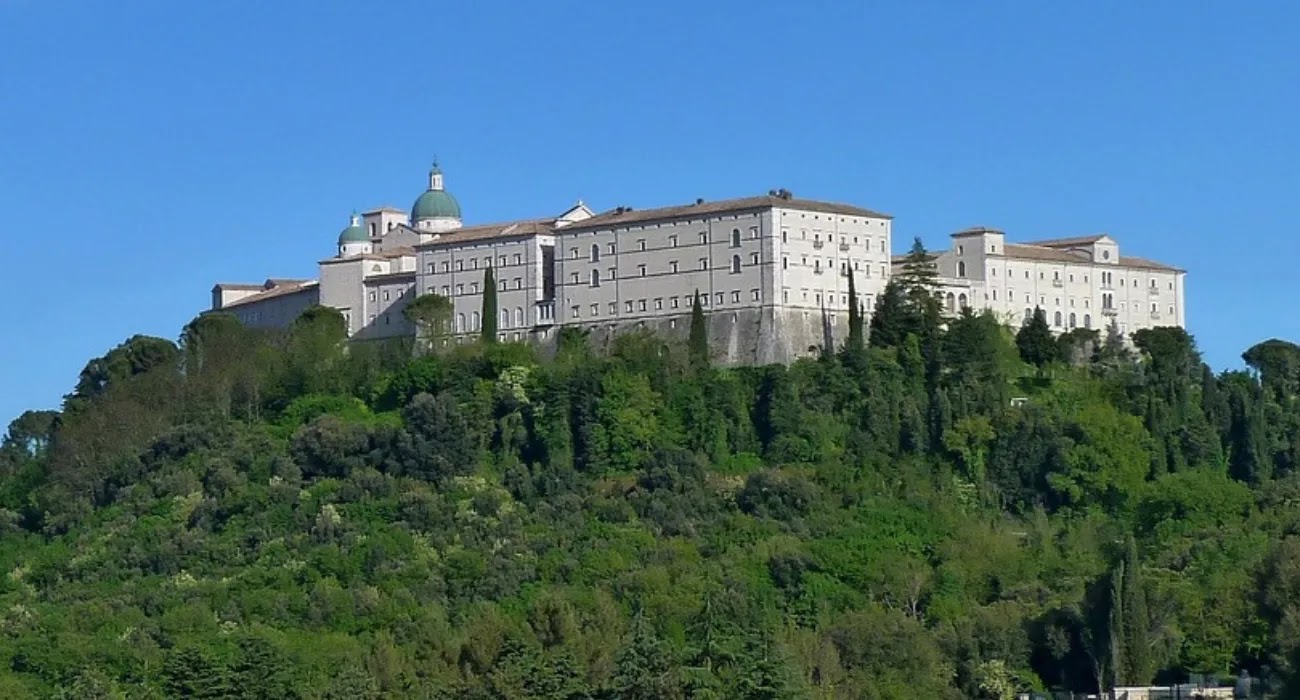
Montecassino


Edward Hutton brought "Naples and Campania Revisited" to an end with visits to three great monasteries, LaCava, Montevergine, and Montecassino. Below is his reflection on Montecassino, including an appendix detailing the destruction caused by the Italian campaign in 1944. During the war Hutton had served with the British army advising on which cultural and historical sites to avoid bombing. Apparently, his advice was not taken on Montecassino. 


Another and a greater abbey than La Cava, the great abbey of Montecassino, the greatest and the most ancient in Europe, stands on a mountain top in Campania Felice, 1.500 feet above the sea, about half way between Naples and Rome. It was the cradle of the Benedictine Order and dates from the first third of the sixth century…. (233)


Such was the abbey as I remembered it, all of which was seemingly swept away by the Allies in 1944. And as I climbed the long hill, crowned as I saw with new buildings, I wondered what I was going to find at the top.


Well, what I found was a reproduction as near as might be of the abbey that was destroyed in 1944. I suppose the monks were so deeply attached  to the destroyed buildings that they could not forgo reproducing them. Yet, though I could well understand this very natural sentimentality, I thought it unfortunate, for there was nothing of any artistic distinction in the buildings that were destroyed….


Every traveller to South Italy should come to Montecassino if only because of the immense influence  it has had in the history of Europe and indeed of mankind. Fourteen hundred years ago and more S. Benedict founded here the cradle of that Order of monks which transformed Europe, cut down its impenetrable forests, drained its impassable marshes, educated its barbarians and made them Christians. It was the monks of S. Benedict who converted the English, supplied the country with statesmen, counsellors and bishops and presently covered England with mighty houses, Glastonbury, Reading, Durham, and the like, to be utterly destroyed by a reckless and unhappy king, yet are now rising again, so that it is today possible to land at Dover, cross the country to the Atlantic, and sleep at a Benedictine monastery every night.


As you lie there on that mountain-side before the abbey newborn, looking over the deep valley where the Liri wanders under Aquino and Pontecorvo and I know not how many other ancient cities groved and garlanded with the ilex, the olive and the vine, where beyond, rises range after range of purple mountain chain, you may think on these things. (239)…


APPENDIX III. SOME OF THE CHURCHES DAMAGED IN CAMPANIA IN THE WAR, 1939-1945.


Perhaps the destruction of Montecassino was the most shocking moral outrage of the war in Italy, Mr. Majdalany points out in his excellent book (Cassino: Portrait of a Battle [1957]} that the Allied Command seems to have been astonished at the difficulties that faced our armies at Cassino, yet the Italian Military College had used Cassino for generations as an example of an impregnable defense barrier. In the tremendous and relentless bombing of the great monastery the Cathedral church was the first to be attacked and destroyed.  What was achieved by the destruction of the famous monastery? According to Mr. Majdalany, who took part in the attack. It “achieved nothing”, but the tenth German Army was able “to establish posts in the Abbey ruins”.


It might seem that the whole Italian campaign was a mistake, misconceived and eventually starved to death. The mere idea of waging modern war up the length of the peninsula through the beautiful cities which hold treasures of architecture, painting and sculpture, the inheritance of mankind, should, I imagine, have given pause to even the most philistine and obsessed political leader. It was, one regrets to recall, an English proposal. The Americans, merely for military reasons, disliked the Italian diversion, and Eisenhower finally brought it to an end by draining it of troops and material for the invasion of Normandy. (275-276)


###


Edward Hutton: Naples and Campania Revisited. London, 1958.Preface. Pp. 235-239, 275-276. 

Friday, June 5, 2026

Paestum


Edward Hutton devoted a chapter to Paestum, its history and its three spectacular, deserted temples: all that is left of an ancient Greek colony that predated the Romans. *


The great spectacle which La Cava or Salerno usually affords the traveller, which for the most part is the reason for a visit to them, is the Greek Temples of Paestum, twenty-four miles to the south of Salerno in the malarious marsh by the low seashore that stretches from Monte Giove on the north to Agropoli on the south. The traveller usually leaves La Cava or Salerno or even Naples in the morning, spends the best part of the day at Paestum, and returns in time for dinner; and this procedure, unsatisfactory as it is, forces one to see those marvellous sanctuaries in the company of a crowd of tourists and in the ugliest hours of the day, but is generally considered necessary on account of the unhealthy and malarious situation of Paestum itself.  Paestum, however, is worth any sort of trouble to see quietly, apart from the crowd, and best of all in the early morning, and therefore one should leave Salerno by automobile so as to get the early morning and if possible the rising sun over the Temples at Paestum, which alas, has been much sophisticated since I first knew it. In the old days I used to go to Eboli and drive from there. Eboli itself, the ancient Eburnum, on the hills to the north-east of the great Pianura di Pesto, I found to be full of interest. This almost unvisited little town boasted a quite possible hostelry in the Albergo Pastore, and from the grand old Castello offered the traveller glorious views of the great mountains and over the forest and the plain to the far-away temples and the sea….


The road from Eboli to Paestum very early in the morning was full of delight. The forest of Persano was of old of much greater extent and beauty than it is today; but in 1746 all the Bosco Grande was destroyed by fire: what remains is a vast ruin of the great forest of the Silarus…


But not the  wild desolation of the plain, nor its silence, nor its shadowy light, prepare one in any way at all for that vision of splendour and sadness which it still guards so well. One enters the gate of the desolate city, and there within the low over grown far-stretched walls of the place, in the immense silence of early morning, in the clear and tender light beside the sea, three temples stand that in their mysterious isolation and tragic beauty are like something wholly divine, at one with the sky and the earth and the sea, from which indeed they come, out of which they were hewn, and in honour of which they still stand, abandoned by man, after centuries of silence, in so great majesty.


Within a walled pentagon, near three miles in circumference, they are alone with the sun, the sea and the wind. What can that city have been like which boasted such sanctuaries as these? It cannot have been less, one might think, than the capital of Magna Graecia, beside which Cuma was a provincial town and Neapolis a village….


The three temples stand within the ruined walls in a rough and stony place, strewn with the debris of other buildings and overgrown with brambles and wild flowers, and among them the newly-planted twice-blossoming roses of which Virgil sings. The two principal temples stand there together in the south, their facades facing the agora, or market-place, the consecrated open space which in coast towns usually lay on the sea side of the city….


When all is said, however, the delight of Paestum lies in its appeal to the eye, in the sheer beauty of these golden buildings shining there in the dawn between the great mountains and the sea, in the midst of the wide plain, deserted and silent, where only the sun and the wind are at home.


### 


Edward Hutton: Naples and Campania Revisited. London, 1958.Preface. Pp. 227-234.


*Note: Look at this image of a diver from a fresco now in the Paestum Museum provided by David Orme from England. What does it tell us about ancient Greece and Rome?