Search This Blog

Friday, February 25, 2022

Florence: Raphael in the Pitti Palace

There was so much to see in the Uffizi gallery that Edward Hutton could do little more, except in the case of Botticelli, than divide the collection into the schools of Florence, Siena, Umbria, and Venice and then offer just a sentence or two to each painting. Even Michelangelo's Doni Tondo, for example, was only described as a "very splendid Holy Family, splendid perhaps rather than beautiful..." But in the Pitti Palace he took notice of its great Raphael collection, and the influence of Florence on the young painter from Umbria.


And it is in this mystical and smiling country, where the light is so soft and tender, softer than on any Tuscan hills, that the most perfect if not the greatest painter of the Renaissance grew up. You may find some memory of that beautiful land of hills and quiet valleys even in his latest work, after he had learned from every master, and summed up, as it were, the whole Renaissance in his achievement. But in the four pictures here in the Pitti, it is the influence of Florence you find imposing itself upon the art of Umbria, transforming it, strengthening it, and suggesting, it may be, the way of advance. Something of the art of Pietro [Perugino] you see in the portraits of Maddalena Doni, Angelo Doni, and La Donna Gravida…It is the influence of Florence we seem to find too in the simplicity of the Madonna del Granduca. Here is a picture certainly in the manner of Perugino, but with something lost, some light, some beatitude, yet with something gained also, if only in a certain measure of restraint, a real simplicity that is foreign to that master.


And then, if we compare it with the Madonna della Sedia, which is said to have been painted on the lid of a wine cask, we shall find, I think, that however many new secrets he may learn Raphael never forgot a lesson. It is Perugino who has taught him to compose so perfectly, that the space, small or large, of the picture itself becomes a means of beauty. How perfectly he has placed Madonna with her little Son, and St. John praying beside them, so that until you begin to take thought you are not aware how difficult that composition must have been, and indeed you never remember how small that tondo really is. How eagerly those easel pictures of Madonna have ben loved, and yet to-day how little they mean to us; some virtue seems to have gone out of them, so that they move us no longer, and we are indeed a little impatient at their fame, and ready to accuse Raphael of I know not what insincerity or dreadful facility.


Yet we have only to look at the portraits to know we are face to face with one of the greatest and most universal of painters. Consider then, La Donna Veleta, or the Pope Julius II, or the Leo X with the two Cardinals, how splendid they are, how absolutely characterized and full of life, life seen in the tranquillity of the artist, who has understood everything, and with whom truth has become beauty. In the Leo X with the Cardinals, Guilio de’ Medici and Lorenzo dei Rossi, how tactfully Raphael has contrived the light and shadow so that the fat heavy face of the Pope is not overemphasized, and you discern perfectly the beauty of the head, the delicacy of the nostrils, the clever, sensual, pathetic, witty mouth. And the hands seem about to move, to be a little tremulous with life, to be on the verge of a gesture, to have only just become motionless on the edge of the book. It is in these portraits that the art of Raphael is at its greatest, becomes universal, achieves, immortality.


 ###


Edward Hutton: Florence and Northern Tuscany with Genoa, second edition, London, 1908. Pp. 340-341. 

Friday, February 18, 2022

Florence: Botticelli in the Uffizi

Edward Hutton thought it almost impossible to do justice to the collection of the Uffizi Gallery which along with the Pitti Palace constituted "the finest collection of the Italian schools of painting in the world." Nevertheless, he was at his best in his discussion of Botticelli's masterpieces including the famous Birth of Venus. 


Painted for Pierfrancesco de’ Medici, the birth of Venus is perhaps the most beautiful, the most expressive, and the most human picture of the Quattrocento. She is younger than the roses which the south-west wind fling at her feet, the roses of earth to the Rose of the sea. Not yet has the Shepherd of Ida praised her, nor Adon refused the honey of her throat; nor yet has Psyche stolen away her joy, nor Mars rolled her on a soldier’s couch amid the spears and bucklers; for now she is but a maid, and she cometh in the dawn to her kingdom dreaming over the sea. If we compare her for a moment with the Madonna of the Magnificat, with the Mary of the Pomegranate, she seems to us more virgin than the Virgin, less troubled by a love in which all the sorrow and desire of the world have found expression, less weary of the prayers that will be hers no less than Mary’s. 


How weary and with what sadness Madonna writes Magnificat, or dreams of the love that even now has come into her arms! Is it that, as Pater has thought, the honour is too good for her, that she would have preferred a humble destiny, the joy of any other mother of Israel? Who is she, this woman of divine and troubling beauty that masquerades as Venus, and with Christ in her arms is so sad and unhappy? Tradition tells us that she was Simonetta, the mistress of Giuliano de’ Medici, who, dying still in her youth, was borne through Florence with uncovered face to her grave under the cypresses. Whoever she may be, she haunts all the work of Botticelli, who, it might seem, loved her as one who had studied Dante, and, one of the company of the Platonists of Lorenzo’s court, might well love a woman altogether remote from him. As Venus she is a maid about to step for the first time upon the shores of Cyprus, and her eyes are like violets, wet with dew that have not looked on the sun; her bright locks heavy with gold her maid has caught about her, and the pale anemones have kissed her breasts, and the scarlet weeds have kissed her on the mouth. As Mary, her destiny is too great for her, and her lips tremble under the beauty of the words she is about to utter; the mystical veils about her head have blinded her, her eyelids have fallen over her eyes, and in her heart she seems to be weeping. But it is another woman not less mysterious who, as Judith, trips homeward so lightly in the morning after the terrible night, her dreadful burden on her head and in her soul some too brutal accusation.


###


Edward Hutton: Florence and Northern Tuscany with Genoa, second edition, London, 1908. Pp. 316-319.

Friday, February 11, 2022

Florence Accademia: Botticelli

Edward Hutton ended his tour of the Accademia with an appreciation of Botticelli at his best.


The Accademia possesses some five pictures by Botticelli,-- the Coronation of the Virgin and its predella, the Madonna with saints and angels, the Dead Christ, the Salome, and the Primavera….


 Here at last we see the greatest, the most personal artist of the fifteenth century really at his best, in that fortunate moment of half-pensive joy which was so soon to pass away. How far has he wandered, and through what secret forbidden ways, from the simple thoughts of Angelico, the gay worldly laughter of Lippo Lippi. On that strange adventurous journey of the soul he has discovered the modern world, just our way of looking at things, as it were, with a sort of gift for seeing in even the most simple things some new and subtle meaning. And then, in that shadowy and yet so real kingdom, not without a certain timidity, he has ventured so far, he has come upon the very gods in exile, and for him Venus is born again from the foam of the sea, and Mars sleeping in a valley will awake to find her beside him, not as of old full of laughter, disdain, and joy; but half reconciled, as it were, to sorrow, to that change which has come upon her so that men now call her Mary, that name in which bitter and sweet are mingled together. With how subtly pensive a mien she comes through the spring woods here in the Primavera, her delicate hand lifted half in protest, half in blessing of that gay and yet thoughtful company,--Flora, her gown full of roses, Spring herself caught in the arms of Aeolus, the Graces dancing a little wistfully together, where Mercurius touches indifferently the unripe fruit with the tip of his caducaeus, and Amor blindfold points his dart, yes almost like a prophecy of death….What is this scene that rises so strangely before our eyes, that are filled with the Paradise of Angelico, the heaven of Lippo Lippi. It is the new heaven, the ancient and beloved earth, filled with spring and peopled with those we have loved, beside whose altars long ago we have hushed our voices. It is the dream of the Renaissance. The names we have given these shadowy beautiful figures are but names, that grace who looks so longingly and sadly at Hermes is but the loveliest among the lovely, though we call her Simonetta and him Giuliano. Here in the garden of the world is Venus’s pleasure house, and there the gods in exile dream of their holy thrones. Shall we forgive them, and forget that since our hearts are changed, they are changed also? They have looked from Olympus upon Calvary … and she, Venus Aphrodite, has been born again, not from the salt sea, but in the bitterness of her own tears, the tears of Madonna Mary. It is thus Botticelli, with a rare and personal art, expresses the very thought of his time, of his own heart, which half in love with Pico of Mirandola would reconcile Plato with Moses, and since man’s allegiance is divided reconcile the gods. You may discern something, perhaps, of the same thought, but already a little cold, a little indifferent in its appeal, in the Adoration of the Shepherds which Luca Signorelli painted now in the Uffizi, where the shepherds are fair and naked youths, the very gods of Greece come to worship the Desire of all Nations. But with Botticelli that divine thought is altogether fresh and sincere.


###


Edward Hutton: Florence and Northern Tuscany with Genoa, second edition, London, 1908. Pp. 307-309.

Friday, February 4, 2022

Florence Accademia: Giotto and Fra Angelico


Edward Hutton used his visit to the Accademia to trace the history of painting in Florence. He began with Giotto. 


Here in the Accademia in the Sala dei Maestri Toscani, you may see an altarpiece that has perhaps come to us from his hands, among much beautiful  languid work that is still in the shadow of the Middle Age, or that coming after him, has almost failed to understand his message, the words of life which may everywhere be found in his frescoes in Assisi, in Florence, in Padua spoiled though they be by the intervention of fools, the spoliation of the vandals.


Those strange and lovely altarpieces ruthlessly torn from  the convents and churches of Tuscany still keep inviolate the secret of those who, not without tears, made them for the love of God: once for sure they made a sunshine in some shadowy place. Hung here today in a museum, just so many specimens that we number and set in order, they seem rude and fantastic enough, and in the cold light of this salone, crowded together like so much furniture, they have lost all meaning or intention. They are dead, and we gaze at them almost with contempt; they will never move us again. That rude and almost terrible picture of Madonna and Saints with its little scenes from the life of our Lord, stolen from the Franciscan convent of S. Chiara at Lucca, what is it to us who pass by? Yet once it listened for the praises of the little nuns of S. Francis, and, who knows, may have heard the very voice of Il Poverello. That passionate and dreadful picture of S. Mary Magdalen covered by her hair as if with a robe of red gold, does it move us at all? Will it explain to us the rise of Florentine painting? And you, O learned archaeologist, you, O scientific critic, you, O careless and curious tourist, will it bring you any comfort to read (if you can) the inscription—


Ne despiretis, vos qui peccare soletis

Exempleque mea vos reperate Deo.”


Those small pictures of the life of St. Mary, which surround her with their beauty, do you even know what they mean? And if you do, are they any more to you than an idle tale, a legend which has lost even its meaning? No, we look at these faint and far-off things merely with curiosity as a botanist looks through his albums, like one who does not know flowers…. (300-301)


Thus we come really into the midst of the fifteenth century, to the work of Fra Angelico, Fra Lippo Lippi, and Botticelli, which we have loved so much….


It is the Renaissance itself, the most simple and divine work it achieved in its earliest and best days that we see in the work of Fra Angelico. One beautiful and splendid picture, the descent from the Cross, alas! repainted, stands near Gentile’s Adoration… but the greater part of Angelico’s work to be found here is in another room. There, in many little pictures, you may see the world as Paradise, the very garden where God talked with Adam. …he will tell us of Paradise, beneath whose towers, in a garden of wild flowers, the saints dance with the angels, crowned with garlands, in the light that streams through the gates of heaven from the throne of God.


How may we rightly speak of such a man, who in his simplicity has seen angels on the hills of Tuscany, the flowers and trees of our world scattered in heaven?...That such things as these could come out of the cloister is not so marvellous as that, since they grew there, we should have suppressed the convents and turned the friars away. For just as the lily of art towered first and broke into blossom on the grave of St. Francis, so here in the convent of S. Marco of the Dominicans was one who for the first time seems to have seen the world, the very byways and hills of Tuscany, and dreamed of them as Heaven. 


###


Edward Hutton: Florence and Northern Tuscany with Genoa, second edition, London, 1908. Pp. 300-305.

Friday, January 28, 2022

Michelangelo in the Bargello


Edward Hutton ended his tour of the Bargello, the sculpture gallery in Florence, with a discussion of Michelangelo, "that beautiful, strong and tragic soul." Michelangelo's most famous works are not in the Bargello but there was still the figure of the Greek god Bacchus, the great Roman Brutus, a lovely relief of the Madonna and Child, as well as a Pieta apparently intended for his own tomb.


There follows Michelangelo (1475-1564). It is with a sort of surprise that one comes fact to face with that sorrowful, heroic figure, as though, following among the flowers, we had come upon some tragic precipice, some immense cavern too deep for sight. How, after the delight, the delicate charm of the fifteenth century, can I speak of this beautiful, strong, and tragic soul? It might almost seem that the greatest Italian of the sixteenth century has left us in sculpture little more than an immortal gesture of despair, of despair of a world which he has not been content to love. His work is beautiful with the beauty of the mountains, of the mountains of which he alone has found the spirit of man. His figures, half unveiled from the living rock, are like some terrible indictment of the world he lived in, and in a sort of rage at its uselessness he leaves them unfinished, and it but half expressed;--an indictment of himself too, of his own heart, of his contempt for things as they are. Yet in his youth, he had been content with beauty—in the lovely Pieta of S. Pietro, for instance, where, on the robe of Mary, alone in all his work he has placed his name; or in the statue of Bacchus, now here in the Bargello, sleepy, half drunken with wine or with visions, the eyelids heavy with dreams, the cup still in his hand. But already in the David his trouble is come upon him; the sorrow that embittered his life has been foreseen, and in a sort of protest against the enslavement of Florence, that nest where he was born, he creates this hero, who seems to be waiting for some tyranny to declare itself.


The Brutus, unfinished as we say, to-day in the Bargello, he refused to touch again, since that city which was made for a thousand lovers, as he said, had been enjoyed by one only, some Medici against whom, as we know, he was ready to fight. If in the beautiful relief of Madonna we find a sweetness and strength that is altogether without bitterness or indignation, it is not any religious consolation we find there, but such comfort rather as life may give when in a moment of inward tragedy we look on the stars or watch a mother with her little son. …


The unfinished Pieta in the Duomo, it is said, he carved for his own grave: like so much of his great tragical work, it is unfinished, unfinished though everything he did was complete from the beginning. For he is like the dawn that brings with it noon and evening, he is like the day which will pass into the night. In him the spirit of man has stammered the syllables of eternity, and in its agony of longing or sorrow has failed to speak only the word love. All things particular to the individual, all that is small or of little account, that endures but for a moment, have been purged away, so that Life itself may make, as it were, an immortal gesticulation, almost monstrous in its passionate intensity—a mirage seen on the mountains, a shadow on the snow. And after him, and long before his death, there came Baccio Bandinelli and the rest, Cellini the goldsmith, Giovanni da Bologna, and the sculptors of the decadence that has lasted till our own day. With him Italian art seems to have been hurled out of heaven; henceforth his followers stand on the brink of Pandemonium, making the frantic gestures of fallen gods.


###


Edward Hutton: Florence and Northern Tuscany with Genoa, second edition, London, 1908. Pp. 296-7.

Friday, January 21, 2022

Florence: Verrocchio

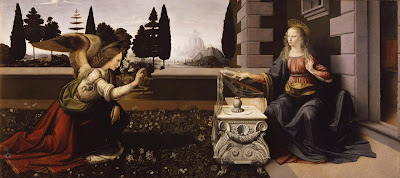
Edward Hutton regarded Andrea Verrocchio as "one of the greatest of all Italian masters of the Renaissance." Sadly, Verrocchio has been eclipsed by his student Leonardo da Vinci. For example, the famous Annunciation in the Uffizi is generally credited to the young Leonardo although it was done in the Verrocchio studio.*  In the Bargello, Hutton found two outstanding examples of Verrocchio's work as a sculptor.


It is, however, in the work of another goldsmith—or at least the pupil of one, whose name he took—that we find the greatest master of the new age, Andrea Verrocchio. Born in 1435, and dead in 1488, he was preoccupied all his life with the fierce splendour of his art, the sublime sweetness that he drew from the strength of his work. The master, certainly, of Lorenzo di Credi and Leonardo, and finally of Perugino also, he was a painter as well as a sculptor; and though his greatest work was achieved in marble and bronze, one cannot lightly pass by the Annunciation of the Uffizi, or the Baptism of the Accademia. Neglected for so long, he is at last recognized as one of the greatest of all Italian masters of the Renaissance. …


More perfect in craftsmanship and in the knowledge of anatomy than Donatello, Verrocchio here, where he seems almost to have been inspired by the David of his master, surpassed him in energy and beauty, and while Donatello’s figure  is involved with the head of Goliath, so that the feet are lost in the massive and almost shapeless bronze, Verrocchio’s David stands clear of the grim and monstrous thing at his feet. Simpler, too, and less uncertain is the whole pose of the figure, who is in no doubt of himself, and in his heart he has already “slain his thousands.”


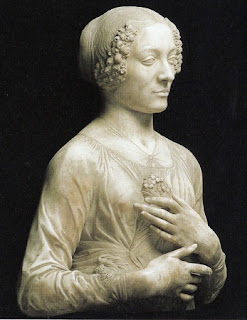
In the portrait of Monna Vanna degli Albizi, the Lady with the Nosegay, Verrocchio is the author of the most beautiful bust of the Renaissance. She fills the room with sunshine, and all day long she seems to whisper some beloved name. A smile seems ever about to pass over her face under her clustering hair, and she has folded her beautiful hands on her bosom, as though she were afraid of her beauty and would live ever in their shadow.


In two reliefs of Madonna and child, one in marble and one in terra-cotta, you find that strange smile again, not, as with Leonardo, some radiance of the soul visible for a moment on the lips, but the smile of a mother happy with her little son. In the two Tornabuoni reliefs that we find here too in the Bargello, it is not Verrocchio’s hand that we see; but in the group of Christ and St. Thomas at Or San Michele, and in the fierce and splendid equestrian statue of Bartolomeo Colleoni at Venice, you see him at his best, occupied with a subtle beauty long sought out, and with an expression of the fierce ardour and passion that consumed him all his life. If he makes only a leaf of bronze for a tomb, it seems to quiver under his hands with an inextinguishable vitality.


###


*Today the Uffizi credits the Annunciation to Leonardo but after a Verrocchio prototype. 


Edward Hutton: Florence and Northern Tuscany with Genoa, second edition, London, 1908. Pp. 292-293.

Friday, January 14, 2022

Florence: Donatello


In his tour of the Bargello, Florence's sculpture gallery, Edward Hutton had high praise for the work of Donatello and its unique contribution to Renaissance sculpture. Donatello's marble David, pictured below, is less famous than his bronze version, but Hutton regarded his St. George as his masterpiece.


Of Donatello’s life we know almost nothing. If we seek to learn something of him, it must be in his works, of which so many remain to us. We know, however, that he was the intimate friend of Brunellesco, and that it was with him he set out for Rome soon after this great and proud man had withdrawn from the contest with Ghiberti for the Baptistery gates. Donatello was to visit Rome again in later life, but on this first journey that he made with Brunellesco for the purpose of study, he must have become acquainted with what was left of antiquity in the Eternal City. It was too soon for that enthusiasm for antiquity, which later overwhelmed Italian art so disastrously, to have arisen. When Donatello returned about a year later to Florence to work for the Opera del Duomo, it is not any classic influence we find in his statues, but rather the study of nature, an extraordinary desire to express not beauty, scarcely ever that, but character. His work is strong, and often splendid, full of energy, movement, and conviction, but save now and then, as in the S. Croce Annunciation, for instance, it is not content with just beauty….(284)


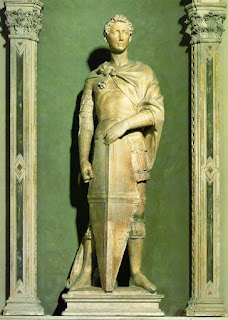
Donatello: St. George


There are some ten works by the master in the Bargello, together with numerous casts of his statues and reliefs in other parts of Italy, so that he may be studied here better than anywhere else. Looking thus on his work more or less as a whole, it is a new influence we seem to divine for the first time in the marble David, a little faintly, perhaps, but obvious enough in the St. George, a Gothic influence that appears very happily for once, in work that almost alone in Italy seems to need just that, well, as an excuse for beauty. That marble statue of David was made at almost the same time as the St. John the Divine, for the Duomo too, where it was to stand within the church in a chapel there in the apse. A little awkward in his half-shy pose, the young David stands over the head of Goliath, uncertain whether to go or stay. It is a failure which passes into the success, the more than success of the St. George,  which is perhaps his masterpiece. Made for the Guild of Armourers, from the first day on which it was set up it has been beloved. Michelangelo loved it well, and Vasari is enthusiastic about it, while Bocchi, writing in 1571, devotes a whole book to it…. With a proud and terrible impetuosity St. George seems about to confront some renowned and famous enemy, that old dragon whom once he slew. Full of confidence and beauty he gazes unafraid… Well may Michelangelo have whispered “March!” as he passed by, it is the very order he awaits, the whisper of his own heart. … 


 So in the bronze David now in the Bargello we seem to see youth itself dreaming after the first victory of all the conquests to come, while a smile of half-conscious delight is passing from the lips; tyranny is dead…. (287)


But here in the Bargello we have enough of his work to enable us to divine something at least of his secret. And this seems to me to have been Donatello’s  intention in the art of sculpture: his figures are like gestures of life, of the soul, sometimes involuntary and full of weariness, sometimes altogether joyful, but always the expression of a mood of the soul which is dumb, that in its agony or delight has in his work expressed  itself by means of the body, so that though he never carves the body for its own sake, or for the sake of beauty, he is as faithful in his study of it for the sake of the truth, as he is in his study of those moods of the soul which through him seem for the first time to have found an utterance. (288)


###


Edward Hutton: Florence and Northern Tuscany with Genoa, second edition, London, 1908. Pp. 284-288.