Search This Blog

Friday, April 3, 2026

Lorenzo Lotto: Crucifixion


Today, we interrupt our posts on Edward Hutton's visit to Naples and the Campania to put up a post from his visit to Monte san Giusto and its famed painting of the Crucifixion by Lorenzo Lotto.
 

"Beyond Pausula, by a rough and hilly road across the Cremone valley, we come to the little walled town of Monte San Giusto, and there in the church of S. Maria is a Crucifixion by Lotto, painted in 1531." (227)
He did not describe the painting and I wonder if he actually saw this magnificent work of the Venetian master. The small church of S. Maria in Telusiano is hard to find and the painting would have been difficult to see before the invention of coin-operated lighting. A few years ago my wife and I visited Monte San Giusto to see the painting. Here is my account.

Italian Renaissance master Lorenzo Lotto was born in Venice around 1480 but spent most of his long career working in provincial towns. Perhaps this is why he is not as well known as Giorgione and Titian, both of whom were born outside of Venice but did most of their work in the great city


Lotto’s most powerful and dramatic work was a Crucifixion that still stands in its original site in the little church of Santa Maria in Telusiano in the small, out of the way, hill town of Monte San Giusto, located in that part of Italy known as the Marche. The town is not too far from Loreto, the religious center where Lotto eventually spent the last years of his life.

Lotto’s Crucifixion shows that he could hold his own with the greatest of Renaissance masters. My wife and I saw the painting a few years ago as we traveled down the Adriatic coast. Our old guidebook called Lotto’s painting in Monte San Giusto “ the most dramatic and powerful of all his large-scale works,” and so we decided to take a side trip out of our way in hope of finding it.  Although we are very thankful for the wonderful works of art preserved in Italian museums, it is always special to see a work “in situ”, where it was originally meant to be seen.


It was not easy to find the church and we finally had to go into a local bank where a patron kindly offered to lead us there through the curvy narrow streets of the town. We parked outside a long stone staircase that went up and up between stone buildings packed closely together on each side. 

It was hard to immediately recognize the church but we finally found a door that led into what was no more than a large chapel. It was dark inside and the church was empty except for a couple of ladies who seemed to be cleaning. We could hardly see the painting behind the only altar but one of the ladies pointed to a little box. We put a coin in and immediately the huge magnificent painting (450x250cm) that took up almost the whole back wall was revealed.

Revealed is an understatement. The light, color, movement, physicality, and dramatic intensity virtually jumped out at us. A crowd of guards and onlookers stand beneath and around the three crosses that reach high into a dark sky. Jesus is in the middle flanked by the two thieves.

Standing in Santa Maria it is hard to examine the huge painting closely because the impression is so overwhelming. But on reflection we can see that Lotto has depicted the moment right after the death of Jesus. We can see the Roman centurion Longinus on his white horse immediately after he has placed the point of his lance in the side of Jesus to verify his death. He has released the lance and it is about to fall. He reaches both hands toward Jesus in the act of shouting, “truly, this man was the Son of God.”

The death of Jesus is also marked by a great wind that causes the loin cloths of Jesus and the thieves to billow as well as the Roman banner on the right where one can just make our the first letters of the name of Caesar Augustus. In the foreground, the disciple John, robed in green, seems to lead the grieving Mother right out of the picture. Behind them red-haired Mary Magdalene dressed in blue stretches out her arms in grief.


Today, it is hard to imagine what churchgoers back in an obscure provincial town must have thought when they beheld this magnificent painting. They could never have seen anything like it before and must have known that a great master had done it. Going to Mass in Santa Maria in Telusiano would never be the same. At the Consecration of the Mass, as the priest at the altar raised high the host, their eyes would behold the sacrificial victim raised high on Calvary in the dramatic and breathtaking altarpiece behind. 

### 

Friday, March 27, 2026

Neapolitans

 Here are some of Edward Hutton's observations of the people of Naples.


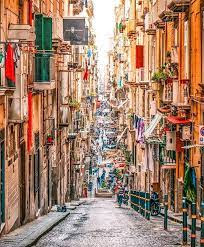
In this boiling cauldron, after a little, when one’s first distress had passed, there remained an extraordinary fascination. The life of Naples was and is the life of the streets, of the decumani, salite, scale, rampe, of which it is full; everything takes place there in these narrow ways, even the toilet; and little by little one is compelled by the obscene spirit of the city to wander continually, and, only half ashamed, to watch these poor people in all their pathetic poverty and animalism, their amazing unself-consciousness, their extraordinary and meaningless violence of gesture and speech—and yes, their joy of life. Was the Neapolitan of antiquity like this?...


For the Neapolitan is indeed a highly composite person. Humanity and cruelty, bravery and cowardice , openness and deceit, thrift and prodigality are all jumbled together in him and it is a puzzle to know which predominates. He is among Italy’s best soldiers—always light-hearted, facetious and pertinacious, marvellously expressive, too, in his features and gestures. He is not more dishonest than anyone else, nor does he lie maliciously, but to glorify himself and to be agreeable. He is too easy-going to be vindictive, he is emotional, but not revengeful. And to call him lazy is the most absurd and ridiculous charge ever brought against people who are essentially indefatigable. Watch the facchini at the port; the boatmen and fishermen, too, toil for hours at the oar on a bit of bread and a crock of water. And the peasants have only to be seen at work, laborious and untiring in the blazing heat, to convince one of their energy. The Neapolitan is, however, a gambler, though not perhaps more than his brother of the English working-class. He is cruel to animals, but not to children….


 Observe a Neapolitan of the upper class; he never walks, he strolls. If he is in a hurry, if he is pressed for time, he takes a cab or a taxi, but generally he strolls; passiare, he calls it. He stops to speak with a friend or greets an acquaintance with an eloquent gesture, loiters past the shop windows, lingers in the Galleria scanning the cafes, stays to read the placards before the newspaper kiosks and the bills displayed before the theatres and of course arrives late at his destination. For the Neapolitan is a flaneur of flaneurs, yet with something Spanish too, which is not surprising considering his history. …


This strolling, this passiare, often turns to good account, for it is the long tradition of the Neapolitans to conduct their affairs in the open air, whether it be the toilet or a business transaction. In this they are still as Greek as their remote ancestors. There in the street, in the piazza, in the Galleria the Neapolitan is most likely to be fortunate in a combinazione. And who will say he is wrong, since the open air is that which glorifies this great southern city set in the most beautiful landscape in the world.


### 


Edward Hutton: Naples and Campania Revisited. London, 1958. Pp. 3-6.

Friday, March 20, 2026

Disillusion in Naples


Revisiting Naples in 1957 after an absence that spanned two world wars, Edward Hutton's initial response was disillusion.


To come to Naples from Rome through the now fallen majesty of the Campagna, along that sombre road under Anagni and Montecassino, or by the Pontine Marshes under the Valerian hills, past spellbound Norma and the lilied meres of Ninfa, or to enter it first without warning out of the loneliness, the silence and the beauty of the sea is to experience an astonishing disillusion.


For there is nothing, I think, in all the South, nothing certainly in Italy, quite like Naples in its sordid and yet tremendous vitality, a vitality that is sterile, that wastes itself upon itself. It is still, as Bergeret the friend of Fragonard found it, the most animated city in Europe. A place so restless and noisy and confused that it might be pandemonium, so drab that it is not really redeemed even by the Castel dell’ Ovo, the Castel Nuovo and Sant’ Elmo.


All this meanness is emphasized and accentuated  by the unrivalled beauty of the world in which Parthenope stands, the spacious and perfect loveliness of the great bay, shining and yet half lost in all the gold of the sun, between the dreamy headlands of Sorrento, of Posilipo, of Misenum; the threatening gesture, the incomparable outline of Vesuvius, the vision of Capri, of Procida and Ischia rising out of the sea, the colour of sea and sky, of valley and mountain and curved shore. For this is Campania, the true Arcady of the Romans, and here more than anywhere else, perhaps, the forms of the past clothed in our dreams are indestructible, and will outface even such a disillusion as Naples affords.


In this incomparable landscape Naples stands, not like Genoa nobly about an amphitheatre of hills, nor like Palermo in an enchanted valley, but in the deepest curve of her vast and beautiful bay, at the foot of the hills and upon their slopes, beneath the great and splendid fortress of Sant’ Elmo, which towers up over the city in shining beauty and pride, the noble feature of a place that, but for it, would be almost without any monumental splendour.


Sant’ Elmo towers there over the city upon the west; farther away and to the north, upon a scarcely lesser height, stands the great Bourbon palace of Capodimonte, while to the east, upon the far side of the fruitful valley of the Sebethus, rises the violent pyramid of Vesuvius now without its silver streamer of smoke. Seen from afar, and especially from the sea, there can be but few places in the world comparable with this; the vast and beautiful bay closed on the west by Capo Miseno, with its sentinel islands Ischia and Procida, and on the east by the by the great headland of Sorrento more than twenty miles away as the gull flies, and defended, as it were, seaward by the island of Capri, is dominated in the very midst by the height and beauty and strangeness of Vesuvius….


Once in the city, Hutton described the pandemonium of its streets.


These long streets the colour of mud, built from the lava of Vesuvius, lined with tall, forbidding houses balconied with iron; those narrow salite climbing up towards Sant’ Elmo or descending to the harbour and Santa Lucia, crowded and squalid and hung everywhere with ragged clothes drying in the squalid air;…the noise that here more than any other city in the world overwhelms everything in its confusion and meanness, the howling of children, the cries of the women, the shouting of the men vainly competing with the hooting of horns, the explosion of the open exhausts of the motor vehicles, the cracking of whips, the beating of hoofs, the sirens of steamers, the innumerable bells—not only those, here so harsh, of the churches, but as I remember them the brutal gongs of trams, the bells of cows and goats; the mere hubbub of human speech that seems more deafening than it is by reason of the appalling emphasis of gesture; all this horrified and confused the stranger, chiefly perhaps, because he could find nothing definite in its confusion for the mind to seize upon—the mind indeed being half paralyzed by the flood of undistinguishable things, not one of which was characteristic, but rather all together. The mere extent of the place too, shapeless as it is, stretching for miles in all its sordidness along the seashore, appalled one; for its disorder was a violent disorder, its voice the voice of the mob, cruel, blatant, enormous, signifying nothing. 


###


Edward Hutton: Naples and Campania Revisited. London, 1958. Pp.  1-3. 

Friday, March 13, 2026

Naples Revisited


Edward Hutton returned to Naples in 1957 having first visited the city sixty years before. Although Italy had changed dramatically, especially after the Second World War, there was something unchanging about Naples. Here I reproduce his Preface to Naples and Campania Revisited.


While Italy is still the most delightful of all countries to live in, I must admit that with the rapid democratization of the world since the Second World War a rather saddening change has befallen her.


The age of the traveller is gone; even the age of the tourist too. Now the tripper, decanted in crowds from charabanc and motor-coach, descends on the lovely cities, and passes like a flood from Cathedral to gallery and museum, open-mouthed or indifferent; or masquerading as a pilgrimage swamps such a city as Assisi, so that it is only possible to enjoy the place in peace in the winter from November to March. Pandemonium resumes her reign at Easter.


And then there is the sophistication of the countryside. Even the Via Appia, the “Queen of Roads”, the backbone of Campania, is outraged with every sort of commercial placard and advertisement. And all its antiquity has been sacrificed to the motor-car.


It is, of course, petrol and perhaps America that are the great levellers.


The noise everywhere in the cities has not only increased but has changed its nature. It is no longer human but mechanical. Every city, every town proclaims at its gates: Zona di Silenzio, which means that it is forbidden to sound the motor-horn in its streets. But what is the good of that when every car, every lorry, every Vespa, every motor-cycle is driven with open exhaust to make as much noise as possible? For the Italian seems to believe that noise is power. In many cities, in Florence for instance and in Rome, too, it is difficult to get any sleep till the not so early hours of the morning, and then at five or six o’clock it begins all over again.


Naples, save Rome the only capitol city in the peninsula, seems largely oblivious of those incursions, which are absorbed perhaps by the Cathedral of S. Januarius, and the museum, but chiefly I suspect by Pompeii and Capri. At any rate the churches of Naples, full of pictures of the seventeenth century and Neapolitan Baroque, are for the most part unvisited, and if the Toledo once no doubt “inexpressively Neapolitan” has been commercialized till it is entirely anonymous and has really become the “Via Roma”, that is to say like any other main street in Milan or Turin, there still remains as unvisited as the churches, and almost as I remember them when I first came to Naples sixty years ago, many stradevichisalitefondaci, and not least the Via del Tribunale and the speccanapoli—the Via San Biagio and the Piazza Capuana with its lovely Tuscan gate and its market entirely Neapolitan neither vulgarized nor emasculate.


To stroll in those narrow streets filled with light and shade between the lofty balconied houses from church to church, from the majolica cloister of the Clarisse of Santa Chiara to the arcaded and fountained garden of San Gregorio Armeno under its many coloured dome, from the Guglia of the Immacolata to the Guglia of San Domenico, from the shrine of the blood of S. Gennaro to the ossuary of Sant’ Agostino alla Zecca, from the tomb of Tino di Camaino in the Donna Regina to the strange Baroque statues of San Severo, to leave Donatello in Sant’ Angelo a Nilo to find Antonio Rossellino in Monte Oliveto, to search for the pictures of Caravaggio, of Caracciolo, of Stanzione, will fill many a morning with quiet unhustled happiness, as though today were yesterday, and almost as though the Regno had never passed away. For in Naples certainly the old songs are the best.


                                                   O dolce Napoli,

                                                   O suol beato,

                                                   Ove sorridere

                                                   Volle il creato!

                                                   Tu sei l’impero

                                                   Dell’ armonia—

                                                   Santa Lucia!

                                                   Santa Lucia! 


  ###


Edward Hutton: Naples and Campania Revisited. London, 1958. Preface. Pp. vii-viii. 

Friday, March 6, 2026

Canossa: End of the Journey

 Edward Hutton ended his tour of Lombardy with a visit to Canossa, and a stirring account of the once-famous eleventh century meeting between the Emperor Henry, and Pope Gregory VII (Hildebrand). Here are some excerpts from his account.


Canossa remains in the imagination of the world as the symbol of the mighty work that Rome achieved during the Dark Ages, I mean the creation of the Papacy that was not only to dominate  but to civilize Europe, and when Hildebrand on that bare and pallid rock broke Henry in the cruel winter of 1077 that creation was proclaimed to Europe and the two succeeding centuries were already secured….


At Ciano you may get a mule or you may walk to Rosetta to that magnificent and isolated spot where the destiny of Europe for more than two centuries was decided. All the way is fair, and nothing in the world is more inspiring than the splendid climb from Ciano to Canossa. The lords of Canossa held in their day not only these mountains and all the passes into Italy across them, but a vast part of Lombardy, including Parma, Reggio, Mantua and Brescia, to say nothing of Tuscany and Spoleto. One feels at once on leaving Reggio and entering the region of the hills that one is at least really in their country.


Matilda…was the greatest of her house, the gran donna d’Italia, the friend of Hildebrand and the handmaid and protectress of the Papacy and the Church, she who reminded Dante of Persephone as she went alone singing and plucking flower after flower that strewed her way. We shall meet her again at Canossa. She lived a virgin, and on her death her vast inheritance passed by her will to the Holy See…. 


If you set out from Reggio…by road you will pass the Quattro Castella….but the Quattro Castella offers the traveller one of the most astonishing spectacles in Italy. Four conical hills rise from the vast hillside all in a line barring the way, and each crowned by a castle. They are the first outworks of that vast system of defense which guarded Canossa. [299]…


 After Rossena, the great white and naked rock of Canossa crowned by its ruin comes in sight, in wonderful contrast with Rossena itself. Here in the winter of 1077 the two great forces of the world met in combat, and the emperor fell.


It is almost impossible for us in our confused and wholly material age to understand the drama that was played out upon this naked upland, as it were upon the top of the world, in the three days and nights of that bitter January. The emperor had come from his Germany into Italy with the intention of making the Pope prisoner. He knew not what he was proposing. To humble the Latin world, which the Papacy expressed, was in itself a barbarian, if an honourable, adventure; but to break the heart and soul of Europe was to achieve what even Attila had failed to do. As the event proved, when the two men were face to face it was the barbarian who was to go down, and that not by force of arms but by force of will….


At Canossa everything was ready for an attack. Azzo d’Este was there and Hugh, Abbot of Clugny, and over them all the great Countess [Matilda]. Uplifted before all Europe, the Emperor and the Pope faced one another to decide who should be master.


Henry came. Was it the mountains that had broken him, or the astonishment of Italy, or the hand of God? Whatever it was, he was broken. His first act was to beg intercession from Matilda, who with Hugh the Abbot met him when he begged it at Bianello. The countess, who was his cousin, undertook to plead his cause.


Then Hildebrand said:  “If Henry is indeed repentant, let him lay down crown and sceptre, and declare that he is unworthy of the name of king.”


There spoke the soul of Europe that cannot be broken.


Henry did as he was ordered. It was the end of January; the earth was covered with snow, the streams were silent with frost. In the thin garb of a penitent, in a shirt of white linen, the successor of the Caesars, nay Caesar himself, slowly climbed the rocky path to the outer gate of Canossa. And they all looked upon him as he stood before the closed inner gate. There; in the bitter weather, he waited fasting for three days and three nights. On the fourth day, half dead with cold, the wretched Emperor was brought into the presence of God’s Vice-gerent. He prostrated himself in the dust, crying for pardon….


That scene will live forever in the mind of man, for it is the most perfect expression of that Europe out of which we are come and to which we shall return. Canossa is its monument, a place worthier of pilgrimage by us who are European than ever was Becket’s tomb of Canterbury, holy though that was and famous through the world. Canossa was a bigger victory than Canterbury, and Italy a bigger stage than England.


Look you, then, how the mountains shine hence, and all Lombardy is spread out before them, and Italy far away thrice guarded there to the south. It is well that our journey should draw to an end in such a famous place as this, where we may look back upon our many days of going, and possess them all in a single heart’s beat, a single glance, as Hildebrand looked over the world.


There lies Cisalpine Gaul, jewelled with cities--Modena, Parma, Verona, Mantua; girdled with her mighty river, the glistening belt of the Po; islanded by the Euganeans, and ringed and fortressed by the Alps. Here are the Apennines, yonder is Italy; and the story of Europe, that noble tale of great Rome turned Christian, and all our past, at our feet. 


###


Edward Hutton: The Cities of Lombardy, New York, 1912. Pp. 297-303.

Friday, February 27, 2026

Piacenza: Pordenone and St. Columban


At Piacenza's S. Maria di Campagna, Edward Hutton found a veritable shrine to Pordenone, the great Renaissance master. Then, he told the story of S. Roch, "one of the true patrons and benefactors of Piacenza." Finally, he took a short but arduous trip to nearby Bobbio to see the famous Abbey associated with S. Columban. 


Pordenone:


The younger contemporary of Lotto, always impetuous, full of aristocratic prejudices and worldly, was his complete opposite both in his life and in his art. Born at Pordenone in 1483, he died at Ferrara in 1539. He has been compared with Rubens, both on account of the vivacity of his temperament, and his love of colossal and well-developed forms. But as Morelli rightly reminds us, while the Fleming was prolific, prudent and calculating, the Italian was “passionate, excitable, ill-regulated and swayed by pride and ambition.” It is certain that he never attained the position of ease and luxury which Rubens won, but at the same time he never sunk into conventionality. “Original, highly gifted at times, even strikingly grand, he at one period sought, not unsuccessfully, to rival Titian.” His great strength lay in fresco painting, and his most interesting frescoes are, I think, these in Piacenza; at any rate they are more accessible than those near Conegliano and those at Treviso.


We see something of his gifts in the curious figure of S. Augustine by the entrance, and more in that splendid Adoration of the Magi in the first chapel on the north side of the church, in the Nativity in the lunette, and on the wall the birth of the Blessed Virgin, and above it the Flight into Egypt; and again in the Chapel of S. Catherine, which he entirely painted, even the altarpiece of the Marriage of S. Catherine being from his hand. But what are we to say of those marvellous Prophets and Sibyls on the cupola, but that there fresco painting actually passes into a kind of glorious music, into movement, colour and light.


Hard to see as these works are, badly as they have been treated, they remain masterpieces that we come back to again and again, that return to the mind when one is far away, as indeed do all his admirable works in this church. Piacenza is to be loved for them; and because of them we are not too sorrowful that the church of S. Sisto here no longer holds that “Sistine” Madonna which Raphael painted for it in 1515, and which was sold in 1753 for 20,000 ducats to the King of Poland, who was also Elector of Saxony, and which remains in Dresden….


Whatever else one does at Piacenza, one should not omit to visit that most famous shrine of a great British or rather Irish saint at the old and splendid Abbey of Bobbio….


But what the reader may ask, is Bobbio, and why should one go there? After all, the British Isles are full of forgotten shrines of early British saints and no one marks them; indeed, these same early British saints are more utterly neglected and forgotten than any other sort of beings. All the same, if you care anything for holiness, if you care at all for great achievement, if you have any reverence for learning, and the old great masters of letters, you must go to Bobbio, for there S. Columban had his home and thence “all the palimpsests known in the world have emerged.” I wish in three words, I could make known to you this Irishman who was as it were S. Benedict and S. Francis and S. Bernard all in one. I wish in three hundred words, or even in three thousand, I could tell you the man he was, and the great Abbot and leader, and above all the great Saint….


That Bobbio which he had founded became the most famous and the most intellectual of the monasteries of Italy; it was the hope of the seventh century, and may be said to have achieved as much in the salvation of Europe as any other place whatsoever. When that was accomplished in the eleventh century it began to decline, later its precious library was distributed, and in the seventeenth century it was but a shadow of itself….


Yet Bobbio is a place to linger in, to remember our Saint, and to search out the mountains as he did, and stray about the woods where the dawn is all yours and the sunset and the night, and where one day telleth another of the ancient glory of God.


###


Edward Hutton: The Cities of Lombardy, New York, 1912. Pp. 252-261. 

Friday, February 20, 2026

Parma and Correggio

For some reason that he could not fully explain, Parma was one of the few little cities in Italy that he "had never been able to love." Still there was the "Duomo in its noble piazza," and the magnificent work of Correggio. 


The church is a cruciform building under an open octagon surmounted by a dome; the choir is raised above a crypt, and from the outside the arcaded apse is, I think, its most beautiful feature. But the church as seen from the street is arcaded everywhere: on the façade we have a triple columnar gallery; each which ends with a quadrilateral, itself arcaded, to which is added a semicircular apse again arcaded. Nothing more noble, rich and charming can be imagined. …


The great spectacle of the church, however, is of course the overwhelming frescoes of Correggio in the dome, which everyone who comes at all to Parma comes to see. For myself, they are beyond anything else to be found in Parma, and indeed among the most astonishing things in all Lombardy. 


Correggio’s first frescoes had been painted  for the Camera di S. Paulo, fortunate and lovely works, and later he had decorated the cupola of S. Giovanni Evangelista. It was therefore with a full knowledge of his work that in 1522 he began to cover the dome of the Cathedral with these frescoes of the Assumption of the Blessed Virgin, to whom the church was dedicated, while below stand the Apostles and the four patron saints of Parma.


Nothing else, I suppose, in European art has quite the sense we find here, the sense of flight. Madonna caught up from death, from the earth and all earthly things, is borne in an ecstasy, her arms stretching open wide, by a glad crowd of angels and cherubs, one of whom, laughing for joy, nestles in her bosom, into the heaven of heavens, a vast dome of light, built of angels, circle after circle, up to the brightness which is the smile of God. And out of that dazzling firmament one peerless archangel, Gabriel, god’s messenger, has hurled him down, trembling for joy, to meet her and welcome her, the Queen of all. Nothing else in Europe, I think, expressed so fully and so unreservedly that sense of flight—the eagerness, the joy, and the confident, radiant power of flight—as does this matchless fresco. It is impossible to look upon it without emotion or to doubt for a moment that the painter had seen a vision. One simply disregards the painter’s foibles and weaknesses; the thing is a rhapsody more wonderful than a Magnificat by Marenzio, almost inarticulate, if you like, for joy; a musical rapture that is beyond music, hat is the expression once and for all of the highest religious emotion. And to those who would criticize it, I would give the reply Titian, who had also painted an Assumption, gave; “Turn it upside down and fill it with gold, and you will still come short of its proper price.” It has been tended with careless hands, and it is to-day but a wreck of what it once was. Yet in colour still, as in gesture and delight, it remains something beyond the power of words to express, something that never was in the world or is here in no satisfying quantity.


###


Edward Hutton: The Cities of Lombardy, New York, 1912. Pp. 273-274. 

Friday, February 13, 2026

Piacenza

When Edward Hutton crossed the Po river to get to Piacenza, he was no longer in Lombardy proper. As usual he discussed the history of the city, part of the famed Duchy of Parma, but noted that the most famous thing in the city was its Piazza de' Cavalli.


It is but twenty-two miles, less than an hour’s journey in the train from Lodi, through Caesale Pusterlengo and Codegno, and so across the Po for the first time in our journey, into Piacenza, an old and a famous city of the Romans. Even though one comes by train that crossing of the Po impresses itself upon the mind, while by road the passage is never to be forgotten, for you make it by a bridge of boats, with the swirling, cruel river within a few feet of you, and horribly strong and overwhelming. And it is well that this should be so; for, by crossing the Po, we leave Lombardy proper and come into that part of the new province of Emilia, which, since the sixteenth century, has been known as the Duchy of Parma, over which ruled the House of Farnese. …


Piacenza can never claim to be, I think, one of the most beautiful cities of Lombardy, yet it is one of the most picturesque by reason of its colouring and its vast, empty piazzas, churches and palaces, the beautiful vistas of its streets and the sense of space and bigness everywhere.


The most famous thing in it is its great Piazza—Piazza de’ Cavalli—which seems so large, so romantic and so like something on the stage, or in a dream, with its magnificent Palazzo del Comune thrust out into it on one side, the modern Palazzo delle Preture on another, the weirdly uncompromising façade of S. Francesco on a third, and everywhere long vistas of streets opening out of it on all sides, and at every angle and corner. Nor is this all. The Palazzo del Comune is perhaps the finest palace of the sort in Italy: yet how much its effect here in this Piazza is enlarged  and added to by the great bronze equestrian statues which rear before the great façade—“insignificant men, exaggerated horses, flying drapery”—yes, as baroque as you please, but splendid here, both in gesture and in colour—vivid green against the terra-cotta—and placed there by a master. 


Nothing in Piacenza is half so well worth seeing as this Piazza seemed to me to be on an autumn evening after rain. It then literally is a vision that slowly vanishes away in the twilight, from glory down to glory into the blue night: and this once seen can never be forgotten. But when we return in the morning sunlight, though the Piazza still remains magnificent, it is no longer a vision : all its poor details stand out in the harsh glitter of light, that nevertheless, I think, alone can reunite us with those affected equestrian statues of the dukes Alessandro and Ranuccio Farnese, seventeenth century work from Tuscany, all but the colour of which and gesture of which is veiled by the evening. …


From the ridiculous statues of the Farnese we turn to the noble Palazzo del Comune. This was built when Piacenza was a free city. It dates from 1281, and is one of the earliest and noblest Gothic buildings in Italy. Below is an open arcade, in which pillars of marble, supporting pointed arches, support the palace proper, consisting of brick with six round-arched windows of terra-cotta, and over all a marble cornice and battlements, with a tower at the angles.


###


Edward Hutton: The Cities of Lombardy, New York, 1912. Pp. 243-250. 

Friday, February 6, 2026

Crema


Edward Hutton described Crema as "a little place, no one goes there" even though it was easy to go from Cremona there and back by train in a day. He gave a brief description of the Cathedral, "no church more beautiful in all Lombardy," but devoted more attention to a church outside the walls.*


When one does pluck up courage to leave Cremona at last, to forgo quietness for the noise of the railway, and the sunshine and delight of that exquisite town for the chances of travel, it must, of course, be for Crema that one sets out—Crema that has almost no history worth knowing, but remains one of the dearest and most hidden places in all this wide and beautiful Lombard country.


I often wonder now I am set down to write about Lombardy, as I did when I made my way along the Lombard roads, whether we who go our ways up and down from city to city, from church to church, from one building to another, ever really are aware how beautiful a countryside Lombardy is under its wide incomparable sky, half lost in its own vastness…. But Lombardy is hard to see, difficult to find out and impossible to possess oneself of, without much fatigue, weariness, mud and dust. The roads are all endless there, the cities always far away, and often when they are but market towns, worse than nothing—places from which one hurries away in the first train that comes by, places that one tries to forget…. But the country: I think, indeed, no one ever sees that in the great plain. It is too big, too vague, too empty to allure us from the security and curiosity of the towns; yet it is a background full of peace to all those peaceful and lovely places: Cremona in the green meadows, Mantua amid the quietness of the lagoons, and last but not least Crema, where the white oxen gather in the streets at evening, drawing their great creaking carts laden with all the wealth of the purple vintage that shall presently, by the winepress, stain the streets and perfume the whole city. …


If there is little for the mere tourist in the streets of Crema…there is undoubtedly a church without her walls that will astonish him. I mean the round church of S. Maria della Croce, which is rather polygonal than round after all, and built of brick in the true Renaissance manner, and reminds one of nothing so much as of that heavenly building Raphael saw in the background of his picture in the Brera. It is a work by Giovanni Battagio of Lodi, a disciple of Bramante’s. I say it reminds one of nothing so much as of Raphael’s there in his picture of the Sposalizio. Well, it has just the tranquillity, the lightness, and the graceful dignity of that visionary building and it stands under its clustered domes and cupolas really like something in a dream, something not made with hands, that would actually be impossible  in any other land but this. And if it be true, as Pater has told us, that “all art aspires toward the condition of music,” here, I think, for once it has been completely successful. For it is as though suddenly as we listened. Some Magnificat by Palestrina or Marenzio had taken visible shape and “materialized itself,” as we say, before our eyes in a temple not made with hands, in which it might please the Queen of the angels a little to abide our coming.


Raphael: Sposalizio. Brera, Milan


###


*There is no church more beautiful in all Lombardy than the cathedral of Crema…it is a thing to love and be proud of, and the people of Crema justly hold it high in their affections, for it is not only beautiful and full of daring, it is also unique: there is nothing like it in all the world.


Edward Hutton: The Cities of Lombardy, New York, 1912. Pp. 234-237.

Friday, January 30, 2026

Cremona Center


 Edward Hutton's visit to Cremona started at the City Center, moved on to see a beautiful painting by Perugino, and ended with an appreciation of the renowned violin makers of the city.


All roads in Cremona lead at last to the centre of the city, the beautiful Piazza del Duomo, about which are grouped the great buildings which lend to Cremona her special charm and character: the Cathedral and Baptistry, the Torrazzo and the Palazzo Comunale opposite to them. Let us begin with the Cathedral which is one of the most remarkable buildings in Lombardy. 


The Cathedral of S. Maria Assunta in Cremona, like the cathedrals of Modena, Parma, and Piacenza, with which it should be compared, is a magnificent and austere basilica in the Lombard style, flanked by the Torrazzo, the noblest tower in all this country….This church was undoubtedly a pure basilica, the nave being vaulted, but not the aisles, which were added later; the northern about 1288, the southern later still; the vaults we see are of the fourteenth century…. 


The façade of the church, one of the most striking anywhere to be seen, was in its origins of pure Lombard style, such as we see in the intarsias of the choir, or on medals conserved in the Museo Civico. But it was divided into three compartments corresponding to the three naves, the loggia to the left, under the Torrazzo, being added in the end of the fifteenth century from the design of Lorenzo Trutti. It was at this time that the façade of the cathedral was largely modified by Alberto Severo di Carrara, who, being a Tuscan, with little understanding of the Lombard style, spoilt it as a work in that manner, but made of it the picturesque thing we see.


All one’s time in Cremona seems to be spent in and about the Piazza and the Cathedral, and rightly so. For whether you come there by day or by night, at dawn when the first light catches the lovely lantern of the Torrazzo, or at evening when the whole city resounds and thrills to the ringing of the Ave Maria, there is nothing at once  so spacious and ordered and as picturesquely delightful as this square, in which the whole story of old Cremona seems to have been gathered and to live….


But the most delightful and simple shrine left to us in Cremona is to be found in the fourteenth-century Church of S. Agostino, a building of rosy brick with a grass grown piazza before it. Here, in the first chapel on the right, is a Pieta by Giolio Campi, and on the last chapel but one on the same side of the church a miracle indeed, a Madonna and Child with S. James and S. Augustine painted in 1494 by Pietro Perugino. On the throne is inscribed: PETRUS PERVSISVS PINXIT MCCCC LXXXXIIII. Crowe and Cavalcaselle believe this picture to have been painted in Florence, but there is just a chance that the Umbrian master may have painted it in Cremona itself, for in 1494 he was in Venice, as we know, and Cremona is but a little way thence. The picture is one of great beauty. Within one of the arches of the Palazzo Comunale, as it were, Madonna sits enthroned, perhaps before her own beautiful Cathedral, her divine Child in her lap. On either side stand S. James and S. Augustine, S. James with a pen in his hand and a book, S. Augustine with Crozier and mitre. Nothing more surprising and more welcome is to be seen in all this country....


 It is impossible to leave Cremona without reminding oneself what an harmonious and musical city it is; that it is the birthplace of the Amati, the great Stradivarius and of Guarnerius, who here made their violins, the necks of which were like the necks of rare and lovely birds, and which even to-day are softer and sweeter than any other instruments. *


###


*Note: here is a link to a street version of "Winter" from Vivaldi's Four Seasons. It is not played on a Stradivarius but still fine. 


Edward Hutton: The Cities of Lombardy, New York, 1912. Pp. 225-233.